

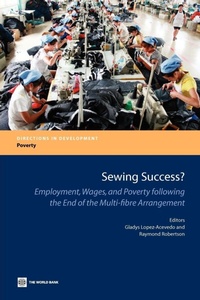
Sewing Success?
Employment and Wages Following the End of the Multi-fibre Arrangement
Published on 30. March 2012
Book
Paperback/Softback
530 pages
978-0-8213-8778-8 (ISBN)
Description
Sewing Success? Employment, Wages, and Poverty following the End of the Multi-Fibre Arrangement (MFA) analyzes the impact of the 2004 MFA phaseout on key social indicators in major apparel-exporting developing countries. This study provides important policy insights on how to maximize the poverty-reduction potential of the apparel industry in a post-MFA environment:
The significant post-MFA reallocation of production across countries did not necessarily match predictions. Wage differences explain some of the production shifts, but domestic policies targeting the apparel industry, ownership type, and functional upgrading of the industry also played important roles.
Using exports as a metric of success in terms of reducing poverty is insufficient. Falling exports usually meant a loss of opportunities for low-income workers, but rising exports did not always benefit poor workers. Rising global competition may induce a shift toward higher-value production and services that are often less labor- and female-intensive.
Post-MFA apparel workers experienced changes in both short- and long-run wage components as well as employment. It is important to understand these different determinants of poverty.
Countries that actively promoted industry upgrading or established a niche position experienced larger increases in exports. Since upgrading does not always correspond to increases in employment or wages, it is also crucial to develop worker skills and improve working conditions.
In short, export and economic growth alone are not enough; the composition of growth also matters. Poverty falls if employment or wages increase for the people at the lower end of the income distribution, and countries that experience growth in labor-intensive sectors are more likely to reduce poverty.
This book will be of interest to academics, policy makers, and decision makers in nongovernmental organizations who work in the areas of international trade, development, and poverty.
The significant post-MFA reallocation of production across countries did not necessarily match predictions. Wage differences explain some of the production shifts, but domestic policies targeting the apparel industry, ownership type, and functional upgrading of the industry also played important roles.
Using exports as a metric of success in terms of reducing poverty is insufficient. Falling exports usually meant a loss of opportunities for low-income workers, but rising exports did not always benefit poor workers. Rising global competition may induce a shift toward higher-value production and services that are often less labor- and female-intensive.
Post-MFA apparel workers experienced changes in both short- and long-run wage components as well as employment. It is important to understand these different determinants of poverty.
Countries that actively promoted industry upgrading or established a niche position experienced larger increases in exports. Since upgrading does not always correspond to increases in employment or wages, it is also crucial to develop worker skills and improve working conditions.
In short, export and economic growth alone are not enough; the composition of growth also matters. Poverty falls if employment or wages increase for the people at the lower end of the income distribution, and countries that experience growth in labor-intensive sectors are more likely to reduce poverty.
This book will be of interest to academics, policy makers, and decision makers in nongovernmental organizations who work in the areas of international trade, development, and poverty.
More details
Language
English
Place of publication
Washington
United States
Product notice
Paperback (trade)
Dimensions
Height: 229 mm
Width: 152 mm
Thickness: 27 mm
Weight
705 gr
ISBN-13
978-0-8213-8778-8 (9780821387788)
Copyright in bibliographic data and cover images is held by Nielsen Book Services Limited or by the publishers or by their respective licensors: all rights reserved.
Schweitzer Classification