

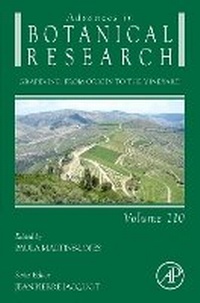
Grapevine: Volume 110
From Origin to the Vineyard
Published on 14. May 2024
Book
Hardback
360 pages
978-0-443-22174-3 (ISBN)
Description
Advances in Botanical Research: From Origin to the Vineyard, Volume 110 highlights new advances in the field, with this new volume presenting interesting chapters on topics such as Grapevine origin and diversity, Climate change implications on the geography of viticulture, Canopy and soil management strategies insights into overcome abiotic stresses in grapevine, Grapevine defense mechanisms when challenged by pathogenic fungi and oomycetes, Management strategies for reducing pesticide use against diseases caused by fungi and oomycetes in grapevine, The Role of Plant Breeding in grapevine production, and New biotechnological tools for grapevine improvement.
More details
Series
Language
English
Place of publication
San Diego
United States
Publishing group
Elsevier Science Publishing Co Inc
Target group
Professional and scholarly
Dimensions
Height: 229 mm
Width: 152 mm
Weight
1000 gr
ISBN-13
978-0-443-22174-3 (9780443221743)
Copyright in bibliographic data and cover images is held by Nielsen Book Services Limited or by the publishers or by their respective licensors: all rights reserved.
Schweitzer Classification
Other editions
Additional editions
Person
Paula Martins-Lopes, is an Associated Professor of Biotechnology and Comparative Molecular Genetics at the Department of Genetics and Biotechnology, University of Tras-os-Montes and Alto Douro (UTAD), Portugal. Paula has a B.Sc. in Agriculture Engineering (1996), a M.Sc. in Genetic Resources and Plant and Forestry Breeding (1999), a Ph.D. in Genetics (2006) and Habilitation in Comparative Molecular Genetics (2019) from UTAD. The M.Sc. and Ph.D. research projects were performed in collaboration with the Cereals Department of the Cambridge Lab, John Innes Centre, Norwich, U.K. She is the Coordinator of the Research Polo of Biosystems & Integrative Sciences Institute (BioISI-UTAD), where she heads the DNA& RNA Sensing Lab, focusing on research related to food authenticity and safety (mainly dedicated to wine, olive oil and honey) strategies, on crop biotic stresses (e.g. Grape Trunk Diseases, Colletotrichum acutatum), studying the interaction host-pathogen and developing early diseases detection methods, and on genetic biodiversity studies. Has experience in several technologies associated to molecular biology, biosensing platforms and plant and animal cell culture and an international reputation in the authenticity of food product research. The most novel contributions to the field of food authenticity have been associated to the definition of multiple strategies to reduce DNA isolation protocols from complex food matrices and the development of PCR and DNA-Biosensing platforms suitable for the detection of specific targeted sequences. She has extended her technological development to fungus detection in food and plant samples, to SARS-CoV2 detection and to cancer-related biomarkers. As a result of the innovative technologies developed, she has registered several patents: one (national and international) related to a DNA extraction protocol from wine samples and three patents (national and international) related to different biosensing platforms. Her work has been granted several awards, amongst them: 1st place in the National Commission of the International Organization of Vine and Wine (CNOIV) innovation award (2018); 1st CNOIV Oenology prize (2020); 1st place of the MSc degree thesis in the 13rd Edition of the Fraunofer Challenge (supervision - 2022) and, 1st place in the 10th Edition of Innovation and Entrepreneurship Award of the "Caixa de Credito Agricola? (2023). During the pandemic she was Co-director of the UTAD COVID-19 Testing Center (2020-2022) and is Co-founder of the Genetics4U lab. She acts regularly as reviewer for multiple international scientific journals, funding agencies, and award committees.
Content
Preface
Paula Filomena Martins-Lopes
1. Grapevine origin and diversity
Rita Vignani and Monica Scali
2. Climate change implications on the geography of viticulture
Joao Andrade Santos, Helder Fraga, Teresa Freitas, Antonio Fernandes and Andre Fonseca
3. Canopy and soil management strategies insights into overcome abiotic stresses in grapevine
Lia-Tania Dinis
4. Grapevine defense mechanisms when challenged by pathogenic fungi and oomycetes
Muriel Viaud, Marielle Adrian, Marie-France Corio-Costet, Agnes Calonned, Stephanie Cluzet, Benoit Poinssot, Sophie Trouvelo and Sabine Wiedemann-Merdinoglu
5. Management strategies for reducing pesticide use against diseases caused by fungi and oomycetes in grapevine
David Gramaje Sr.
6. The Role of Plant Breeding in grapevine production
Mara Fernandes Moura, Geovani Luciano de Oliveira, Cinthia Souza Rodrigues and Erasmo Jose Paioli-Pires
7. New biotechnological tools for grapevine improvement
Anca Livia Butiuc
Paula Filomena Martins-Lopes
1. Grapevine origin and diversity
Rita Vignani and Monica Scali
2. Climate change implications on the geography of viticulture
Joao Andrade Santos, Helder Fraga, Teresa Freitas, Antonio Fernandes and Andre Fonseca
3. Canopy and soil management strategies insights into overcome abiotic stresses in grapevine
Lia-Tania Dinis
4. Grapevine defense mechanisms when challenged by pathogenic fungi and oomycetes
Muriel Viaud, Marielle Adrian, Marie-France Corio-Costet, Agnes Calonned, Stephanie Cluzet, Benoit Poinssot, Sophie Trouvelo and Sabine Wiedemann-Merdinoglu
5. Management strategies for reducing pesticide use against diseases caused by fungi and oomycetes in grapevine
David Gramaje Sr.
6. The Role of Plant Breeding in grapevine production
Mara Fernandes Moura, Geovani Luciano de Oliveira, Cinthia Souza Rodrigues and Erasmo Jose Paioli-Pires
7. New biotechnological tools for grapevine improvement
Anca Livia Butiuc