

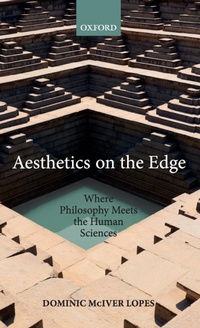
Aesthetics on the Edge
Where Philosophy Meets the Human Sciences
Published on 5. June 2018
Book
Hardback
248 pages
978-0-19-879665-7 (ISBN)
Description
Philosophers say what art is and then scientists and then other scholars study how we are equipped, cognitively and socially, to make art and appreciate it. This time-honoured approach will not work. Recent science reveals that we have poor intuitive access to artistic and aesthetic phenomena. Dominic McIver Lopes argues for a new approach that mandates closer integration, from the start, between aesthetics and the human sciences.
In these eleven essays he proposes a methodology especially suited to aesthetics, where problems in philosophy are addressed principally by examining how aesthetic phenomena are understood in the human sciences. Since the human sciences include much of the humanities as well as the social, behavioural, and brain sciences, the methodology promises to integrate arts research across the academy. Aesthetics on the Edge opens with a four essays outlining the methodology and its potential. The following essays put the methodology to work, shedding light on the perceptual and social-pragmatic capacities that are implicated in responding to works of art, especially images, but also music, literature, and conceptual art.
In these eleven essays he proposes a methodology especially suited to aesthetics, where problems in philosophy are addressed principally by examining how aesthetic phenomena are understood in the human sciences. Since the human sciences include much of the humanities as well as the social, behavioural, and brain sciences, the methodology promises to integrate arts research across the academy. Aesthetics on the Edge opens with a four essays outlining the methodology and its potential. The following essays put the methodology to work, shedding light on the perceptual and social-pragmatic capacities that are implicated in responding to works of art, especially images, but also music, literature, and conceptual art.
More details
Language
English
Place of publication
Oxford
United Kingdom
Target group
College/higher education
Dimensions
Height: 222 mm
Width: 145 mm
Thickness: 17 mm
Weight
448 gr
ISBN-13
978-0-19-879665-7 (9780198796657)
Copyright in bibliographic data and cover images is held by Nielsen Book Services Limited or by the publishers or by their respective licensors: all rights reserved.
Schweitzer Classification
Other editions
Additional editions
E-Book
05/2018
1st Edition
OUP eBook
€47.99
Available for download
E-Book
05/2018
1st Edition
OUP eBook
€37.99
Available for download
Person
Dominic McIver Lopes is Professor of Philosophy at the University of British Columbia and author of five books and a series of papers that examine the meaning and values of images, technology in the arts, and the nature of art and the arts. His forthcoming book, Being for Beauty: Aesthetic Agency and Value, looks beyond the arts to understanding the human importance of our aesthetic practices.
Content
Introduction
Part I: Methods
1: Aesthetics in Three Dimensions
2: Feckless Reason
3: Shikinen Sengu: The Ontology of Architecture in Japan
4: with Vincent Bergeron: Aesthetic Theory and Aesthetic Science: Prospects for Integration
Part II: Modes
5: Art Media and the Sense Modalities: Tactile Pictures
6: Vision, Touch, and the Value of Pictures
7: with Vincent Bergeron: Hearing and Seeing Musical Expression
8: In the Eye of the Beholder
Part III: Means
9: Directive Pictures
10: Drawing in a Social Science: Lithic Illustration
11: An Empathic Eye
Part I: Methods
1: Aesthetics in Three Dimensions
2: Feckless Reason
3: Shikinen Sengu: The Ontology of Architecture in Japan
4: with Vincent Bergeron: Aesthetic Theory and Aesthetic Science: Prospects for Integration
Part II: Modes
5: Art Media and the Sense Modalities: Tactile Pictures
6: Vision, Touch, and the Value of Pictures
7: with Vincent Bergeron: Hearing and Seeing Musical Expression
8: In the Eye of the Beholder
Part III: Means
9: Directive Pictures
10: Drawing in a Social Science: Lithic Illustration
11: An Empathic Eye