

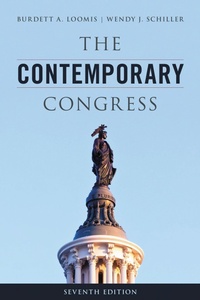
The Contemporary Congress
7th Edition
Will be published approx. on 15. January 2018
Book
Paperback/Softback
256 pages
978-1-5381-0156-8 (ISBN)
Description
In an era of heightened partisanship and increased polarization, The Contemporary Congress offers a clear and concise introduction to legislative processes. Perfect as a brief core or supplementary text for undergraduate courses, Loomis and Schiller construct a comprehensive portrait of the U.S. Congress, from defining congressional structures and procedures, to outlining the process of elections, and analyzing presidential-congressional relations.
The seventh edition focuses on two parallel trends: an increasingly partisan and polarized Congress, and a growing executive power. In addition, the authors make some early observations of relations between the Congress and the Trump Administration. New coverage includes the art of electioneering, the pressures of campaign fundraising, and updated policy goals of the political parties that shape the congressional agenda. From a late night deciding vote by Senator John McCain (R-AZ), to the rise and fall of Freedom Caucus member Representative Tim Huelskamp (R-KS), a new "Spotlight" feature provides brief case studies of decisions made by individual members to illustrate the constant balance that they must strike between their party and their constituents, and what happens when they get that balance wrong.
The seventh edition focuses on two parallel trends: an increasingly partisan and polarized Congress, and a growing executive power. In addition, the authors make some early observations of relations between the Congress and the Trump Administration. New coverage includes the art of electioneering, the pressures of campaign fundraising, and updated policy goals of the political parties that shape the congressional agenda. From a late night deciding vote by Senator John McCain (R-AZ), to the rise and fall of Freedom Caucus member Representative Tim Huelskamp (R-KS), a new "Spotlight" feature provides brief case studies of decisions made by individual members to illustrate the constant balance that they must strike between their party and their constituents, and what happens when they get that balance wrong.
Reviews / Votes
Any serious student in American politics, institutions, and democracy should read Loomis and Schiller's Contemporary Congress. The text offers the historic framework of Congress' strength and power through decades of dramatic change in the 20th-21st centuries. -- Ravi K. Perry, Virginia Commonwealth University A narrative rich text that is filled with interesting stories about Congress and exceptionally well written; likely the most student-friendly Congress text that I have encountered. -- Michael S. Lynch, University of Georgia For a brief but sophisticated overview of Congress, this book cannot be beat. The authors have included all of the essential information for an understanding of how Congress works. -- Charles Bullock, University of GeorgiaMore details
Edition
7th edition
Language
English
Place of publication
United States
Publishing group
Bloomsbury Publishing Plc
Target group
College/higher education
US School Grade: From College Freshman to College Graduate Student
Product notice
Paperback (trade)
Unsewn / adhesive bound
Illustrations
27 b/w photos; 18 tables; 7 graphs; 19 textboxes
Dimensions
Height: 226 mm
Width: 147 mm
Thickness: 13 mm
Weight
272 gr
ISBN-13
978-1-5381-0156-8 (9781538101568)
Copyright in bibliographic data and cover images is held by Nielsen Book Services Limited or by the publishers or by their respective licensors: all rights reserved.
Schweitzer Classification
Other editions
Additional editions
Burdett A. Loomis | Wendy J. Schiller
The Contemporary Congress
E-Book
01/2018
7th Edition
Rowman & Littlefield Publishers
€44.99
Available for download
Burdett A. Loomis | Wendy J. Schiller
The Contemporary Congress
E-Book
01/2018
7th Edition
Rowman & Littlefield Publishers
€44.99
Available for download
Persons
Burdett Loomis is a professor of political science at the University of Kansas, where he has taught since 1979. He has written extensively on Congress, interest groups, and state politics, including his edited book, The U.S. Senate: From Deliberation to Dysfunction. He served as an American Political Science Association Congressional Fellow with Rep. Paul Simon (D-IL), and founded KU's Washington intern program in 1983 and continues as its director. He is currently working on studies of Rep. Bob Michel and Sen Bob Dole, along with a book on Kansas politics over the past fifty years.
Wendy J. Schiller is professor of political science at Brown University where she has taught since 1994. Before receiving her PhD from the University of Rochester, Schiller served on the staffs of the Senator Daniel Patrick Moynihan and Governor Mario Cuomo. She has written extensively on the United States Senate, including her book Partners and Rivals: Representation in U.S. Senate Delegations, and Electing the Senate: Indirect Democracy before the Seventeenth Amendment. She is currently working on the effects of federalism on gender equality and human security across states. Schiller also provides political commentary on legislative politics to local and national news outlets.
Wendy J. Schiller is professor of political science at Brown University where she has taught since 1994. Before receiving her PhD from the University of Rochester, Schiller served on the staffs of the Senator Daniel Patrick Moynihan and Governor Mario Cuomo. She has written extensively on the United States Senate, including her book Partners and Rivals: Representation in U.S. Senate Delegations, and Electing the Senate: Indirect Democracy before the Seventeenth Amendment. She is currently working on the effects of federalism on gender equality and human security across states. Schiller also provides political commentary on legislative politics to local and national news outlets.
Content
1. The Drama of Representation
2. Congressional Decentralization in Design and Evolution
3. The Changing Environment of Congressional Politics
4. Congressional Elections: All for One and One for All?
5. Parties, Leaders, and Ideology in Congress
6. Presidential and Congressional Relations: Boundaries of Power
7. Policymaking in the House and Senate
8. The Individual Enterprise
9. The Competitive Congress: Centrifugal Forces in a Partisan Era
2. Congressional Decentralization in Design and Evolution
3. The Changing Environment of Congressional Politics
4. Congressional Elections: All for One and One for All?
5. Parties, Leaders, and Ideology in Congress
6. Presidential and Congressional Relations: Boundaries of Power
7. Policymaking in the House and Senate
8. The Individual Enterprise
9. The Competitive Congress: Centrifugal Forces in a Partisan Era