

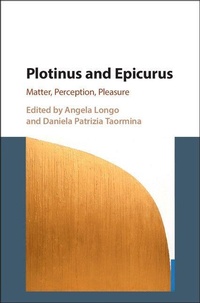
Plotinus and Epicurus
Matter, Perception, Pleasure
Published on 3. August 2016
Book
Hardback
254 pages
978-1-107-12421-9 (ISBN)
Description
This volume investigates the reasons why Plotinus, a philosopher inspired by Plato, made critical use of Epicurean philosophy. Eminent scholars show that some fundamental Epicurean conceptions pertaining to ethics, physics, epistemology and theology are drawn upon in the Enneads to discuss crucial notions such as pleasure and happiness, providence and fate, matter and the role of sense perception, intuition and intellectual evidence in relation to the process of knowledge acquisition. By focusing on the meaning of these terms in Epicureanism, Plotinus deploys sophisticated methods of comparative analysis and argumentative procedures that ultimately lead him to approach certain aspects of Epicurus' philosophy as a benchmark for his own theories and to accept, reject or discredit the positions of authors of his own day. At the same time, these discussions reveal what aspects of Epicurean philosophy were still perceived to be of vital relevance in the third century AD.
Reviews / Votes
'The volume has a clear and comprehensive stage-setting introduction by the editors and a full biography. There is hardly a sentence in the Enneads that is not rooted in the history of philosophy as Plotinus knew it. This book s a valuable addition to the scholarship seeking to illuminate this background.' Lloyd P. Gerson, Bryn Mawr Classical ReviewMore details
Language
English
Place of publication
Cambridge
United Kingdom
Target group
Professional and scholarly
Dimensions
Height: 235 mm
Width: 157 mm
Thickness: 18 mm
Weight
526 gr
ISBN-13
978-1-107-12421-9 (9781107124219)
Copyright in bibliographic data and cover images is held by Nielsen Book Services Limited or by the publishers or by their respective licensors: all rights reserved.
Schweitzer Classification
Other editions
Additional editions
E-Book
09/2016
Cambridge University Press
€84.49
Available for download
E-Book
08/2016
Cambridge University Press
€71.49
Available for download
Persons
Angela Longo is Associate Professor of Ancient Greek Philosophy at the University of L'Aquila. Her research focuses on Plato and late Platonism, particularly Plotinus, Syrianus, Hermias and Proclus. Her books include Plotin, Traite 2 (IV, 7). Sur l'immortalite de l'ame. Introduction, traduction, commentaire et notes (2009) and Argument from Hypothesis in Ancient Philosophy (2011). Daniela Patrizia Taormina is Associate Professor of Ancient Greek Philosophy at the University of Rome 'Tor Vergata' and Visiting Professor at the University of Paris I, Pantheon-Sorbonne, the Friedrich-Schiller-Universitaet Jena and the Ecole Pratique des Hautes Etudes (EPHE), Paris. Her books include Plutarco di Atene. L'Uno, l'anima e le forme (1989), Jamblique, critique de Plotin et de Porphyre. Quatre etudes (1999) and Giamblico. I frammenti dalle epistole. Introduzione, testo, traduzione e commento (with R. M. Piccione, 2010).
Content
Preface Daniela Patrizia Taormina; Introduction Angela Longo and Daniela Patrizia Taormina; Part I. Historical Overview: 1. The school and texts of Epicurus in the early centuries of the Roman empire Tiziano Dorandi; Part II. Common Anti-Epicurean Arguments in Plotinus: 2. The mention of Epicurus in Plotinus' tr. 33 (Enn. II 9) in the context of the polemics between Pagans and Christians in the second-third century AD: parallels between Celsus, Plotinus and Origen Angela Longo; 3. Epicureans and Gnostics in tr. 47 (Enn. III 2) 7.29-41 Manuel Mazzetti; 4. 'Heavy birds' in tr. 5 (Enn. V 9) 1.8: References to Epicureanism and the problem of pleasure in Plotinus Mauricio Pagotto Marsola; 5. Plotinus, Epicurus and the problem of intellectual evidence: tr. 32 (Enn. V 5) 1 Pierre-Marie Morel; 6. 'What is known through sense perception is an image'. Plotinus' tr. 32 (Enn. V 5) 1.12-19: an anti-Epicurean argument? Daniela Patrizia Taormina; Part III. Plotinus' Criticism of Epicurean Doctrines: 7. Corporeal matter, indefiniteness and multiplicity: Plotinus' critique of Epicurean atomism in tr. 12 (Enn. II 4) 7.20-8 Marco Ninci; 8. Plotinus' reception of Epicurean atomism in On Fate, tr. 3 (Enn. III 1) 1-3 Erik Eliasson; Part IV. Epicureans Elements in Plotinus: Some Instances: 9. Athroa epibole: on an Epicurean formula in Plotinus' work Andrei Cornea; 10. Plotinus and Epicurus on pleasure and happiness Alessandro Linguiti.