

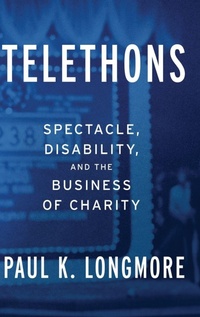
Telethons
Spectacle, Disability, and the Business of Charity
Published on 18. February 2016
Book
Hardback
360 pages
978-0-19-026207-5 (ISBN)
Description
Looking back at postwar US history, it seems that a telethon accompanied every social ill, disability, disease, and natural disaster. A unique combination of entertainment and charity, this form of fundraising became a fixture in American life not long after NBC broadcast the first one, hosted by Milton Berle, in 1949. Conceived specifically for the new medium of television, the telethon--a portmanteau of "television" and "marathon"--became the fundraising vehicle of choice for the nation's leading charitable organizations. Marshaling two decades' worth of painstaking research, Telethons provides the first cultural history of the popular phenomenon. It charts the rise of the telethon as a result of five influential charities (most notably, the Muscular Dystrophy Association) and profiles the key figures--philanthropists, politicians, celebrities, corporate sponsors, and recipients--involved. The book also serves as a chronicle of disabilty history in the postwar US, as Longmore shows the changing depiction of the disabled-from objects of pity in the Fifties and Sixties to figures of empowerment in the late twentieth century. A significant portion of the book analyzes the various clashes between telethon-producing charities and activists in the disability rights movement that have become increasingly frequent since the 1970s. Throughout, Telethons explores familiar staples of the genre such as "poster children," the comedic emcee, and the concept of "conspicuous contribution."
Reviews / Votes
Longmore's book wears its intelligence in its incisive commentary and concepts. Students and scholars could learn a lot from this book, including how to write about complex ideas in clear, readable prose. The book manages to do all this in thirteen tightly written chapters, plus introduction and conclusion ... While concise, the book takes no shortcuts, being heavily or even exhaustively evidenced ... Longmore's book is powerful and persuasive. It's also a great pleasure to read, in the way that watching a master thinker is pleasurable. He thinks with material in impressive ways that seem effortless ... Scholars with other interests would no doubt see much else in Longmore's book related to their interests, as there is a great deal in this fine book. We should all be grateful that Longmore wrote Telethons and that his colleagues did the work to make sure we could read it. * Disability Studies Quarterly * Recommended. * CHOICE *More details
Language
English
Place of publication
New York
United States
Target group
College/higher education
Professional and scholarly
Illustrations
15 illustrations
Dimensions
Height: 240 mm
Width: 161 mm
Thickness: 24 mm
Weight
705 gr
ISBN-13
978-0-19-026207-5 (9780190262075)
Copyright in bibliographic data and cover images is held by Nielsen Book Services Limited or by the publishers or by their respective licensors: all rights reserved.
Schweitzer Classification
Other editions
Person
Paul K. Longmore, until his death in 2009, was Professor of History at San Francisco State. His books include The Invention of George Washington. Why I Burned My Book and Other Essays on Disability, and the coedited volume, The New Disability History: American Perspectives.
Content
Abbreviations ; Editors' Note ; Introduction ; Chapter 1. Charity Professionals: Ambivalent Generosity and the New Business of Philanthropy ; Chapter 2. Neither Public Nor Private: Telethons in the U.S. Health and Welfare System ; Chapter 3. The Hidden Politics of Telethons: Where Volunteerism, Government, and Business Meet ; Chapter 4. "They've Got a Good Thing with Us and We've Got a Good Thing with Them": ; Telethons and Cause-Related Marketing ; Chapter 5. Givers and Takers: Conspicuous Contribution and a Distinctly American Moral Community ; Chapter 6. Dignity Thieves: Greed, Generosity, and Objects of Charity ; Chapter 7. Suffering as Spectacle: Pity, Pathos, and Ideology ; Chapter 8 "Look at Us We're Walking": Cure-Seekers, Invalids and Overcomers ; Chapter 9 American and Un-American Bodies: Searching for Fitness through Technology and Sport ; Chapter 10. Smashing Icons: Gender, Sexuality, and Disability ; Chapter 11. "Heaven's Special Child": The Making of Poster Children ; Chapter 12. Family Burdens: Parents, Children, and Disability ; Chapter 13. Jerry's Kids Grow Up: Disability Rights Activists and Telethons ; Conclusion: The End of Telethons and Challenges for Disability Rights ; Afterword ; Notes