

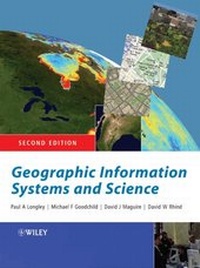
Geographic Information Systems and Science
2nd Edition
Published on 18. February 2005
Book
Paperback/Softback
536 pages
978-0-470-87001-3 (ISBN)
Description
The first edition of Geographic Information Systems and Science has taken the GIS textbook market by storm, selling over 22,000 copies since publication. It is the most current, authoritative and comprehensive treatment of the field, that goes from fundamental principles to the big picture.
GISS 2/e builds on the success of the first edition:
* Completely revised with a new five part structure: Foundations; Principles; Techniques; Analysis; Management and Policy
* All new personality boxes of current GIS practitioners
* New chapters on Distributed GIS, Map Production, Geovisualization, Modeling, and Managing GIS
* Specific coverage of current hot topics:
' '
GIS and the New World Order
Security, health and well-Being
Digital differentiation in GIS consumption
The core organizing role of GIS in geography
The greening of GIS
Grand challenges of GIS science
Science and explanation ' '
A new suite of instructor resources including a companion website with an on-line lab resource and personal student sullabus and a cehensive Instructor's Manual that maps the textbook to various disciplines and levels of courses.
GISS 2/e builds on the success of the first edition:
* Completely revised with a new five part structure: Foundations; Principles; Techniques; Analysis; Management and Policy
* All new personality boxes of current GIS practitioners
* New chapters on Distributed GIS, Map Production, Geovisualization, Modeling, and Managing GIS
* Specific coverage of current hot topics:
' '
GIS and the New World Order
Security, health and well-Being
Digital differentiation in GIS consumption
The core organizing role of GIS in geography
The greening of GIS
Grand challenges of GIS science
Science and explanation ' '
A new suite of instructor resources including a companion website with an on-line lab resource and personal student sullabus and a cehensive Instructor's Manual that maps the textbook to various disciplines and levels of courses.
Reviews / Votes
One of the nicest features is the book's accessibility this is a must have reference guide for all newcomers to the field, be they students or professionals. (GIS Professional, July / August 2005)More details
Edition
2., Auflage
Language
English
Place of publication
Chichester
United Kingdom
Publishing group
John Wiley and Sons Ltd
Target group
Professional and scholarly
Edition type
Revised edition
Illustrations
col. Illustrations, col. maps, col. ports.
Dimensions
Height: 26 cm
Width: 20 cm
Thickness: 27 mm
Weight
1420 gr
ISBN-13
978-0-470-87001-3 (9780470870013)
Schweitzer Classification
Other editions
Previous edition
Book
05/2001
Wiley
€39.90
Article exhausted; check for reprint
Content
Foreword.
Addendum.
Preface.
List of Acronyms and Abbreviations.
PART I: INTRODUCTION.
1. Systems, Science, and Study.
2. A Gallery of Applications.
PART II: PRINCIPLES.
3. Representing Geography.
4. The Nature of Geographic Data.
5. Georeferencing.
6. Uncertainty.
PART III: TECHNIQUES.
7. GIS Software.
8. Geographic Data Modeling.
9. GIS Data Collection.
10. Creating and Maintaining Geographic Databases.
11. Distributed GIS.
PART IV: ANALYSIS.
12. Cartography and Map Production.
13. Geovisualization.
14. Query, Measurement, and Transformation.
15. Descriptive Summary, Design, and Inference.
16. Spatial Modeling with GIS.
PART V: MANAGEMENT AND POLICY.
17. Managing GIS.
18. GIS AND Management, the Knowledge Economy, and Information.
19. Exploiting GIS Assets and Navigating Constraints.
20. GIS Partnerships.
21. Epilog.
Index.
Addendum.
Preface.
List of Acronyms and Abbreviations.
PART I: INTRODUCTION.
1. Systems, Science, and Study.
2. A Gallery of Applications.
PART II: PRINCIPLES.
3. Representing Geography.
4. The Nature of Geographic Data.
5. Georeferencing.
6. Uncertainty.
PART III: TECHNIQUES.
7. GIS Software.
8. Geographic Data Modeling.
9. GIS Data Collection.
10. Creating and Maintaining Geographic Databases.
11. Distributed GIS.
PART IV: ANALYSIS.
12. Cartography and Map Production.
13. Geovisualization.
14. Query, Measurement, and Transformation.
15. Descriptive Summary, Design, and Inference.
16. Spatial Modeling with GIS.
PART V: MANAGEMENT AND POLICY.
17. Managing GIS.
18. GIS AND Management, the Knowledge Economy, and Information.
19. Exploiting GIS Assets and Navigating Constraints.
20. GIS Partnerships.
21. Epilog.
Index.