

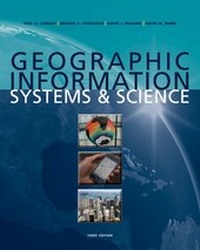
Geographic Information Systems and Science
3rd Edition
Published on 13. August 2010
Book
Paperback/Softback
560 pages
978-0-470-72144-5 (ISBN)
Description
The Third Edition of this bestselling textbook has been fully revised and updated to include the latest developments in the field and still retains its accessible format to appeal to a broad range of students.
Now divided into five clear sections the book investigates the unique, complex and difficult problems that are posed by geographic information and together they build into a holistic understanding of the key principles of GIS.
This is the most current, authoritative and comprehensive treatment of the field, that goes from fundamental principles to the big picture of:
* GIS and the New World Order
* security, health and well-being
* digital differentiation in GIS consumption
* the core organizing role of GIS in Geography
* the greening of GIS
* grand challenges of GIScience
* science and explanation
Key features:
* Four-colour throughout
* Associated website with free online resources
* Teacher's manual available for lecturers
* A complete learning resource, with accompanying instructor links, free online lab resources and personal syllabi
* Includes learning objectives and review boxes throughout each chapter
New in this edition:
* Completely revised with a new five part structure: Foundations; Principles; Techniques; Analysis; Management and Policy
* All new personality boxes of current GIS practitioners
* New chapters on Distributed GIS, Map Production, Geovisualization, Modeling, and Managing GIS
Now divided into five clear sections the book investigates the unique, complex and difficult problems that are posed by geographic information and together they build into a holistic understanding of the key principles of GIS.
This is the most current, authoritative and comprehensive treatment of the field, that goes from fundamental principles to the big picture of:
* GIS and the New World Order
* security, health and well-being
* digital differentiation in GIS consumption
* the core organizing role of GIS in Geography
* the greening of GIS
* grand challenges of GIScience
* science and explanation
Key features:
* Four-colour throughout
* Associated website with free online resources
* Teacher's manual available for lecturers
* A complete learning resource, with accompanying instructor links, free online lab resources and personal syllabi
* Includes learning objectives and review boxes throughout each chapter
New in this edition:
* Completely revised with a new five part structure: Foundations; Principles; Techniques; Analysis; Management and Policy
* All new personality boxes of current GIS practitioners
* New chapters on Distributed GIS, Map Production, Geovisualization, Modeling, and Managing GIS
More details
Other editions
New editions
Paul A. Longley | Michael F. Goodchild | David J. Maguire
Geographic Information Science and Systems
Book
04/2015
4th Edition
Wiley
€218.50
Shipment within 15-20 days
Previous edition

Paul A. Longley | Mike Goodchild | David J. Maguire
Geographic Information Systems and Science
Book
05/2010
3rd Edition
Wiley
€112.00
Shipment within 10-20 days
Persons
Content
FOREWORD.
DEDICATION.
PREFACE.
LIST OF ACRONYMS.
Chapter 1: Systems, Science, and Study
Chapter 2: A Gallery of Applications
Chapter 3: Representing Geography
Chapter 4: The Nature of Geographic Data
Chapter 5: Georeferencing
Chapter 6: Uncertainty
Chapter 7: GIS Software
Chapter 8: Geographic Data Modeling
Chapter 9: GIS Data Collection
Chapter 10: Creating and Maintaining Geographic Databases
Chapter 11: The GeoWeb
Chapter 12: Cartography and Map Production
Chapter 13: Geovisualization
Chapter 14: Spatial Data Analysis
Chapter 15: Spatial Analysis and Inference
Chapter 16: Spatial Modeling with GIS
Chapter 17: Managing GIS
Chapter 18: Operating Safely with GIS
Chapter 19: GIS Partnerships
Chapter 20: Epilogue: GIS&S in the Service
of Humanity
Index.
DEDICATION.
PREFACE.
LIST OF ACRONYMS.
Chapter 1: Systems, Science, and Study
Chapter 2: A Gallery of Applications
Chapter 3: Representing Geography
Chapter 4: The Nature of Geographic Data
Chapter 5: Georeferencing
Chapter 6: Uncertainty
Chapter 7: GIS Software
Chapter 8: Geographic Data Modeling
Chapter 9: GIS Data Collection
Chapter 10: Creating and Maintaining Geographic Databases
Chapter 11: The GeoWeb
Chapter 12: Cartography and Map Production
Chapter 13: Geovisualization
Chapter 14: Spatial Data Analysis
Chapter 15: Spatial Analysis and Inference
Chapter 16: Spatial Modeling with GIS
Chapter 17: Managing GIS
Chapter 18: Operating Safely with GIS
Chapter 19: GIS Partnerships
Chapter 20: Epilogue: GIS&S in the Service
of Humanity
Index.