

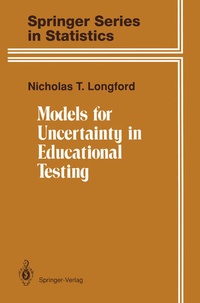
Models for Uncertainty in Educational Testing
Published on 12. October 2011
Book
Paperback/Softback
XIV, 285 pages
978-1-4613-8465-6 (ISBN)
Description
A theme running through this book is that of making inference about sources of variation or uncertainty, and the author shows how information about these sources can be used for improved estimation of certain elementary quantities. Amongst the topics covered are: essay rating, summarizing item-level properties, equating of tests, small-area estimation, and incomplete longitudinal studies. Throughout, examples are given using real data sets which exemplify these applications.
More details
Series
Edition
Softcover reprint of the original 1st ed. 1995
Language
English
Place of publication
New York
United States
Target group
Professional and scholarly
Research
Illustrations
XIV, 285 p.
Dimensions
Height: 235 mm
Width: 155 mm
Thickness: 17 mm
Weight
464 gr
ISBN-13
978-1-4613-8465-6 (9781461384656)
DOI
10.1007/978-1-4613-8463-2
Schweitzer Classification
Other editions
Additional editions
Nicholas T. Longford
Models for Uncertainty in Educational Testing
Book
07/1995
Springer
€96.00
Article not available at the moment
Content
1 Inference about variation.- 1.1 Imperfection and variation.- 1.2 Educational measurement and testing.- 1.3 Statistical context.- 2 Reliability of essay rating.- 2.1 Introduction.- 2.2 Models.- 2.3 Estimation.- 2.4 Extensions.- 2.5 Diagnostic procedures.- 2.6 Examples.- 2.7 Standard errors.- 2.8 Summary.- 2.9 Literature review.- 3 Adjusting subjectively rated scores.- 3.1 Introduction.- 3.2 Estimating severity.- 3.3 Examinee-specific shrinkage.- 3.4 General scheme.- 3.5 More diagnostics.- 3.6 Examples.- 3.7 Estimating linear combinations of true scores.- 3.8 Summary.- Appendix. Derivation of MSE for the general adjustment scheme.- 4 Rating several essays.- 4.1 Introduction.- 4.2 Models.- 4.3 Estimation.- 4.4 Application.- 4.5 Choice of essay topics.- 4.6 Summary.- 5 Summarizing item-level properties.- 5.1 Introduction.- 5.2 Differential item functioning.- 5.3 DIF variance.- 5.4 Estimation.- 5.5 Examples.- 5.6 Shrinkage estimation of DIF coefficients.- 5.7 Model criticism and diagnostics.- 5.8 Multiple administrations.- 5.9 Conclusion.- 6 Equating and equivalence of tests.- 6.1 Introduction.- 6.2 Equivalent scores.- 6.3 Estimation.- 6.4 Application.- 6.5 Summary.- 7 Inference from surveys with complex sampling design.- 7.1 Introduction.- 7.2 Sampling design.- 7.3 Proficiency scores.- 7.4 Jackknife.- 7.5 Model-based method.- 7.6 Examples.- 7.7 Estimating proportions.- 7.8 Regression with survey data.- 7.9 Estimating many subpopulation means.- 7.10 Jackknife and model-based estimators.- 7.11 Summary.- 8 Small-area estimation.- 8.1 Introduction.- 8.2 Shrinkage estimation.- 8.3 Regression with survey data.- 8.4 Fitting two-level regression.- 8.5 Small-area mean prediction.- 8.6 Selection of covariates.- 8.7 Application.- 8.8 Summary and literature review.- 9 Cut scores forpass/fail decisions.- 9.1 Introduction.- 9.2 Models.- 9.3 Fitting logistic regression.- 9.4 Examples.- 9.5 Summary.- 10 Incomplete longitudinal data.- 10.1 Introduction.- 10.2 Informative missingness.- 10.3 Longitudinal analysis.- 10.4 EM algorithm.- 10.5 Application.- 10.6 Estimation.- 10.7 Summary.- References.