

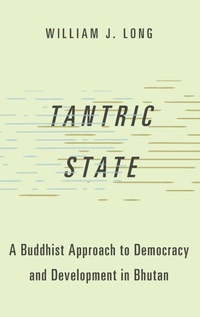
Tantric State
A Buddhist Approach to Democracy and Development in Bhutan
Published on 7. February 2019
Book
Hardback
248 pages
978-0-19-084339-7 (ISBN)
Description
Today, the majority of sovereign states can be described as "democracies" because they possess elected political leadership and some measure of commitment to the protection and promotion of individual rights and equality under law. In the economic realm, most democracies are market-based and are integrated into wider regional and global markets. Virtually all are organized around Western liberal principles and values. For some, these philosophical commitments are indigenous and longstanding, and for others they were imported later, often through colonization. This book asks how democratic governance and economic development differ when founded on Eastern, Buddhist principles, rather than Western, liberal, and Enlightenment values and beliefs.
The small, remote country of Bhutan is the only democratic, market-based state that is rooted constitutionally and culturally in Mahayana Buddhist principles and ethics. In this book, William J. Long provides an authentic basis for theoretical and empirical comparison between two distinct models of democracy and development that differ on important, first-order principles. Bhutanese Buddhist and Western liberal concepts of the individual "self," "human nature" and "the pursuit of happiness"-the building blocks of democratic and market-based economic theory-differ profoundly. Because the two approaches-liberal and Buddhist-are based on distinctive philosophical traditions, this comparison elucidates new questions, frames of inquiry, and alternative understandings of democracy and development.
The book describes how democratic political institutions and markets emerged and how they function in Bhutan, demonstrating how, in real-world terms, Bhutan organizes and operates a political and economic system consistent with its Buddhist worldview. It considers the nature of Bhutan's unique political institutions and its economic touchstone, the pursuit of "Gross National Happiness (GNH)," rather than Gross National Product, as its ordering principle for policy. Ultimately, Tantric State reflects on whether Bhutan's unique model can withstand the forces of globalization and what insights Bhutan might have to share with the rest of us about dilemmas facing Western democracies and the need to pursue development in a more holistic and sustainable way.
The small, remote country of Bhutan is the only democratic, market-based state that is rooted constitutionally and culturally in Mahayana Buddhist principles and ethics. In this book, William J. Long provides an authentic basis for theoretical and empirical comparison between two distinct models of democracy and development that differ on important, first-order principles. Bhutanese Buddhist and Western liberal concepts of the individual "self," "human nature" and "the pursuit of happiness"-the building blocks of democratic and market-based economic theory-differ profoundly. Because the two approaches-liberal and Buddhist-are based on distinctive philosophical traditions, this comparison elucidates new questions, frames of inquiry, and alternative understandings of democracy and development.
The book describes how democratic political institutions and markets emerged and how they function in Bhutan, demonstrating how, in real-world terms, Bhutan organizes and operates a political and economic system consistent with its Buddhist worldview. It considers the nature of Bhutan's unique political institutions and its economic touchstone, the pursuit of "Gross National Happiness (GNH)," rather than Gross National Product, as its ordering principle for policy. Ultimately, Tantric State reflects on whether Bhutan's unique model can withstand the forces of globalization and what insights Bhutan might have to share with the rest of us about dilemmas facing Western democracies and the need to pursue development in a more holistic and sustainable way.
Reviews / Votes
William J. Long's Tantric State...is an excellent book...It seriously and profoundly employs and explains general Buddhism as paradigm, and it does so in outstanding, very erudite preliminary chapters that explain, better than any other recent work on Buddhist Economics for instance (my own included), what the Buddhist scriptural tradition here is. * , Wolfgang Drechsler Asian Affairs * "In our troubled times, Tantric State provides us hope with a Buddhist approach to holistic, sustainable, and democratic development. He makes Mahayana Buddhism accessible, and engages the reader to think creatively about how small Bhutan can teach the rest of the world to live with awareness of our interdependence with others and the planet. This inspiring book provides us with the know-how and the will to move beyond consumption to true happiness." Clair Brown, author of Buddhist Economics: An Enlightened Approach to the Dismal Science "Tantric State is a carefully researched study of Bhutanas daring experiment in blending democratic and Buddhist valuesaan experiment in political organization and policy-making premised on the reality of deep interdependence between humanity and nature and across generations, and the conviction that humane politics must privilege compassion over competition. Long looks critically under the hood of Bhutanese efforts to heighten agross national happiness,a assessing their impacts over the decade since Bhutan made the worldas first struggle- and violence-free democratic transition. But, he also holds the Bhutanese experiment up as a mirror in which to see our own political practices and prejudices from new angles. The view afforded by the Tantric State, in both directions, is revealing." Peter D. Hershock, author of Valuing Diversity: Buddhist Reflection on Realizing a More Equitable Global Future "In Tantric State, Professor Long convincingly examines how a small state like Bhutan, with Buddhist influence, enabled itself to face the challenges of political transition without compromising the ethos of development. An excellent insight into the foundation of a happy and modern democracy."Rajesh S. Kharat, School of International Studies (SIS), JNU New DelhiMore details
Series
Language
English
Place of publication
New York
United States
Target group
Professional and scholarly
Dimensions
Height: 240 mm
Width: 161 mm
Thickness: 18 mm
Weight
537 gr
ISBN-13
978-0-19-084339-7 (9780190843397)
Copyright in bibliographic data and cover images is held by Nielsen Book Services Limited or by the publishers or by their respective licensors: all rights reserved.
Schweitzer Classification
Other editions
Additional editions
E-Book
11/2018
OUP eBook
€30.49
Available for download
E-Book
11/2018
OUP eBook
€39.49
Available for download
Person
William J. Long is Professor in the Global Studies Institute and Department of Political Science at Georgia State University, and the former dean of the College of Arts and Sciences. He is the author of five books and numerous articles. Dr. Long is the recipient of research and teaching awards and grants from the Hewlett, Pew, Sloan, and MacArthur Foundations, the Fulbright Commission, the Carnegie Corporation, the European Union, and the U.S. Department of Education.
Content
Acknowledgements
Chapter One, Introduction
Chapter Two, A Buddhist Philosophical Foundation for Social Theory
Chapter Three, A Buddhist Approach to Politics and Economics
Chapter Four, Bhutan's Nascent Democracy
Chapter Five, Gross National Happiness: A Buddhist Model of Development
Chapter Six, Current Challenges: Globalization and National Identity, Inter-Generational Transfer of Values and Protection of Minority Rights
Chapter Seven, The Dragon's Roar: The Wider Relevance of Bhutan's Buddhist Approach to Democracy and Development
References
Index
Chapter One, Introduction
Chapter Two, A Buddhist Philosophical Foundation for Social Theory
Chapter Three, A Buddhist Approach to Politics and Economics
Chapter Four, Bhutan's Nascent Democracy
Chapter Five, Gross National Happiness: A Buddhist Model of Development
Chapter Six, Current Challenges: Globalization and National Identity, Inter-Generational Transfer of Values and Protection of Minority Rights
Chapter Seven, The Dragon's Roar: The Wider Relevance of Bhutan's Buddhist Approach to Democracy and Development
References
Index