

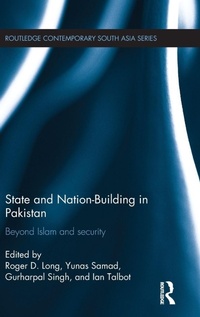
State and Nation-Building in Pakistan
Beyond Islam and Security
1st Edition
Published on 1. October 2015
Book
Hardback
214 pages
978-1-138-90347-0 (ISBN)
Description
Religion, violence, and ethnicity are all intertwined in the history of Pakistan. The entrenchment of landed interests, operationalized through violence, ethnic identity, and power through successive regimes has created a system of 'authoritarian clientalism.' This book offers comparative, historicist, and multidisciplinary views on the role of identity politics in the development of Pakistan.
Bringing together perspectives on the dynamics of state-building, the book provides insights into contemporary processes of national contestation which are crucially affected by their treatment in the world media, and by the reactions they elicit within an increasingly globalised polity. It investigates the resilience of landed elites to political and social change, and, in the years after partition, looks at the impact on land holdings of population transfer. It goes on to discuss religious identities and their role in both the construction of national identity and in the development of sectarianism. The book highlights how ethnicity and identity politics are an enduring marker in Pakistani politics, and why they are increasingly powerful and influential.
An insightful collection on a range of perspectives on the dynamics of identity politics and the nation-state, this book on Pakistan will be a useful contribution to South Asian Politics, South Asian History, and Islamic Studies.
Bringing together perspectives on the dynamics of state-building, the book provides insights into contemporary processes of national contestation which are crucially affected by their treatment in the world media, and by the reactions they elicit within an increasingly globalised polity. It investigates the resilience of landed elites to political and social change, and, in the years after partition, looks at the impact on land holdings of population transfer. It goes on to discuss religious identities and their role in both the construction of national identity and in the development of sectarianism. The book highlights how ethnicity and identity politics are an enduring marker in Pakistani politics, and why they are increasingly powerful and influential.
An insightful collection on a range of perspectives on the dynamics of identity politics and the nation-state, this book on Pakistan will be a useful contribution to South Asian Politics, South Asian History, and Islamic Studies.
More details
Series
Language
English
Place of publication
London
United Kingdom
Publishing group
Taylor & Francis Ltd
Target group
College/higher education
Illustrations
6 s/w Tabellen, 4 s/w Abbildungen, 4 s/w Zeichnungen
6 Tables, black and white; 4 Line drawings, black and white; 4 Illustrations, black and white
Dimensions
Height: 240 mm
Width: 161 mm
Thickness: 17 mm
Weight
520 gr
ISBN-13
978-1-138-90347-0 (9781138903470)
Copyright in bibliographic data and cover images is held by Nielsen Book Services Limited or by the publishers or by their respective licensors: all rights reserved.
Schweitzer Classification
Other editions
Additional editions
Roger D. Long | Gurharpal Singh | Yunas Samad
State and Nation-Building in Pakistan
Beyond Islam and Security
Book
08/2018
1st Edition
Routledge
€71.30
Shipment within 10-20 days
Roger D. Long | Gurharpal Singh | Yunas Samad
State and Nation-Building in Pakistan
Beyond Islam and Security
E-Book
10/2015
Routledge
€64.49
Available for download
Roger D. Long | Gurharpal Singh | Yunas Samad
State and Nation-Building in Pakistan
Beyond Islam and Security
E-Book
10/2015
Routledge
€64.49
Available for download
Persons
Roger D. Long is Professor of History at Eastern Michigan University, USA.
Yunas Samad is Professor of South Asian Studies at the University of Bradford, UK.
Gurharpal Singh is Dean of the Faculty of Arts and Humanities at the School of Oriental and African Studies, the University of London, UK.
Ian Talbot is Professor of History and Director of Post-Graduate Research at the University of Southampton, UK, and former Chair of the British Association for South Asian Studies.
Yunas Samad is Professor of South Asian Studies at the University of Bradford, UK.
Gurharpal Singh is Dean of the Faculty of Arts and Humanities at the School of Oriental and African Studies, the University of London, UK.
Ian Talbot is Professor of History and Director of Post-Graduate Research at the University of Southampton, UK, and former Chair of the British Association for South Asian Studies.
Content
Introduction: Themes, Theories, and Topics in the History of Religion, Violence, and Political Mobilization in Pakistan 1. The Impact of the Redistribution of Partition's Evacuee Property on the Patterns of Land Ownership and Power in Pakistani Punjab in the 1950s 2. Elections, Bureaucracy, and the Law: The Reproduction of Landed Power in Post-Colonial Punjab 3. Factionalism and Indiscipline in Pakistan's Political System 4. Constructing a State: Constitutional Integration of the Princely States in Pakistan 5. Identity Politics and Nation-Building in Pakistan: The Case of Sindhi Nationalism 6. Understanding the Insurgency in Balochistan 7. A Sublime, Yet Disputed, Object of Political Ideology? Sufism in Pakistan at the Crossroads 8. The Rise of Militancy among Pakistani Barelvis: The Case of the Sunni Tehrik 9. Pakistan's Religious Others: Reflections on the Minority Discourse on Christians in the Punjab Tahir 10. Violence and State Formation in Pakistan