

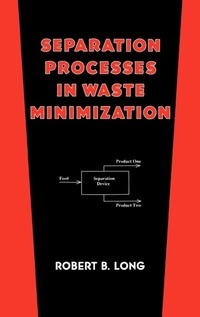
Separation Processes in Waste Minimization
1st Edition
Published on 6. June 1995
Book
Hardback
480 pages
978-0-8247-9634-1 (ISBN)
Description
This work offers an accessible discussion of current and emerging separation processes used for waste minimization, showing how the processes work on a day-to-day basis and providing troubleshooting tips for equipment that doesn't function according to design specifications. It describes the fundamentals of over 30 processes, types of equipment available, vendors, and common problems encountered in operations with hazardous waste.
Reviews / Votes
"This practical reference offers an easily accessible discussion of both current and emerging separation processes used for waste minimization"---showing how the processes work on a day-to-day basis and providing trouble-shooting tips for equipment that doesn't function according to design specifications.
---Abstracts of Public Administration, Development, and Environment
More details
Series
Language
English
Place of publication
Bosa Roca
United States
Publishing group
Taylor & Francis Inc
Target group
College/higher education
Professional and scholarly
Dimensions
Height: 240 mm
Width: 161 mm
Thickness: 30 mm
Weight
886 gr
ISBN-13
978-0-8247-9634-1 (9780824796341)
Copyright in bibliographic data and cover images is held by Nielsen Book Services Limited or by the publishers or by their respective licensors: all rights reserved.
Schweitzer Classification
Other editions
Additional editions
Robert B. Long
Separation Processes in Waste Minimization
E-Book
09/2020
1st Edition
CRC Press
€89.99
Available for download
Robert B. Long
Separation Processes in Waste Minimization
E-Book
09/2020
1st Edition
CRC Press
€89.99
Available for download
Robert B. Long
Separation Processes in Waste Minimization
Book
06/2019
1st Edition
CRC Press
€97.40
Shipment within 15-20 days
Person
Long\, Robert B.
Content
Part 1 Background: Waste Minimization; Basic Principles of Separation Science; Types of Separation Processes Used in Waste Minimization. Part 2 Specific Separations by Mechanical Forces: Separation of Solids; Settling and Flotation Filtration and Drying; Centrifuging and Cycloning. Part 3 Specific Separations by Differential Rates: Chemical Precipitation and Sedimentation; Membrane Processes; Electrostatic Precipitation and Electrochemical Processes. Part 4 Specific Separations Based on Equilibrium: Evaporation and Crystallization; Distillation Absorption, Stripping, and Scrubbing; Adsorption, Ion Exchange, and Reversible Reactions with Solids; Solvent Extraction, Solvent Precipitation, and Leaching.