

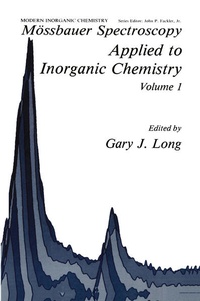
Mössbauer Spectroscopy Applied to Inorganic Chemistry
Published on 31. December 1984
Book
Hardback
XVIII, 668 pages
978-0-306-41647-7 (ISBN)
Description
When presented with a new compound or material, the inorganic chemist will usually have several questions in mind about its composition and structure. Although a simple elemental analysis may answer many questions about its composition, the chemist will still have questions about its structure, and, ifthe material contains a metal atom, he will often want to know its oxidation state, coordination number and geometry. Further, at an increasingly frequent rate, the chemist may need details of the spin state, magnetic and perhaps dynamic properties of the material. If the investigator is fortunate, the material or compound may contain an ele ment such as iron, tin, antimony, iodine, gold, or one of several of the rare earth metals which are amenable to study by the Mossbauer effect. Often the Mossbauer effect can, sometimes with quite simple experiments, provide the answers to all of these questions. The goal of this book is to illustrate the effectiveness of the Mossbauer effect in providing the answers to the many questions that arise in char acterizing new materials and, indeed, in studying known materials in more detail. Several chapters introduce the effect to the novice and provide details about the various hyperfine interactions that are the "bread and butter" of the Mossbauer spectroscopist. Three chapters deal specifically with the experimental aspects of the technique and the increasing impor tance of sophisticated computer analysis of the resulting data.
More details
Series
Edition
1984 ed.
Language
English
Place of publication
New York
United States
Publishing group
Springer Science+Business Media
Target group
College/higher education
Research
Illustrations
XVIII, 668 p.
Dimensions
Height: 241 mm
Width: 160 mm
Thickness: 42 mm
Weight
1182 gr
ISBN-13
978-0-306-41647-7 (9780306416477)
DOI
10.1007/978-1-4899-0462-1
Schweitzer Classification
Other editions
Additional editions
E-Book
11/2013
Springer
€213.99
Available for download
Book
08/2013
Springer
€213.99
Shipment within 15-20 days
Content
and Historical Background.- Basic Concepts of Mössbauer Spectroscopy.- Mössbauer Spectrometers and Calibration.- Spectral Data Reduction and Refinement.- Mössbauer-Effect Isomer Shifts.- The Electric Field Gradient and the Quadrupole Interaction.- Mössbauer Spectroscopy of Magnetic Systems.- Relaxation Phenomena for Chemists.- X-Ray and Conversion Electron Mössbauer Scattering for Chemists.- Mössbauer Spectroscopy and the Coordination Chemistry of Iron.- Spin Transition in Iron Complexes.- Applications to Biological Systems.- Mössbauer Spectroscopy in Heterogeneous Catalysis.- Mössbauer Spectroscopy of Silicate Minerals.- Studies of Ceramics and Archaeological Materials.- Structure and Bonding in Tin Compounds.- Gold-197 Mössbauer Spectroscopy in the Characterization of Gold Compounds.- One-Dimensional Magnetism.