

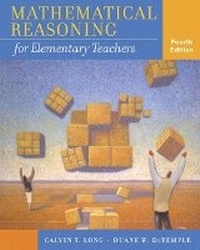
Mathematical Reasoning for Elementary Teachers
4th Edition
Published on 14. April 2005
Book
Hardback
1080 pages
978-0-321-28696-3 (ISBN)
Description
The fourth edition of Mathematical Reasoning has an increased focus on professional development and connecting the material from this class to the elementary and middle school classroom. The authors have provided more meaningful content and pedagogy to arm students with all the tools that they will need to become excellent elementary or middle school teachers.
More details
Edition
4th edition
Language
English
Place of publication
United States
Publishing group
Pearson Education (US)
Target group
Professional and scholarly
Dimensions
Height: 263 mm
Width: 209 mm
Thickness: 41 mm
Weight
2080 gr
ISBN-13
978-0-321-28696-3 (9780321286963)
Copyright in bibliographic data and cover images is held by Nielsen Book Services Limited or by the publishers or by their respective licensors: all rights reserved.
Schweitzer Classification
Other editions
New editions
Calvin T. Long | Duane W. DeTemple | Richard Millman
Mathematical Reasoning for Elementary Teachers
Book
03/2008
5th Edition
Pearson
€68.19
Article exhausted; check for reprint
Previous edition
Calvin T. Long | Duane W. DeTemple
Mathematical Reasoning for Elementary Teachers
Book
11/2002
3rd Edition
Pearson
€48.35
Article exhausted; check for reprint
Persons
Cal Long received his undergraduate degree in Mathematics at the University of Idaho and his Ms and PhD in Mathematics at the University of Oregon. Since then, he has served as Professor of Mathematics at Washington State University for 36 years and, quite frequently, taught the two-semester mathematics content course for elementary school teachers.
He has also served as an invited speaker at international, national, and regional mathematics education meetings including at least 150 presentations at national and regional meetings of NCTM and state affiliates. Cal has conducted numerous in-service programs for elementary, middle school, and high school teachers and has directed numerous summer institutres for teachers, served as educational consultant for the National Science Foundation, for the National Assessment of Educational Progress, and for the Washington State Superintendent of Public Instruction. He also served on numerous committees for the National Council of Teachers of Mathematics and the Mathematical Association of America, including committees that drew up guidelines for the mathematical preparation of teachers.
Duane DeTemple received his BS degree in Applied Science from Portland State college, and went on to earn his MS and Ph. D. in mathematics from Stanford University. He has been on the mathematics faculty at Washington State University since 1970, where he became a full professor in 1985.
His research productivity includes nearly 100 papers in analysis, geometric probability, geometry, combinatorics, graph theory, and curriculum materials for K-12 classrooms. He was Boeing Distinguished Professor of Science and Mathematics Education for 2000-2002.
Dr. DeTemple's family is also committed to teaching: his wife Janet teaches violin, his daughter Jill is completing her Ph. D. in religious studies at the University of North Carolina, and his younger daughter Rachel is a high school English teacher. Professor DeTemple has interests in hiking, canoeing, and playing early music.
He has also served as an invited speaker at international, national, and regional mathematics education meetings including at least 150 presentations at national and regional meetings of NCTM and state affiliates. Cal has conducted numerous in-service programs for elementary, middle school, and high school teachers and has directed numerous summer institutres for teachers, served as educational consultant for the National Science Foundation, for the National Assessment of Educational Progress, and for the Washington State Superintendent of Public Instruction. He also served on numerous committees for the National Council of Teachers of Mathematics and the Mathematical Association of America, including committees that drew up guidelines for the mathematical preparation of teachers.
Duane DeTemple received his BS degree in Applied Science from Portland State college, and went on to earn his MS and Ph. D. in mathematics from Stanford University. He has been on the mathematics faculty at Washington State University since 1970, where he became a full professor in 1985.
His research productivity includes nearly 100 papers in analysis, geometric probability, geometry, combinatorics, graph theory, and curriculum materials for K-12 classrooms. He was Boeing Distinguished Professor of Science and Mathematics Education for 2000-2002.
Dr. DeTemple's family is also committed to teaching: his wife Janet teaches violin, his daughter Jill is completing her Ph. D. in religious studies at the University of North Carolina, and his younger daughter Rachel is a high school English teacher. Professor DeTemple has interests in hiking, canoeing, and playing early music.
Content
1. Thinking Critically
1.1 Introduction to Problem Solving.
1.2 Polya's Problem-Solving Principles.
1.3 More Problem-Solving Strategies.
1.4 Additional Problem-Solving Strategies.
1.5 Reasoning Mathematically.
2. Sets and Whole Numbers
2.1 Sets and Operations on Sets.
2.2 Sets, Counting, and the Whole Numbers.
2.3 Addition and Subtraction of Whole Numbers.
2.4 Multiplication and Division of Whole Numbers.
3. Numeration and Computation
3.1 Numeration Systems Past and Present.
3.2 Nondecimal Positional Systems.
3.3 Algorithms for Adding and Subtracting Whole Numbers.
3.4 Algorithms for Multiplication and Division of Whole Numbers.
3.5 Mental Arithmetic and Estimation.
3.6 Getting the Most Out of Your Calculator.
4. Number Theory
4.1 Divisibility of Natural Numbers.
4.2 Tests for Divisibility.
4.3 Greatest Common Divisors and Least Common Multiples.
4.4 Codes and Credit Card Numbers: Connections to Number Theory.
5. Integers
5.1 Representation of Integers.
5.2 Addition and Subtraction of Integers.
5.3 Multiplication and Division of Integers.
5.4 Clock Arithmetic.
6. Fractions and Rational Numbers
6.1 The Basic Concepts of Fractions and Rational Numbers.
6.2 The Arithmetic of Rational Numbers.
6.3 The Rational Number System.
7. Decimals and Real Numbers
7.1 Decimals.
7.2 Computations with Decimals.
7.3 Ratio and Proportion.
7.4 Percent.
8. Algebraic Reasoning and Representation
8.1 Algebraic Expressions and Equations.
8.2 Functions.
8.3 Graphing Functions in the Cartesian Plane.
9. Statistics: The Interpretation of Data
9.1 The Graphical Representation of Data.
9.2 Measures of Central Tendency and Variability.
9.3 Statistical Inference.
10. Probability
10.1 Empirical Probability.
10.2 Principles of Counting.
10.3 Theoretical Probability.
11. Geometric Figures
11.1 Figures in the Plane.
11.2 Curves and Polygons in the Plane.
11.3 Figures in Space.
11.4 Networks.
12. Measurement
12.1 The Measurement Process.
12.2 Area and Perimeter.
12.3 The Pythagorean Theorem.
12.4 Surface Area and Volume.
13. Transformations, Symmetries, and Tilings
13.1 Rigid Motions and Similarity Transformations.
13.2 Patterns and Symmetries.
13.3 Tilings and Escher-like Design.
14. Congruence, Constructions, and Similarities
14.1 Congruent Triangles.
14.2 Constructing Geometric Figures.
14.3 Similar Triangles.
1.1 Introduction to Problem Solving.
1.2 Polya's Problem-Solving Principles.
1.3 More Problem-Solving Strategies.
1.4 Additional Problem-Solving Strategies.
1.5 Reasoning Mathematically.
2. Sets and Whole Numbers
2.1 Sets and Operations on Sets.
2.2 Sets, Counting, and the Whole Numbers.
2.3 Addition and Subtraction of Whole Numbers.
2.4 Multiplication and Division of Whole Numbers.
3. Numeration and Computation
3.1 Numeration Systems Past and Present.
3.2 Nondecimal Positional Systems.
3.3 Algorithms for Adding and Subtracting Whole Numbers.
3.4 Algorithms for Multiplication and Division of Whole Numbers.
3.5 Mental Arithmetic and Estimation.
3.6 Getting the Most Out of Your Calculator.
4. Number Theory
4.1 Divisibility of Natural Numbers.
4.2 Tests for Divisibility.
4.3 Greatest Common Divisors and Least Common Multiples.
4.4 Codes and Credit Card Numbers: Connections to Number Theory.
5. Integers
5.1 Representation of Integers.
5.2 Addition and Subtraction of Integers.
5.3 Multiplication and Division of Integers.
5.4 Clock Arithmetic.
6. Fractions and Rational Numbers
6.1 The Basic Concepts of Fractions and Rational Numbers.
6.2 The Arithmetic of Rational Numbers.
6.3 The Rational Number System.
7. Decimals and Real Numbers
7.1 Decimals.
7.2 Computations with Decimals.
7.3 Ratio and Proportion.
7.4 Percent.
8. Algebraic Reasoning and Representation
8.1 Algebraic Expressions and Equations.
8.2 Functions.
8.3 Graphing Functions in the Cartesian Plane.
9. Statistics: The Interpretation of Data
9.1 The Graphical Representation of Data.
9.2 Measures of Central Tendency and Variability.
9.3 Statistical Inference.
10. Probability
10.1 Empirical Probability.
10.2 Principles of Counting.
10.3 Theoretical Probability.
11. Geometric Figures
11.1 Figures in the Plane.
11.2 Curves and Polygons in the Plane.
11.3 Figures in Space.
11.4 Networks.
12. Measurement
12.1 The Measurement Process.
12.2 Area and Perimeter.
12.3 The Pythagorean Theorem.
12.4 Surface Area and Volume.
13. Transformations, Symmetries, and Tilings
13.1 Rigid Motions and Similarity Transformations.
13.2 Patterns and Symmetries.
13.3 Tilings and Escher-like Design.
14. Congruence, Constructions, and Similarities
14.1 Congruent Triangles.
14.2 Constructing Geometric Figures.
14.3 Similar Triangles.