

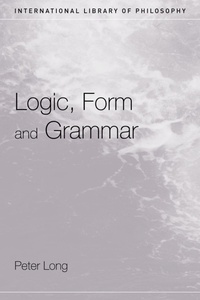
Logic, Form and Grammar
1st Edition
Published on 1. May 2006
Book
Paperback/Softback
120 pages
978-0-415-40808-0 (ISBN)
Description
The notion of logical form and its applications are at the heart of some of the classical problems in philosophical logic and are the focus of Peter Long's investigations in the three essays that comprise this volume.
In the first, major, essay the concern is with the notion of logical form as it applies to arguments involving hypotethical statements, for example 'If today is Wednesday then tomorrow is Thursday; today is Wednesday: therefore tomorrow is Thursday.' Whilst such an argument (an argument by modus ponens) is cited by logical textbooks as a paradigm of one that is 'formally valid', it is not hard to show that the conjunction forming a hypothetical statement is not a logical constant, in which case the argument form If p then q; p: therefore q is not a logical form. But, then, how can logic claim to be the science of formal inference? The author resolves this difficulty by drawing a fundamental distinction within the notion of the form under which an argument is valid. With this distinction it becomes possible for the first time to determine the status of any formally valid argument involving hypotheticals, whether as premises or conclusion or both.
The second and third essays take up the notion of logical form as it applies to such simple propositions as 'This sheet is white' and 'London is north of Paris.' When we speak of the first as giving expression to the relation of relations's relating to its terms, what is in question is a formal relation and we call it such because the relation is expressed through these propositions having the respective forms Fa and Fab. It is shown that the confusion of formal relations with relations proper explains the assimilation of facts to complexes and is that the root of the theory of universals.
Peter Long has taught at the University of Leeds and University College London, and is a past Fellow of Trinity College, Cambridge.
In the first, major, essay the concern is with the notion of logical form as it applies to arguments involving hypotethical statements, for example 'If today is Wednesday then tomorrow is Thursday; today is Wednesday: therefore tomorrow is Thursday.' Whilst such an argument (an argument by modus ponens) is cited by logical textbooks as a paradigm of one that is 'formally valid', it is not hard to show that the conjunction forming a hypothetical statement is not a logical constant, in which case the argument form If p then q; p: therefore q is not a logical form. But, then, how can logic claim to be the science of formal inference? The author resolves this difficulty by drawing a fundamental distinction within the notion of the form under which an argument is valid. With this distinction it becomes possible for the first time to determine the status of any formally valid argument involving hypotheticals, whether as premises or conclusion or both.
The second and third essays take up the notion of logical form as it applies to such simple propositions as 'This sheet is white' and 'London is north of Paris.' When we speak of the first as giving expression to the relation of relations's relating to its terms, what is in question is a formal relation and we call it such because the relation is expressed through these propositions having the respective forms Fa and Fab. It is shown that the confusion of formal relations with relations proper explains the assimilation of facts to complexes and is that the root of the theory of universals.
Peter Long has taught at the University of Leeds and University College London, and is a past Fellow of Trinity College, Cambridge.
More details
Series
Language
English
Place of publication
London
United Kingdom
Publishing group
Taylor & Francis Ltd
Target group
College/higher education
Postgraduate
Dimensions
Height: 234 mm
Width: 156 mm
Thickness: 7 mm
Weight
202 gr
ISBN-13
978-0-415-40808-0 (9780415408080)
Copyright in bibliographic data and cover images is held by Nielsen Book Services Limited or by the publishers or by their respective licensors: all rights reserved.
Schweitzer Classification
Other editions
Additional editions
Peter Long
Logic, Form and Grammar
Book
12/2000
1st Edition
Routledge
€184.50
Article not available at the moment
Person
Peter Long
Content
Part 1 Logical form and hypothetical reasoning; Chapter 1 Synopsis; Chapter 2 Text; Part 2 Formal relations; Chapter 3 Formal relations; Part 3 Universals: logic and metaphor; Chapter 4 Universals: logic and metaphor;