

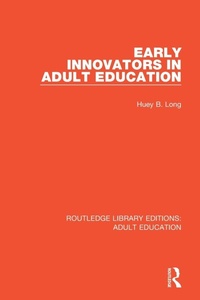
Early Innovators in Adult Education
1st Edition
Published on 18. August 2020
Book
Paperback/Softback
178 pages
978-1-138-36210-9 (ISBN)
Description
Originally published in 1991 this book analyses the input of those who made important contributions to the education of adults in the USA between 1607 and 1920. Examining the historical roots of adult education the book explores commonalities among innovators such as Cotton Mather, Benjamin Franklin, Margaret Fuller Ossoli and Ida Tarbell. It charts the development of important educational programmes including the American Lyceum, Chautauqua and local organizations such as mechanics' institutes and the Junto in Philadelphia.
More details
Series
Language
English
Place of publication
London
United Kingdom
Publishing group
Taylor & Francis Ltd
Target group
College/higher education
Professional and scholarly
Dimensions
Height: 234 mm
Width: 156 mm
Thickness: 10 mm
Weight
281 gr
ISBN-13
978-1-138-36210-9 (9781138362109)
Copyright in bibliographic data and cover images is held by Nielsen Book Services Limited or by the publishers or by their respective licensors: all rights reserved.
Schweitzer Classification
Other editions
Additional editions
Huey B. Long
Early Innovators in Adult Education
Book
11/2018
1st Edition
Routledge
€148.56
Shipment within 10-20 days
Huey B. Long
Early Innovators in Adult Education
E-Book
11/2018
1st Edition
Routledge
€45.99
Available for download
Person
Huey B. Long
Content
Part 1: Introduction 1. Early Innovators in the Education of Adults: Their Lives and Times Part 2: Innovators in the Formative Era (1607-1790) 2. Anne Marbury Hutchinson 3. Cotton Mather 4. Benjamin Franklin Part 3: Innovators in the Establishment Era (1791-1860) 5. Timothy Claxton 6. Josiah Holbrook 7. Margaret Fuller Ossoli Part 4: Innovators in the National Era (1861-1920) 8. Peter Cooper 9. John Heyl Vincent and Lewis Miller 10. Ida Tarbell Part 5: Summary and Conclusions 11. Innovators in the Education of Adults 1607-1920: Summary and Conclusions