

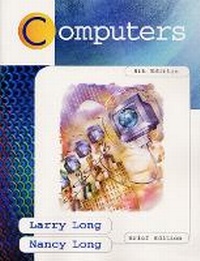
Computers, Brief Edition
8th Edition
Published on 17. July 2000
Book
Paperback/Softback
326 pages
978-0-13-863234-2 (ISBN)
Description
For an introductory course in computers and information technology (IT) or in computer competency, often offered in Business, CIS, or Computer Science. This text meets the necessary requirements for a shorter course or a course combined with a lab component.
Designed to accommodate the computer competency needs of students from a broad spectrum of disciplines and interests, this best-selling text/supplements package provides an exceptionally well-illustrated overview of computing concepts and IT applications-all in a format that allows instructors the flexibility to meet their courses' educational objectives. It strikes a good balance between efficiency of presentation and content that holds students' interest and invites learning. Only concepts critical to general information technology competency are covered in order to provide an understanding of basic computer literacy.
Designed to accommodate the computer competency needs of students from a broad spectrum of disciplines and interests, this best-selling text/supplements package provides an exceptionally well-illustrated overview of computing concepts and IT applications-all in a format that allows instructors the flexibility to meet their courses' educational objectives. It strikes a good balance between efficiency of presentation and content that holds students' interest and invites learning. Only concepts critical to general information technology competency are covered in order to provide an understanding of basic computer literacy.
More details
Edition
8th edition
Language
English
Place of publication
United States
Publishing group
Pearson Education (US)
Target group
Professional and scholarly
Dimensions
Height: 275 mm
Width: 210 mm
Thickness: 12 mm
Weight
702 gr
ISBN-13
978-0-13-863234-2 (9780138632342)
Copyright in bibliographic data and cover images is held by Nielsen Book Services Limited or by the publishers or by their respective licensors: all rights reserved.
Schweitzer Classification
Other editions
Previous edition
Larry Long | Nancy Long
Computers, Brief Edition
Book
08/1999
7th Edition
Pearson
€29.70
Article exhausted; check for reprint
Persons
Dr. Larry Long and Dr. Nancy Long have written more than 30 books, which have been used in hundreds of colleges throughout the world. Larry is a lecturer, author, consultant, and educator in the information technology fields. He has served as a consultant to all levels of management in virtually every major type of industry. He has over 25 years of classroom experience at IBM, the University of Oklahoma, Lehigh University, and the University of Arkansas. Nancy has teaching and administrative experience at all levels of education.
Content
INFORMATION TECHNOLOGY CONCEPTS.
1. Information Technology in Perspective.
The Information Society. Networking: Bringing People Together. Computers: The Essentials. Personal Computers to Supercomputers. A Computer System at Work. How Do We Use Computers?
2. Using the PC: Popular Productivity Software.
Personal Computing with Popular Productivity Packages. Word Processing: The Most Popular PC Application. Desktop Publishing: Freedom of the Press. Presentation Software: Putting on the Show. Spreadsheet: The Magic Matrix. Database: A Dynamic Data Tool.
3. Inside the Computer.
Going Digital. The PC System Unit: Looking in the Box. Describing the Processor. Processor Design.
4. Storing and Retrieving Information.
Mass Storage and Files. Magnetic Disks. Backup: Better Safe than Sorry. Optical Laser Disks: High-Density Storage. Storage Forecast: Is There a Disk in Your Future?
5. Information Input and Output.
I/O Devices: Let's Interface. Traditional Input Devices. Source-Data Automation. Output Devices. Terminals: Input and Output.
6. Networks and Networking.
Our Weird, Wild, Wired World. Data Communications Hardware: Making It Happen. The Data Communications Channel: Data Highways. Networks: Connecting Nodes. Networks: The WAN, MAN, LAN, and TAN.
7. Going Online.
The Online World. Information Services: America Online, CompuServe, and More. The Internet: A World Wide Web of Computers and Information. Browsers: The Information Tool. Internet Resources and Applications. Internet Issues.
8. The Windows Environment.
The Operating System: Directing the Action. Platforms: Homes for Software. Windows Concepts and Terminology. Sharing Information among Windows Applications. Interacting with the PC and Its Software.
1. Information Technology in Perspective.
The Information Society. Networking: Bringing People Together. Computers: The Essentials. Personal Computers to Supercomputers. A Computer System at Work. How Do We Use Computers?
2. Using the PC: Popular Productivity Software.
Personal Computing with Popular Productivity Packages. Word Processing: The Most Popular PC Application. Desktop Publishing: Freedom of the Press. Presentation Software: Putting on the Show. Spreadsheet: The Magic Matrix. Database: A Dynamic Data Tool.
3. Inside the Computer.
Going Digital. The PC System Unit: Looking in the Box. Describing the Processor. Processor Design.
4. Storing and Retrieving Information.
Mass Storage and Files. Magnetic Disks. Backup: Better Safe than Sorry. Optical Laser Disks: High-Density Storage. Storage Forecast: Is There a Disk in Your Future?
5. Information Input and Output.
I/O Devices: Let's Interface. Traditional Input Devices. Source-Data Automation. Output Devices. Terminals: Input and Output.
6. Networks and Networking.
Our Weird, Wild, Wired World. Data Communications Hardware: Making It Happen. The Data Communications Channel: Data Highways. Networks: Connecting Nodes. Networks: The WAN, MAN, LAN, and TAN.
7. Going Online.
The Online World. Information Services: America Online, CompuServe, and More. The Internet: A World Wide Web of Computers and Information. Browsers: The Information Tool. Internet Resources and Applications. Internet Issues.
8. The Windows Environment.
The Operating System: Directing the Action. Platforms: Homes for Software. Windows Concepts and Terminology. Sharing Information among Windows Applications. Interacting with the PC and Its Software.