

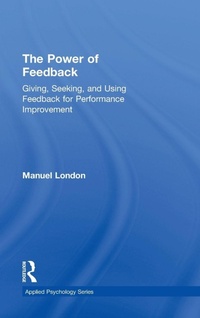
The Power of Feedback
Giving, Seeking, and Using Feedback for Performance Improvement
1st Edition
Published on 14. July 2014
Book
Hardback
226 pages
978-1-84872-547-8 (ISBN)
Description
This follow up to the 2003 edition of Job Feedback by Manuel London is updated to cover new research in the area of organizational management. This edition bridges a gap in research that now covers cultural responses to employer feedback, feedback through electronic communications, and how technology has changed the way teams work in organizations. The Power of Feedback includes examples of feedback from friends, family, colleagues, and volunteers in non-profit organizations. In this new book, both employers and employees will learn to view feedback as a positive tool for improving performance, motivation, and interpersonal relationships. Managers, human resource professionals, and students who will one day oversee teams will benefit from the research and advice found in The Power of Feedback.
Reviews / Votes
"This is a worthwhile book with a wealth of well-researched content, it is both enjoyable andabsorbing.A "must read" for both the manager and the managed...This book is so comprehensive it is definitely one to have close at hand. It will help practitioners to prepare to give or receive feedback constructively and confidently, making performance improvement a more rewarding experience for all concerned." - Lucy Windsor (The Performance Business, Surrey, UK) for Emerald Insight
"Dr. London shows us that giving and receiving feedback is a vital process in our work and in our lives. In a clear and engaging manner, he provides the knowledge and tools we need to improve our practices of exchanging feedback. This book is a must read for anyone who works with others." - Valerie I. Sessa, Associate Professor, Industrial and Organizational Psychology, Montclair State University
"This comprehensive book, filled with useful examples, distills the latest research into easy-to-understand and actionable guidelines that will benefit any manager and organization. If people routinely followed Dr. London's advice, we would live in a world with more engaged, productive, and satisfied workers. This book shows how to increase managers' effectiveness and build better relationships at work." - James W. Smither, Chair and Professor, Management and Leadership Department, La Salle University
"This book is a must-read for all managers, consultants, HR professionals, graduate students, and researchers. Both practical and very readable, Dr. London's look at feedback is comprehensive: informed by the latest research, it includes vivid case studies and offers scores of best practices. It encourages the reader to critically examine his or her own strengths, weaknesses, concerns, and fears about feedback, making it an important resource for personal and professional development." - Edward Mone, President, Edward Mone Consulting LLC, and Lecturer, School of Professional Development, Stony Brook University
More details
Series
Language
English
Place of publication
London
United Kingdom
Publishing group
Taylor & Francis Ltd
Target group
College/higher education
Illustrations
2 s/w Tabellen
2 Tables, black and white
Dimensions
Height: 235 mm
Width: 157 mm
Thickness: 17 mm
Weight
485 gr
ISBN-13
978-1-84872-547-8 (9781848725478)
Copyright in bibliographic data and cover images is held by Nielsen Book Services Limited or by the publishers or by their respective licensors: all rights reserved.
Schweitzer Classification
Other editions
Additional editions
Book
07/2014
1st Edition
Routledge
€76.30
Shipment within 3-4 weeks
E-Book
06/2014
1st Edition
Routledge
€69.99
Available for download
E-Book
06/2014
1st Edition
Routledge
€69.99
Available for download
Person
Manuel London is Dean of the College of Business at the State University of New York at Stony Brook. He is also Director of the Center for Human Resource Management at Stony Brook. He received his PhD in industrial and organizational psychology from the Ohio State University and taught for three years at the Business School of the University of Illinois in Champaign-Urbana. He moved to Stony Brook in 1989. His research interests are in employee management and development, including career motivation, performance evaluation, feedback, and training.
Content
Section I: How People See Themselves and Others 1. Introduction: The Power and Challenge of Feedback 2. How and Why Feedback Work 3. How People Evaluate Themselves 4. Understanding Giving, Seeking, and Using Feedback 5. The Source's Perspective Section II: Sources of Feedback Information and Support 6. Performance Appraisal Methods 7. 360 Degree Feedback 8. Assessment Centers and Simulations 9. Being a Developer and Coach Section III: Expanding the Power of Feedback 10. Feedback Across the Globe 11. Feedback in Team 12. Technology and Feedback 13. Becoming a Feedback-Oriented Continuous Learner