

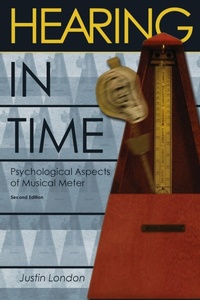
Hearing in Time
Psychological Aspects of Musical Meter
2nd Edition
Published on 24. May 2012
Book
Paperback/Softback
252 pages
978-0-19-974437-4 (ISBN)
Description
Our sense that a waltz is "in three" or a blues song is "in four with a shuffle" comes from our sense of musical meter. Hearing in Time explores the metric aspect of our musical experience from a psychological point of view. Musical meter is taken as a musically-specific instance entrainment, that is, our more general ability to synchronize our actions to the rhythms around us. As such, musical meter is subject to a number of fundamental perceptual and cognitive constraints. These constraints are the cornerstones of Hearing in Time's account of musical meter. Hearing in Time also takes into account the fact that listening to music, like many other rhythmic activities, is something that we do a lot. It also approaches musical meter in the context of music as it is actually performed, with nuances of timing and dynamics, rather than as a theoretical ideal.
Hearing in Time's approach to meter is not based on any particular musical style or cultural practice, and so it discusses musical examples from a wide range of musical styles and cultures--from Beethoven and Bach to Brubeck and Ghanaian (Ewe) drumming. In taking this broad approach a number of fundamental similarities between a variety of different metric phenomena--such as the difference between so-called simple versus complex or additive meters--become apparent.
Hearing in Time is written for musicians, musicologists, music theorists and psychologists who are interested in rhythm and meter. Only a modest ability read a musical score is presumed, and most musical examples are taken from familiar popular and classical repertory.
Hearing in Time's approach to meter is not based on any particular musical style or cultural practice, and so it discusses musical examples from a wide range of musical styles and cultures--from Beethoven and Bach to Brubeck and Ghanaian (Ewe) drumming. In taking this broad approach a number of fundamental similarities between a variety of different metric phenomena--such as the difference between so-called simple versus complex or additive meters--become apparent.
Hearing in Time is written for musicians, musicologists, music theorists and psychologists who are interested in rhythm and meter. Only a modest ability read a musical score is presumed, and most musical examples are taken from familiar popular and classical repertory.
Reviews / Votes
London's book clearly provides the single best introduction to, and summary of, a century of psychological and theoretical study into the nature of musical meter and rhythm. For both music scholars and performers, this text offers an unbiased, reliable, and wide-ranging discussion of these important concepts. * Robert Gjerdingen, Music Theory Program, Northwestern University School of Music *More details
Edition
2nd Revised edition
Language
English
Place of publication
New York
United States
Target group
Professional and scholarly
College/higher education
Musicologists, ethnomusicologists, music theorists, musicians and composers as well as cognitive psychologists and music cognition researchers.
Edition type
Revised edition
Dimensions
Height: 234 mm
Width: 156 mm
Thickness: 15 mm
Weight
435 gr
ISBN-13
978-0-19-974437-4 (9780199744374)
Copyright in bibliographic data and cover images is held by Nielsen Book Services Limited or by the publishers or by their respective licensors: all rights reserved.
Schweitzer Classification
Other editions
Additional editions
E-Book
05/2012
2nd Edition
OUP eBook
€34.99
Available for download
E-Book
04/2012
2nd Edition
OUP eBook
€34.99
Available for download
Book
09/2004
Oxford University Press Inc
€28.47
Article exhausted; check for reprint
Previous edition
Book
09/2004
Oxford University Press Inc
€28.47
Article exhausted; check for reprint
Person
Justin London is Professor of Music at Carleton College. He is the author of Hearing in Time (OUP 2004) as well as several articles in the recent revision of The New Grove Dictionary of Music and The Cambridge History of Western Music Theory. He served as President of the Society for Music Theory in 2007-2009.
Content
Table of Contents ; Introduction ; Meter as a Kind of Attentional Behavior ; Relevant research on Rhythmic Perception and Production ; The Neurobiology and Development of Rhythm ; Meter-Rhythm Interactions I: Ground Rules ; Metric Representations and Metric Well-Formedness ; Meter-Rhythm Interactions II: Problems ; Metric Flux in Beethoven's Fifth ; Non-Isochronous Meters ; NI-Meters in Theory and Practice ; The Many Meters Hypothesis ; Conclusion ; Notes ; Bibliography ; Index