

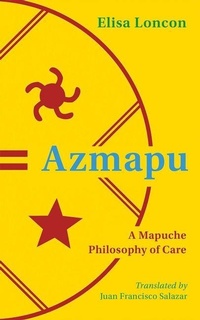
Azmapu
Description
In 2021, Mapuche scholar Elisa Loncon led Chile's historic effort to revise its constitution. Her attempts to formally recognize Indigenous and environmental rights challenged entrenched ideas about power and reverberated internationally.
In this intimate book, Loncon shares the Indigenous knowledge system that shapes her work as a scholar and human rights activist. Azmapu introduces readers to Mapuche philosophy, which is rooted in Mapuzugun (the "language of the Earth"). Rejecting Western ideas about human dominance, this book elevates a worldview in which all beings are interconnected.
Loncon explains how küme mogen, "good living," results from people being in balance with nature. She explores Mapuche understandings of language, governance, ceremony, and gender and sexuality. She also highlights the vital role Indigenous women play in resisting colonialism and in knowledge transmission.
Rooted in Mapuche teachings yet resonating far beyond, Azmapu offers an alternative vision for how humans might live with the Earth.
More details
Persons
Elisa Loncon is an internationally renowned Indigenous and environmental rights activist and an associate professor in the Faculty of Humanities at the University of Santiago, Chile. She holds a PhD in Humanities from the University of Leiden (2017) and doctoral degree in Literature from the Pontifical Catholic University of Chile. In 2021, she was elected to represent the Mapuche people in the Chilean Constitutional Convention and then served as the Convention's first president. That same year, she was awarded the René Cassin Human Rights Award from the Basque Government in recognition of her substantial contributions to the defence of human rights. TIME magazine named her one of the world's "100 Most Influential People" and she was also recognized by the Financial Times as one of the "25 Most Influential Women of 2021."
Juan Francisco Salazar is a professor of communication and media and the director of the Institute for Culture and Society at Western Sydney University, Australia. He was born in Santiago, Chile, and migrated to Sydney in 1998, where he has since become an interdisciplinary researcher, author, and documentary filmmaker whose work explores social-ecological change. He has developed pioneering Indigenous media projects and has worked with communities and organizations in Australia, Chile, Colombia, Fiji, Vanuatu, Mexico, and Antarctica. His creative work has been shown at prestigious venues and festivals including the Venice Biennale, Serpentine Galleries in London, and Biennale of Sydney. He is a member of the editorial board of the journals Public Humanities, The Polar Journal, Media Environment and Cultural Anthropology.