

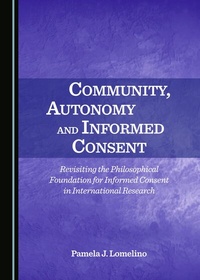
Community, Autonomy and Informed Consent
Revisiting the Philosophical Foundation for Informed Consent in International Research
Published on 30. January 2015
Book
Hardback
190 pages
978-1-4438-7115-0 (ISBN)
Description
In using the example of informed consent guidelines for international research on human subjects, this book demonstrates one of the many useful ways that philosophy can be used to move from theory to praxis by providing a general picture of how a philosophical analysis of underlying concepts can affect the way that public policy is framed; the ways that such policies are exclusionary; and a general methodology for remedying injustices in public policy and practice once they have been identified.With diseases, such as AIDS, reaching epidemic proportions in less developed countries, medical research on human subjects in these areas is on the rise. Current international guidelines for research on human subjects stress the importance of informed consent, which is meant to ensure that people freely choose whether to participate in research trials. In an effort to be more globally applicable, many current international ethical guidelines for informed consent in research on human subjects attempt to incorporate community in the informed consent process. This book explains how these attempts encounter two primary problems: (1) they fail to adequately acknowledge the importance community has for many people in less developed countries; and (2) they fail to attend to the constraints to autonomy that oftentimes become magnified once community is involved in the informed consent process. The reason for these shortcomings can be traced to the current account of autonomy reflected in international informed consent guidelines, which is here referred to as the traditional account of autonomy. Although traditional autonomy can account for what this book defines as external constraints to autonomy, it is unequipped to recognize the internal constraints which arise in the medical context. In order to adequately recognize the importance of community in autonomy and to attend to internal constraints to autonomy, it is essential to adopt an account of relational autonomy. Using such a relational autonomy account, the book provides a set of minimally sufficient ethical conditions that can assist policy makers in revising international informed consent guidelines in research on human subjects, so that these guidelines better attend to community involvement in the informed consent process. To demonstrate how these conditions might be used, the book also presents examples of possible revisions to the CIOMS Ethical Guidelines, one of the leading international ethical guidelines for research on human subjects.
More details
Series
Edition
Unabridged edition
Language
English
Place of publication
Newcastle upon Tyne
United Kingdom
Target group
College/higher education
Professional and scholarly
Edition type
Unabridged edition
Product notice
With dust jacket
Dimensions
Height: 212 mm
Width: 148 mm
ISBN-13
978-1-4438-7115-0 (9781443871150)
Copyright in bibliographic data and cover images is held by Nielsen Book Services Limited or by the publishers or by their respective licensors: all rights reserved.
Schweitzer Classification
Other editions
Additional editions
Pamela J. Lomelino
Community, Autonomy and Informed Consent
Revisiting the Philosophical Foundation for Informed Consent in International Research
E-Book
02/2015
1st Edition
Cambridge Scholars Publishing
€146.99
Available for download
Person
Pamela J. Lomelino is a Philosophy Professor at Loyola University, Chicago, where she teaches courses in Healthcare Ethics, Philosophy of Medicine, and Feminist Philosophy. She received her PhD in Philosophy and a Women and Gender Studies certificate from the University of Colorado, Boulder. Her research interest is analyzing the relationship between autonomy and informed consent in medical research and clinical medicine, and exploring ways to improve the informed consent process in various medical contexts in order to better ensure autonomous decision-making, especially for more vulnerable persons.