

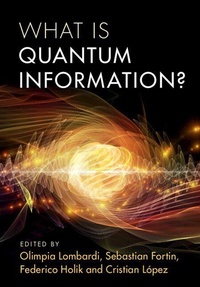
What is Quantum Information?
Published on 24. April 2017
Book
Hardback
272 pages
978-1-107-14211-4 (ISBN)
Description
Combining physics and philosophy, this is a uniquely interdisciplinary examination of quantum information science which provides an up-to-date examination of developments in this field. The authors provide coherent definitions and theories of information, taking clearly defined approaches to considering information in connection with quantum mechanics, probability, and correlations. Concepts addressed include entanglement of quantum states, the relation of quantum correlations to quantum information, and the meaning of the informational approach for the foundations of quantum mechanics. Furthermore, the mathematical concept of information in the communicational context, and the notion of pragmatic information are considered. Suitable as both a discussion of the conceptual and philosophical problems of this field and a comprehensive stand-alone introduction, this book will benefit both experienced and new researchers in quantum information and the philosophy of physics.
Reviews / Votes
'This book debates the topic of quantum information from both a physical and philosophical perspective, addressing the main questions about its nature. ... Providing an interdisciplinary examination of quantum information science, this book is aimed at philosophers of science, quantum physicists and information-technology experts who are interested in delving into the multiple conceptual and philosophical problems inherent to this recently born field of research.' CERN Courier 'What is Quantum Information? is a convenient reference point for discussions in that region where physics and philosophy intermingle.' Blake C. Stacey, TheoriaMore details
Language
English
Place of publication
Cambridge
United Kingdom
Target group
Professional and scholarly
Illustrations
7 Tables, black and white; 2 Halftones, black and white; 5 Line drawings, black and white
Dimensions
Height: 250 mm
Width: 175 mm
Thickness: 19 mm
Weight
657 gr
ISBN-13
978-1-107-14211-4 (9781107142114)
Copyright in bibliographic data and cover images is held by Nielsen Book Services Limited or by the publishers or by their respective licensors: all rights reserved.
Schweitzer Classification
Other editions
Additional editions
Olimpia Lombardi | Sebastian Fortin | Federico Holik
What is Quantum Information?
E-Book
05/2017
Cambridge University Press
€73.99
Available for download
Olimpia Lombardi
What is Quantum Information?
E-Book
04/2017
Cambridge University Press
€62.99
Available for download
Persons
Olimpia Lombardi is the director of a research group in the philosophy of physics and the philosophy of chemistry. She has reviewed for several of the most prestigious journals specialized in physics and the philosophy of science, and has been awarded grants from the Foundational Questions Institute, New York and the John Templeton Foundation. Sebastian Fortin is a Research Fellow of the National Scientific and Technical Research Council in Argentina, and has spoken and published widely on quantum information theory, the foundations of quantum mechanics, and the foundations of quantum chemistry. Federico Holik is a Research Fellow of the National Scientific and Technical Research Council in Argentina. His research focusses on the foundations of quantum mechanics, quantum information theory, the interpretation of quantum probabilities, and the study of the logical, algebraic and geometrical aspects of the quantum formalism. Cristian Lopez is a Visiting Fellow of the Muenich Center for Mathematical Philosophy and holds a graduate-research fellowship at the National Scientific and Technical Research Council in Argentina. His research focusses on the philosophy of physics and the philosophy of time.
Content
Preface; Introduction; Part I. About the Concept of Information: 1. About the concept of information Sebastian Fortin and Olimpia Lombardi; 2. Representation, information, and theories of information Armond Duwell; 3. Information, communication, and manipulability Olimpia Lombardi and Cristian Lopez; Part II. Information and quantum mechanics: 4. Quantum versus classical information Jeffrey Bub; 5. Quantum information and locality Dennis Dieks; 6. Pragmatic information in quantum mechanics Juan Roederer; 7. Interpretations of quantum theory: a map of madness Adan Cabello; Part III. Probability, Correlations, and Information: 8. On the tension between ontology and epistemology in quantum probabilities Amit Hagar; 9. Inferential versus dynamical conceptions of physics David Wallace; 10. Classical models for quantum information Federico Holik and Gustavo Martin Bosyk; 11. On the relative character of quantum correlations Guido Bellomo and Angel Ricardo Plastino; Index.