

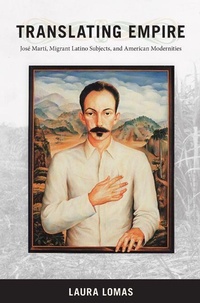
Translating Empire
Jose Marti, Migrant Latino Subjects, and American Modernities
Will be published approx. on 2. January 2009
Book
Paperback/Softback
400 pages
978-0-8223-4325-7 (ISBN)
Description
In Translating Empire, Laura Lomas uncovers how late nineteenth-century Latino migrant writers developed a prescient critique of U.S. imperialism, one that prefigures many of the concerns about empire, race, and postcolonial subjectivity animating American studies today. During the 1880s and early 1890s, the Cuban journalist, poet, and revolutionary JosE MartI and other Latino migrants living in New York City translated North American literary and cultural texts into Spanish. Lomas reads the canonical literature and popular culture of the United States in the Gilded Age through the eyes of MartI and his fellow editors, activists, orators, and poets. In doing so, she reveals how, in the process of translating Anglo-American culture into a Latino-American idiom, the Latino migrant writers invented a modernist aesthetics to criticize U.S. expansionism and expose Anglo stereotypes of Latin Americans. Lomas challenges longstanding conceptions about MartI through readings of neglected texts and reinterpretations of his major essays. Against the customary view that emphasizes his strong identification with Ralph Waldo Emerson and Walt Whitman, the author demonstrates that over several years, MartI actually distanced himself from Emerson's ideas and conveyed alarm at Whitman's expansionist politics. She questions the association of MartI with pan-Americanism, pointing out that in the 1880s, the Cuban journalist warned against foreign geopolitical influence imposed through ostensibly friendly meetings and the promotion of hemispheric peace and "free" trade. Lomas finds MartI undermining racialized and sexualized representations of America in his interpretations of Buffalo Bill and other rituals of westward expansion, in his self-published translation of Helen Hunt Jackson's popular romance novel Ramona, and in his comments on writing that stereotyped Latino/a Americans as inherently unfit for self-government. With Translating Empire, Lomas recasts the contemporary practice of American studies in light of MartI's late-nineteenth-century radical decolonizing project.
Reviews / Votes
"Laura Lomas's monograph is a superb contribution to the scholarship on JosE MartI and the ways in which he and other Latino authors in the late nineteenth-century United States laid the foundations for a critique of a rising United States by viewing its relationship to Latin America from their anticolonial perspective as migrants. . . . [A] highly original and timely presentation on an exciting and growing field of literary and culturalscholarship." - RaUl FernAndez, Hispanic American Historical Review "Translating Empire is an often provocative text that manages to pull off a difficult feat: saying something new about MartI. . . . Lomas's rereading of MartI's work is an expert account of his political commitments and his formal innovations, and it offers a compelling vision for the political vocation of Latino Studies and an anti-imperial American Studies." - John Patrick Leary, Criticism "Translating Empire is a provocative study that will reorient our understanding of the late nineteenth century, modernism, and transnational Latino writing, and of JosE MartI as an important cultural worker of the period who translated empire across and between many borders." - Marissa LOpez, Nineteenth-Century Literature "Lomas's most valuable contribution in Translating Empire is the foregrounding of MartI's lesser-known works. Examining Marti's career as a journalist and translator during his fifteen-year stay in the United States, Lomas adds greatly to our understanding of a migrant Latino consciousness with roots deep in the nineteenth century." - John MorAn GonzAlez, American Literature "Translating Empire aims to show how indispensable Latino migrant translations have been to the imagining of American cultural and literary history. It is a task that captures in a small but convincing and eloquent way the mood of the moment, in which Barack Obama's appeal, for example, to engage with Latin America on the basis of equality and mutual respect, a shared Americanness, appears to herald a new era of relations." - Gavin O'Toole, Latin American Review of Books "Lomas's magisterial study focuses on the writings and intellectual legacies of
Cuban independence leader JosE MartI. . . . In the process, Lomas seeks to engage explicitly with contemporary theories and critiques of empire undertaken in American studies and inter-American modernisms in order to instantiate a 'genealogy of alternative American modernities'(ix)." - LAzaro Lima, American Literary History "At a time when transnational cultural and economic flows preoccupy scholars and politicians, and debates on immigration rage in the media and in the halls of Congress, Laura Lomas returns us to the rich writings of JosE MartI. Lomas's MartI is not just the towering intellectual and Cuban independence leader familiar to scholars of Latin American culture, but also a Latino migrant who thought deeply about the workings of the U.S. empire, about immigrants, and about how the imagination can shape a truly democratic future in the Americas. Lomas is a sensitive and learned reader of MartI and one of our very best guides into his vast corpus. She creates the conditions for MartI's aladas palabras (winged words) to soar for legions of new readers."-David Luis-Brown, author of Waves of Decolonization: Discourses of Race and Hemispheric Citizenship in Cuba, Mexico, and the United States "This beautifully written and meticulously researched book significantly broadens what most U.S. Americanists will know-and will think they need to know-about JosE MartI. Laura Lomas's arguments about the imbrication of modernist experimental form with imperial modernity are provocative and likely to be widely discussed."-Kirsten Silva Gruesz, author of Ambassadors of Culture: The Transamerican Origins of Latino Writing "Translating Empire aims to show how indispensable Latino migrant translations have been to the imagining of American cultural and literary history. It is a task that captures in a small but convincing and eloquent way the mood of the moment, in which Barack Obama's appeal, for example, to engage with Latin America on the basis of equality and mutual respect, a shared Americanness, appears to herald a new era of relations." - Gavin O'Toole (Latin American Review of Books) "Translating Empire is a provocative study that will reorient our understanding of the late nineteenth century, modernism, and transnational Latino writing, and of JosE MartI as an important cultural worker of the period who translated empire across and between many borders." - Marissa Lopez (Nineteenth-Century Literature) "Translating Empire is an often provocative text that manages to pull off a difficult feat: saying something new about MartI. . . . Lomas's rereading of MartI's work is an expert account of his political commitments and his formal innovations, and it offers a compelling vision for the political vocation of Latino Studies and an anti-imperial American Studies." - John Patrick Leary (Criticism) "Laura Lomas's monograph is a superb contribution to the scholarship on JosE MartI and the ways in which he and other Latino authors in the late nineteenth-century United States laid the foundations for a critique of a rising United States by viewing its relationship to Latin America from their anticolonial perspective as migrants. . . . [A] highly original and timely presentation on an exciting and growing field of literary and cultural scholarship." - Raul Fernandez (Hispanic American Historical Review) "Lomas's magisterial study focuses on the writings and intellectual legacies of Cuban independence leader JosE MartI. . . . In the process, Lomas seeks to engage explicitly with contemporary theories and critiques of empire undertaken in American studies and inter-American modernisms in order to instantiate a 'genealogy of alternative American modernities'(ix)." - Lazaro Lima (American Literary History)
More details
Series
Language
English
Place of publication
North Carolina
United States
Target group
College/higher education
Product notice
Paperback (trade)
Illustrations
7 illustrations
Dimensions
Height: 224 mm
Width: 149 mm
Thickness: 24 mm
Weight
546 gr
ISBN-13
978-0-8223-4325-7 (9780822343257)
Copyright in bibliographic data and cover images is held by Nielsen Book Services Limited or by the publishers or by their respective licensors: all rights reserved.
Schweitzer Classification
Person
Laura Lomas is Assistant Professor of English Literature and American Studies at Rutgers University.
Content
Preface: Criticar es Amar: Translation and Self-Criticism ix
Introduction: Metropolitan Debts, Imperial Modernity, and Latino Modernism 1
1. Latino American Postcolonial Theory from a Space In-Between 41
2. La AmErica with an Accent: North Americans, Spanish-Language Print Culture, and American Modernities 83
3. The "Evening of Emerson": MartI's Postcolonial Double Consciousness 130
4. MartI's "Mock-Congratulatory Signs": Walt Whitman's Occult Artistry 177
5. MartI's Border Writing: Infiltrative Translation, Late Nineteenth-Century "Latinness" and the Perils of Pan-Americanism 216
Conclusion. Cross-Pollinating "Dust on Butterfly's Wings": Latina/o Writing and Culture Beyond and After MartI 278
Notes 285
Bibliography 347
Index 375
Introduction: Metropolitan Debts, Imperial Modernity, and Latino Modernism 1
1. Latino American Postcolonial Theory from a Space In-Between 41
2. La AmErica with an Accent: North Americans, Spanish-Language Print Culture, and American Modernities 83
3. The "Evening of Emerson": MartI's Postcolonial Double Consciousness 130
4. MartI's "Mock-Congratulatory Signs": Walt Whitman's Occult Artistry 177
5. MartI's Border Writing: Infiltrative Translation, Late Nineteenth-Century "Latinness" and the Perils of Pan-Americanism 216
Conclusion. Cross-Pollinating "Dust on Butterfly's Wings": Latina/o Writing and Culture Beyond and After MartI 278
Notes 285
Bibliography 347
Index 375