

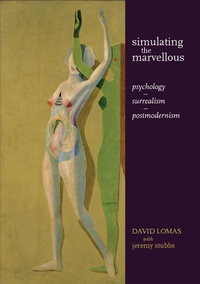
Simulating the Marvellous
Psychology - Surrealism - Postmodernism
Published on 30. December 2013
Book
Hardback
424 pages
978-0-7190-8882-7 (ISBN)
Description
Simulating the marvellous presents important new research on Surrealism and the culture from which it arose. Offering fresh interpretations of Surrealist art and literature based around the theme of simulation, the book shows, in the late nineteenth and early twentieth centuries, that the notion of simulation arose in a number of discrete contexts, in relation to hysteria and war neuroses; more broadly it shadows the emergence of our concept of 'the unconscious'.
Acknowledging simulation's relevance to Surrealism, this book argues, radically alters our understanding of the Surrealists' project and the terms in which one gauges its success or failure. It leads one to question the naive assumption that automatic writing or drawing represent an authentic outpouring of the unconscious and gives renewed significance to a figure such as Salvador Dali who embraced simulation and made it the basis of his art and aesthetic. Resonances are also explored with postmodern theory and art practice, around the themes of simulation and the simulacrum.It also points to one of the ways in which Surrealism chimes with a core preoccupation of contemporary art and theory.
Written accessibly, and ranging across many of the core ideas of Surrealism, David Lomas balances coverage of both Surrealist art and literature, looking at such figures as Dali, Eluard, Masson, Desnos, Brouillet, Picasso, Tanning and Janet, as well as Glenn Brown, Douglas Gordon and Sarah Lucas. The book will interest not only art historians and theorists, but also students and those with a general interest in Surrealism. -- .
Acknowledging simulation's relevance to Surrealism, this book argues, radically alters our understanding of the Surrealists' project and the terms in which one gauges its success or failure. It leads one to question the naive assumption that automatic writing or drawing represent an authentic outpouring of the unconscious and gives renewed significance to a figure such as Salvador Dali who embraced simulation and made it the basis of his art and aesthetic. Resonances are also explored with postmodern theory and art practice, around the themes of simulation and the simulacrum.It also points to one of the ways in which Surrealism chimes with a core preoccupation of contemporary art and theory.
Written accessibly, and ranging across many of the core ideas of Surrealism, David Lomas balances coverage of both Surrealist art and literature, looking at such figures as Dali, Eluard, Masson, Desnos, Brouillet, Picasso, Tanning and Janet, as well as Glenn Brown, Douglas Gordon and Sarah Lucas. The book will interest not only art historians and theorists, but also students and those with a general interest in Surrealism. -- .
More details
Edition
UK edition
Language
English
Place of publication
Manchester
United Kingdom
Target group
College/higher education
Professional and scholarly
Product notice
sewn/stitched
Cloth over boards
With dust jacket
Illustrations
Illustrations, black & white
Dimensions
Height: 241 mm
Width: 173 mm
Thickness: 28 mm
Weight
1134 gr
ISBN-13
978-0-7190-8882-7 (9780719088827)
Copyright in bibliographic data and cover images is held by Nielsen Book Services Limited or by the publishers or by their respective licensors: all rights reserved.
Schweitzer Classification
Persons
David Lomas is Professor of Art History at the University of Manchester
Jeremy Stubbs is tutor in the University of London Institute in Paris -- .
Jeremy Stubbs is tutor in the University of London Institute in Paris -- .
Content
Prologue: Breton and Dali: elements of a dialogue
Introduction: Simulation in contexts
Part I: Simulating the marvellous
1 Psychological medicine to surrealism
2 Surrealism and the Salpetriere legacy
3 Convulsive identity: mimicry, magic and hysteria
4 A theatre of hysteria: surrealism and the postmodern turn
Part II: Surrealism as simulation
5 Automatism, pastiche, simulation
6 Simulation experiments: science, spiritualism and surrealism
7 Painting the simulacrum
8 Simulacra and the order of mimesis in Dali and Glenn Brown
Index -- .
Introduction: Simulation in contexts
Part I: Simulating the marvellous
1 Psychological medicine to surrealism
2 Surrealism and the Salpetriere legacy
3 Convulsive identity: mimicry, magic and hysteria
4 A theatre of hysteria: surrealism and the postmodern turn
Part II: Surrealism as simulation
5 Automatism, pastiche, simulation
6 Simulation experiments: science, spiritualism and surrealism
7 Painting the simulacrum
8 Simulacra and the order of mimesis in Dali and Glenn Brown
Index -- .