

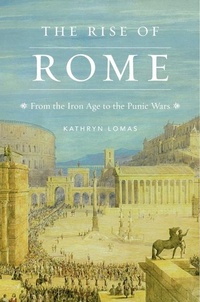
The Rise of Rome
From the Iron Age to the Punic Wars
Published on 26. February 2018
Book
Hardback
432 pages
978-0-674-65965-0 (ISBN)
Description
By the third century BC, the once-modest settlement of Rome had conquered most of Italy and was poised to build an empire throughout the Mediterranean basin. What transformed a humble city into the preeminent power of the region? In The Rise of Rome, the historian and archaeologist Kathryn Lomas reconstructs the diplomatic ploys, political stratagems, and cultural exchanges whereby Rome established itself as a dominant player in a region already brimming with competitors. The Latin world, she argues, was not so much subjugated by Rome as unified by it. This new type of society that emerged from Rome's conquest and unification of Italy would serve as a political model for centuries to come.
Archaic Italy was home to a vast range of ethnic communities, each with its own language and customs. Some such as the Etruscans, and later the Samnites, were major rivals of Rome. From the late Iron Age onward, these groups interacted in increasingly dynamic ways within Italy and beyond, expanding trade and influencing religion, dress, architecture, weaponry, and government throughout the region. Rome manipulated preexisting social and political structures in the conquered territories with great care, extending strategic invitations to citizenship and thereby allowing a degree of local independence while also fostering a sense of imperial belonging.
In the story of Rome's rise, Lomas identifies nascent political structures that unified the empire's diverse populations, and finds the beginnings of Italian peoplehood.
Archaic Italy was home to a vast range of ethnic communities, each with its own language and customs. Some such as the Etruscans, and later the Samnites, were major rivals of Rome. From the late Iron Age onward, these groups interacted in increasingly dynamic ways within Italy and beyond, expanding trade and influencing religion, dress, architecture, weaponry, and government throughout the region. Rome manipulated preexisting social and political structures in the conquered territories with great care, extending strategic invitations to citizenship and thereby allowing a degree of local independence while also fostering a sense of imperial belonging.
In the story of Rome's rise, Lomas identifies nascent political structures that unified the empire's diverse populations, and finds the beginnings of Italian peoplehood.
Reviews / Votes
This is an admirably clear and engagingly written book. It offers an impressively wide-ranging and up-to-date synthesis, and does an excellent job of situating the city-state of Rome and its rise to hegemony in their wider Italian context. -- J.H. Richardson, Massey University Lomas shows great skill in uncovering reliable and fascinating information about an obscure and poorly documented period of history and presenting it in a clear and straightforward way. Her book is unusual for its extensive use and up-to-date knowledge of archaeological evidence and for its distinctive emphasis on the Italian background to the rise of Rome. -- Timothy Cornell, University of Manchester Lomas' clear narrative and up-to-date archaeological knowledge is just the right combination to bring the fascinating story of the emergence of Rome as a world power to a wider audience. -- Christopher Smith, Director of the British School at Rome and Professor of Ancient History at St Andrews Kathryn Lomas has excavated the complexities of myth, written sources, and archaeological stratigraphy to produce her clear historical synthesis of the political foundations of early Europe. -- Simon Stoddart, Magdalene College, University of CambridgeMore details
Series
Language
English
Place of publication
Cambridge, Mass.
United States
Publishing group
Harvard University Press
Product notice
sewn/stitched
Cloth over boards
Illustrations
8 Karten
8 Maps
Dimensions
Height: 244 mm
Width: 167 mm
Thickness: 34 mm
Weight
821 gr
ISBN-13
978-0-674-65965-0 (9780674659650)
Copyright in bibliographic data and cover images is held by Nielsen Book Services Limited or by the publishers or by their respective licensors: all rights reserved.
Schweitzer Classification
Person
Kathryn Lomas is Honorary Research Fellow and part-time lecturer in Classics and Ancient History at Durham University.