

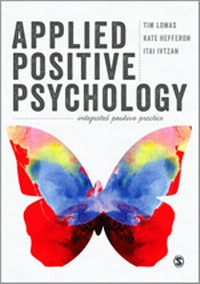
Applied Positive Psychology
Integrated Positive Practice
1st Edition
Published on 23. September 2014
Book
Hardback
240 pages
978-1-4462-9862-6 (ISBN)
Description
If you think you know what positive psychology is, think again! This book offers a new integrative vision for making life better that takes in the body and the brain, culture and society, childhood and development... A must read for students."
- Stephen Joseph, University of Nottingham
"Captures the best of the positive psychology initiative, and most importantly, translates it to practice. The authors bring remarkable depth and breadth to the subject matter and do so in a way that is fresh, engaging, relevant, and unusually thoughtful."
- Carol Ryff, University of Wisconsin-Madison
"If you want to understand what positive psychology really is, learn how it works in practice and discover its huge potential to transform our lives and our world then look no further than this superb book. I really can't recommend it highly enough."
- Mark Williamson, Director of Action for Happiness
This exciting new textbook, written by leading academics in the UK, offers the very first authored title on applied positive psychology for university courses.
Consisting of the latest cutting-edge theory and research in the subject and structured around a pioneering multidimensional model of wellbeing, this book will provide you with the knowledge and tools to apply positive psychology in many areas of life. These include interventions aimed at developing mental and physical functioning, to recommendations for enhancing relationships and reshaping organisational structures. The book shows how these practices can be successfully deployed in diverse real-world settings, from the classroom to the workplace. Key features include:
Learning objectives set out at the start of each chapter
Practice essay questions throughout and quizzes to test your knowledge at the end of each chapter
Useful measurement tools and recommendations for research
Summary boxes and suggested further reading and resources
Case studies and 'Reflection' boxes that invite you to explore topics in greater depth and relate findings to your everyday life.
This book will be essential reading for all students with an interest in or studying a course in applied positive psychology, and is strongly recommended to students taking a wider course in positive psychology and the psychology of happiness and wellbeing.
- Stephen Joseph, University of Nottingham
"Captures the best of the positive psychology initiative, and most importantly, translates it to practice. The authors bring remarkable depth and breadth to the subject matter and do so in a way that is fresh, engaging, relevant, and unusually thoughtful."
- Carol Ryff, University of Wisconsin-Madison
"If you want to understand what positive psychology really is, learn how it works in practice and discover its huge potential to transform our lives and our world then look no further than this superb book. I really can't recommend it highly enough."
- Mark Williamson, Director of Action for Happiness
This exciting new textbook, written by leading academics in the UK, offers the very first authored title on applied positive psychology for university courses.
Consisting of the latest cutting-edge theory and research in the subject and structured around a pioneering multidimensional model of wellbeing, this book will provide you with the knowledge and tools to apply positive psychology in many areas of life. These include interventions aimed at developing mental and physical functioning, to recommendations for enhancing relationships and reshaping organisational structures. The book shows how these practices can be successfully deployed in diverse real-world settings, from the classroom to the workplace. Key features include:
Learning objectives set out at the start of each chapter
Practice essay questions throughout and quizzes to test your knowledge at the end of each chapter
Useful measurement tools and recommendations for research
Summary boxes and suggested further reading and resources
Case studies and 'Reflection' boxes that invite you to explore topics in greater depth and relate findings to your everyday life.
This book will be essential reading for all students with an interest in or studying a course in applied positive psychology, and is strongly recommended to students taking a wider course in positive psychology and the psychology of happiness and wellbeing.
Reviews / Votes
If you think you know what positive psychology is, think again! This book offers a new integrative vision for making life better that takes in the body and the brain, culture and society, and childhood and development. Written by the team who lead the Applied Positive Psychology programme at the University of East London you can be sure that the scholarship is cutting edge. A must read for students of positive psychology. -- Professor Stephen Joseph, editor of Positive Psychology in Practice It's hard to think of any discipline that could be more important in modern society than Positive Psychology - the science and practice of improving wellbeing. This book marks a significant coming-of-age for this exciting and rapidly developing field. It provides a grounded, compelling and comprehensive view of the many ways that Positive Psychology can help make life better - from individuals and families to schools, workplaces and communities; from birth and childhood to adult life and old age. If you want to understand what Positive Psychology really is, learn how it works in practice and discover its huge potential to transform our lives and our world then look no further than this superb book. I really can't recommend it highly enough. -- Dr Mark Williamson This textbook captures the best of the positive psychology initiative, and most importantly, translates it to practice. The authors bringremarkable depth and breadth to the subject matter and do so in a way that is fresh, engaging, relevant, and unusually thoughtful. Everyone who reads this book will derive useful insights about how to live. The closing chapter on ethical and reflective practice is a masterpiece. -- Carol Ryff If you are interested in having a positive impact on people's lives then this book is for you. By firmly placing Positive Psychology in an applied and social context the authors identify its true purpose - to make life better. It does a brilliant job of showing readers how to apply the insights that research has uncovered. It will surely become one of the go-to text books for all students of Positive Psychology. -- Nic Marks A major strength of the book relates to the diversity with which the material is presented. It is rare for a textbook to contain such a multitude of learning tools (e.g. case studies, measurement tools, media, and quizzes).
In sum, Applied Positive Psychology provides a thoughtful and thorough description of the practical realm of positive psychology. It is an appropriate textbook choice for courses with an applied focus, and a good companion text for courses with a broader focus on positive psychology. -- Kelly Campbell, California State University, San Bernardino
More details
Edition
First
Language
English
Place of publication
London
United Kingdom
Target group
College/higher education
Dimensions
Height: 242 mm
Width: 170 mm
Weight
600 gr
ISBN-13
978-1-4462-9862-6 (9781446298626)
Copyright in bibliographic data and cover images is held by Nielsen Book Services Limited or by the publishers or by their respective licensors: all rights reserved.
Schweitzer Classification
Other editions
New editions
Book
10/2024
2nd Edition
SAGE Publications Ltd
€137.00
Shipment within 15-20 days
Additional editions
E-Book
11/2014
1st Edition
SAGE Publications Ltd
€74.99
Available for download
Persons
Dr Tim Lomas, PhD, is a Psychology Research Scientist in the Department of Epidemiology at the Harvard T.H. Chan School of Public Health, and part of the Human Flourishing Program at Harvard University. Tim's main research focus is exploring cross-cultural perspectives on wellbeing, especially concepts and practices deemed 'non-Western.' Since 2013, Tim has published over 100 papers and 12 books relating to wellbeing, involving topics/approaches including linguistics, non-human intelligence, semiotics, art, emotional dialectics, balance/harmony, systems theory, social theory, politics, gender, and Buddhism. His latest book, entitled Happiness, was published in 2023 by MIT Press as part of their Essential Knowledge series. Dr. Kate Hefferon is a Chartered Research Psychologist, Senior Lecturer and Programme Leader of the Msc in Applied Positive Psychology at the University of East London. She is the author of several peer-reviewed papers, books and book chapters and has presented at conferences nationally and internationally on positive psychology. Her research interests include posttraumatic growth, resilience, physical activity and embodiment.
Dr Itai Ivtzan is passionate about the combination of psychology and spirituality. He is the director of the School of Positive Transformation. He published several books, as well as many journal papers and book chapters. His main interests are positive psychology, mindfulness, and spirituality. He is a regular keynote speaker at conferences. If you wish to get additional information about his work or contact him, please visit the School of Positive Transformation website.
Dr Itai Ivtzan is passionate about the combination of psychology and spirituality. He is the director of the School of Positive Transformation. He published several books, as well as many journal papers and book chapters. His main interests are positive psychology, mindfulness, and spirituality. He is a regular keynote speaker at conferences. If you wish to get additional information about his work or contact him, please visit the School of Positive Transformation website.
Content
Introduction
Chapter 1: Preparing for the Journey
A map to guide us
Our motto
Chapter 2: The Mind
Consciousness
Embodiment
Emotions
Cognitions
Awareness+
Chapter 3: The Body and the Brain
Biochemistry
Neurons
Neural networks
The nervous system
The body
Chapter 4: Culture and Society
Microsystem
Mesosystem
Exosystem
Macrosystem
Ecosystem
Chapter 5: Childhood and Development
Pregnancy and birth
Infancy
Early childhood
Positive education
Positive youth development
Development throughout adulthood
Positive aging
Chapter 6: Occupations and Organisations
The mind
The body
Culture
Society
Chapter 7: Religion and Spirituality
The religion-health connection
Meditation and Buddhism
Yoga and Hinduism
Religion, spirituality, and positive psychology
Chapter 8: Ethical and Reflective Practice
Ethical practice
Reflective practice
Chapter 1: Preparing for the Journey
A map to guide us
Our motto
Chapter 2: The Mind
Consciousness
Embodiment
Emotions
Cognitions
Awareness+
Chapter 3: The Body and the Brain
Biochemistry
Neurons
Neural networks
The nervous system
The body
Chapter 4: Culture and Society
Microsystem
Mesosystem
Exosystem
Macrosystem
Ecosystem
Chapter 5: Childhood and Development
Pregnancy and birth
Infancy
Early childhood
Positive education
Positive youth development
Development throughout adulthood
Positive aging
Chapter 6: Occupations and Organisations
The mind
The body
Culture
Society
Chapter 7: Religion and Spirituality
The religion-health connection
Meditation and Buddhism
Yoga and Hinduism
Religion, spirituality, and positive psychology
Chapter 8: Ethical and Reflective Practice
Ethical practice
Reflective practice