

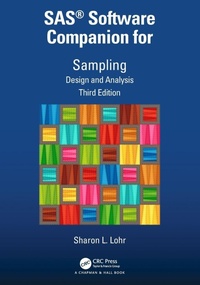
SAS (R) Software Companion for Sampling
Design and Analysis, Third Edition
1st Edition
Published on 30. November 2021
Book
Paperback/Softback
248 pages
978-0-367-74851-7 (ISBN)
Description
The SAS (R) Software Companion for Sampling: Design and Analysis, designed to be read alongside Sampling: Design and Analysis, Third Edition by Sharon L. Lohr (SDA; 2022, CRC Press), shows how to use the survey selection and analysis procedures of SAS (R) software to perform calculations for the examples in SDA.
No prior experience with SAS software is needed. Chapter 1 tells you how to access the software, introduces basic features, and helps you get started with analyzing data.
Each subsequent chapter provides step-by-step guidance for working through the data examples in the corresponding chapter of SDA, with code, output, and interpretation. Tips and warnings help you develop good programming practices and avoid common survey data analysis errors.
Features of the SAS software procedures are introduced as they are needed so you can see how each type of sample is selected and analyzed. Each chapter builds on the knowledge developed earlier for simpler designs; after finishing the book, you will know how to use SAS software to select and analyze almost any type of probability sample.
All code is available on the book website and is easily adapted for your own survey data analyses. The website also contains all data sets from the examples and exercises in SDA to help you develop your skills through analyzing survey data from social and public opinion research, public health, crime, education, business, agriculture, and ecology
No prior experience with SAS software is needed. Chapter 1 tells you how to access the software, introduces basic features, and helps you get started with analyzing data.
Each subsequent chapter provides step-by-step guidance for working through the data examples in the corresponding chapter of SDA, with code, output, and interpretation. Tips and warnings help you develop good programming practices and avoid common survey data analysis errors.
Features of the SAS software procedures are introduced as they are needed so you can see how each type of sample is selected and analyzed. Each chapter builds on the knowledge developed earlier for simpler designs; after finishing the book, you will know how to use SAS software to select and analyze almost any type of probability sample.
All code is available on the book website and is easily adapted for your own survey data analyses. The website also contains all data sets from the examples and exercises in SDA to help you develop your skills through analyzing survey data from social and public opinion research, public health, crime, education, business, agriculture, and ecology
More details
Language
English
Place of publication
Oxford
United Kingdom
Publishing group
Taylor & Francis Ltd
Target group
College/higher education
Professional and scholarly
Illustrations
4 s/w Abbildungen, 4 s/w Zeichnungen, 60 s/w Tabellen
60 Tables, black and white; 4 Line drawings, black and white; 4 Illustrations, black and white
Dimensions
Height: 254 mm
Width: 178 mm
Thickness: 14 mm
Weight
474 gr
ISBN-13
978-0-367-74851-7 (9780367748517)
Copyright in bibliographic data and cover images is held by Nielsen Book Services Limited or by the publishers or by their respective licensors: all rights reserved.
Schweitzer Classification
Other editions
Additional editions
Book
11/2021
1st Edition
Chapman & Hall/CRC
€114.80
Shipment within 15-20 days
E-Book
11/2021
1st Edition
Chapman & Hall/CRC
€44.99
Available for download
E-Book
11/2021
1st Edition
Chapman & Hall/CRC
€44.99
Available for download
Person
Sharon L. Lohr, the author of Measuring Crime: Behind the Statistics, has published widely about survey sampling and statistical methods for education, public policy, law, and crime. She is a Fellow of the American Statistical Association and an elected member of the International Statistical Institute, and has received the Gertrude M. Cox, Morris Hansen, and Deming Awards. Formerly Dean's Distinguished Professor of Statistics at Arizona State University and a Vice President at Westat, she is now a statistical consultant and writer.
Content
1. Getting Started. 2. Simple Random Sampling. 3. Stratified Sampling. 4. Ratio and Regression Estimation. 5. Cluster Sampling with Equal. 6. Sampling with Unequal Probabilities. 7. Complex Surveys. 8. Nonresponse. 9. Variance Estimation in Complex Surveys. 10. Categorical Data Analysis in Complex Surveys. 11. Regression with Complex Survey Data. 12. Additional Topics for Survey Data Analysis.