

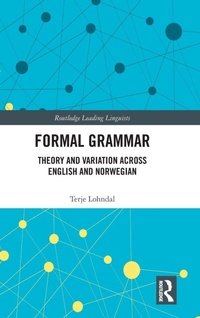
Formal Grammar
Theory and Variation across English and Norwegian
1st Edition
Published on 12. October 2017
Book
Hardback
448 pages
978-1-138-28969-7 (ISBN)
Description
This volume draws together fourteen previously published papers which explore the nature of mental grammar through a formal, generative approach. The book begins by outlining the development of formal grammar in the last fifty years, with a particular focus on the work of Noam Chomsky, and moves into an examination of a diverse set of phenomena in various languages that shed light on theory and model construction. Many of the papers focus on comparisons between English and Norwegian, highlighting the importance of comparative approaches to the study of language. With a comprehensive collection of papers that demonstrate the richness of formal approaches, this volume is key reading for students and scholars interested in the study of grammar.
More details
Series
Language
English
Place of publication
London
United Kingdom
Publishing group
Taylor & Francis Ltd
Target group
College/higher education
Illustrations
27 s/w Abbildungen, 9 s/w Zeichnungen, 18 s/w Tabellen
18 Tables, black and white; 9 Line drawings, black and white; 27 Illustrations, black and white
Dimensions
Height: 235 mm
Width: 157 mm
Thickness: 29 mm
Weight
812 gr
ISBN-13
978-1-138-28969-7 (9781138289697)
Copyright in bibliographic data and cover images is held by Nielsen Book Services Limited or by the publishers or by their respective licensors: all rights reserved.
Schweitzer Classification
Other editions
Additional editions

Book
07/2019
1st Edition
Routledge
€55.79
Shipment within 15-20 days
E-Book
10/2017
Routledge
€63.49
Available for download
E-Book
10/2017
Routledge
€63.49
Available for download
Person
Terje Lohndal is Professor of English linguistics at NTNU Norwegian University of Science and Technology in Trondheim, where he also serves as Deputy Head of Research in the Department of Language and Literature. Additionally, he holds an Adjunct Professorship in the Department of Language and Culture at UiT The Arctic University of Norway in Tromso.
Content
Introduction
Part A: Transformational constraints
1 Brief Overview of the History of Generative Grammar
2 Noam Chomsky: A selected annotated bibliography
3 Comp-t Effects: Variation in the Position and Features of C
4 Freezing Effects and Objects
5 Medial-wh Phenomena, Parallel Movement, and Parameters
6 Sentential subjects in English and Norwegian
7 Be careful how you use the left periphery
Part B: The syntax-semantics interface
8 Negative Concord and (Multiple) Agree: A Case Study of West Flemish
9 Medial adjunct PPs in English: Implications for the syntax of sentential negation
10 Neodavidsonianism in semantics and syntax
11 Interrogatives, Instructions, and I-languages: An I-Semantics for Questions
Part C: Multilingualism and formal grammar
12 Generative grammar and language mixing
13 Language mixing and exoskeletal theory: A case study of word-internal mixing
in American Norwegian
14 Grammatical Gender in American Norwegian Heritage Language: Stability or
attrition?
Part A: Transformational constraints
1 Brief Overview of the History of Generative Grammar
2 Noam Chomsky: A selected annotated bibliography
3 Comp-t Effects: Variation in the Position and Features of C
4 Freezing Effects and Objects
5 Medial-wh Phenomena, Parallel Movement, and Parameters
6 Sentential subjects in English and Norwegian
7 Be careful how you use the left periphery
Part B: The syntax-semantics interface
8 Negative Concord and (Multiple) Agree: A Case Study of West Flemish
9 Medial adjunct PPs in English: Implications for the syntax of sentential negation
10 Neodavidsonianism in semantics and syntax
11 Interrogatives, Instructions, and I-languages: An I-Semantics for Questions
Part C: Multilingualism and formal grammar
12 Generative grammar and language mixing
13 Language mixing and exoskeletal theory: A case study of word-internal mixing
in American Norwegian
14 Grammatical Gender in American Norwegian Heritage Language: Stability or
attrition?