

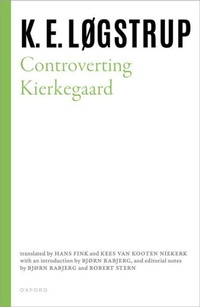
Controverting Kierkegaard
Published on 25. May 2023
Book
Hardback
226 pages
978-0-19-887476-8 (ISBN)
Description
This is the first English edition of a major work by the Danish philosopher and theologian K. E. Logstrup (1905-81). It is the culmination of his critical engagement with Kierkegaardianism, which had begun almost 20 years earlier. In this text, Logstrup focuses on four main themes in Kierkegaard: his understanding of Christ and thus of Christianity; his understanding of suffering in human existence; Christian vs. secular ethics; and Platonistic influences on Kierkegaard's position, which Logstrup characterises as nihilistic.
Logstrup presents his own alternative conception in response: that Christ revealed universal ontological ethical structures that put Christians and non-Christians on a par; that suffering is a basic human experience and so there is no such thing as a particular Christian suffering; that sovereign expressions of life such as trust, sincerity, and compassion are the fundamental phenomena of ethics that enable our lives to function, and are thus given as a gift of creation, not of faith; and finally that human existence as created is meaningful and holds value and so is not a Kierkegaardian 'nothingness' of mere relativity. As well as offering a classic and yet controversial critique of Kierkegaard, this text also develops Logstrup's conception of the sovereign expressions of life, which was to become central to his later ethics, further deepening his distinctive understanding of the human condition. Here translated in full for the first time, it will now be possible for English-speaking readers to explore the issues that drew Logstrup into his controversion with Kierkegaard.
Logstrup presents his own alternative conception in response: that Christ revealed universal ontological ethical structures that put Christians and non-Christians on a par; that suffering is a basic human experience and so there is no such thing as a particular Christian suffering; that sovereign expressions of life such as trust, sincerity, and compassion are the fundamental phenomena of ethics that enable our lives to function, and are thus given as a gift of creation, not of faith; and finally that human existence as created is meaningful and holds value and so is not a Kierkegaardian 'nothingness' of mere relativity. As well as offering a classic and yet controversial critique of Kierkegaard, this text also develops Logstrup's conception of the sovereign expressions of life, which was to become central to his later ethics, further deepening his distinctive understanding of the human condition. Here translated in full for the first time, it will now be possible for English-speaking readers to explore the issues that drew Logstrup into his controversion with Kierkegaard.
Reviews / Votes
The insightful introductions are written by well-known Logstrup scholars, and the translations are fluent and precise...Knud E. Logstrup is a philosophical force to be reckoned with. * Michiel Herman, International Journal of Philosophy and Theology *More details
Series
Language
English
Place of publication
Oxford
United Kingdom
Target group
Professional and scholarly
Product notice
sewn/stitched
Cloth over boards
Dimensions
Height: 240 mm
Width: 162 mm
Thickness: 18 mm
Weight
472 gr
ISBN-13
978-0-19-887476-8 (9780198874768)
Copyright in bibliographic data and cover images is held by Nielsen Book Services Limited or by the publishers or by their respective licensors: all rights reserved.
Schweitzer Classification
Other editions
Additional editions
K. E. Løgstrup | Bjørn Rabjerg | Robert Stern
Controverting Kierkegaard
E-Book
04/2023
1st Edition
OUP eBook
€59.49
Available for download
K. E. Løgstrup | Bjørn Rabjerg | Robert Stern
Controverting Kierkegaard
E-Book
04/2023
1st Edition
OUP eBook
€59.49
Available for download
Persons
Robert Stern is Professor of Philosophy at the University of Sheffield, where he has worked since 1989. He has published extensively on Kant, Hegel, and transcendental arguments, as well as on accounts of moral obligation. He has recently published the first monograph in English on Logstrup, entitled The Radical Demand in Logstrup's Ethics.
Bjorn Rabjerg is Assistant Professor of Ethics and Philosophy of Religion at Aarhus University, Denmark, where he has been since 2010. He holds a PhD in Systematic Theology and an MA in Philosophy. He has worked extensively on Logstrup since 2004 and has been Head of the Logstrup Archive at Aarhus University since 2013. His most recent publications have been on Logstrup, Soren Kierkegaard, Martin Luther, and Karl Ove Knausgard.
Kees van Kooten Niekerk was formerly Associate Professor of Ethics and Philosophy of Religion at the University of Aarhus. He was in charge of the Logstrup Archive and the editor of its newsletter between 2000 and 2013. He has published works on the relationship between theology and science, bioethics, and K. E. Logstrup.
Hans Fink is Emeritus Professor of Philosophy at the University of Aarhus. He is the co-editor of What Is Ethically Demanded?: K. E. Logstrup's Philosophy of Moral Life (Notre Dame 2017, with Robert Stern).
Bjorn Rabjerg is Assistant Professor of Ethics and Philosophy of Religion at Aarhus University, Denmark, where he has been since 2010. He holds a PhD in Systematic Theology and an MA in Philosophy. He has worked extensively on Logstrup since 2004 and has been Head of the Logstrup Archive at Aarhus University since 2013. His most recent publications have been on Logstrup, Soren Kierkegaard, Martin Luther, and Karl Ove Knausgard.
Kees van Kooten Niekerk was formerly Associate Professor of Ethics and Philosophy of Religion at the University of Aarhus. He was in charge of the Logstrup Archive and the editor of its newsletter between 2000 and 2013. He has published works on the relationship between theology and science, bioethics, and K. E. Logstrup.
Hans Fink is Emeritus Professor of Philosophy at the University of Aarhus. He is the co-editor of What Is Ethically Demanded?: K. E. Logstrup's Philosophy of Moral Life (Notre Dame 2017, with Robert Stern).
Content
Translators' Preface
Acknowledgements
A Chronology of Logstrup's Life
Introduction
German Foreword
Foreword
Part I: Christianity Without the Historical Jesus
1: The Christian Message is Derived from Paradoxicality, and Jesus's Proclamation and Works are not Integral to Christianity
2: The Question of the Occasion for Faith According to Kierkegaard
3: The Approximation Problem
4: An Alternative to Kierkegaard's View
5: The Paradoxicality
6: The Interpretation of the Crucifixion
7: Following Christ
Part II: Sacrifice
1: Suffering
2: Christianity and the Naturally Generated and Culturally Formed Communities
Part III: The Movement of Infinity
1: The Infinite Movement of Resignation
2: Taking Over Concrete Existence
3: The Abstract and Negative Self
4: Sartre's and Kierkegaard's Portrayal of Demonic Self-Enclosedness
5: The Absolute Good
6: Conformity and the Collision Between Faith in God and the Neighbour
7: The Sovereign Expressions of Life and the Question of the Freedom or Bondage of the Will
8: Taking Over the Situation Through the Sovereign Expressions of Life
9: How the Ethical Life of the People is Lost, Conformism, and How the Relation of Spirit is Doubled
10: Morality Is the Provision of Substitute Motives for Substitute Actions
11: The Levelling Down of Finitude
12: Consciousness of Guilt
13: Action and Attitude of Mind
Part IV: Nothingness
1: Knowledge as It Is Understood in Transcendental Philosophy, and Existence
2: The Synthesis Between Infinity and Finitude, Between Eternity and Temporality
3: The Doubling of the Relation of Spirit
4: Nothingness and Action
5: Knowledge and Reflection
Editors' Notes
Select Bibliography
Index
Acknowledgements
A Chronology of Logstrup's Life
Introduction
German Foreword
Foreword
Part I: Christianity Without the Historical Jesus
1: The Christian Message is Derived from Paradoxicality, and Jesus's Proclamation and Works are not Integral to Christianity
2: The Question of the Occasion for Faith According to Kierkegaard
3: The Approximation Problem
4: An Alternative to Kierkegaard's View
5: The Paradoxicality
6: The Interpretation of the Crucifixion
7: Following Christ
Part II: Sacrifice
1: Suffering
2: Christianity and the Naturally Generated and Culturally Formed Communities
Part III: The Movement of Infinity
1: The Infinite Movement of Resignation
2: Taking Over Concrete Existence
3: The Abstract and Negative Self
4: Sartre's and Kierkegaard's Portrayal of Demonic Self-Enclosedness
5: The Absolute Good
6: Conformity and the Collision Between Faith in God and the Neighbour
7: The Sovereign Expressions of Life and the Question of the Freedom or Bondage of the Will
8: Taking Over the Situation Through the Sovereign Expressions of Life
9: How the Ethical Life of the People is Lost, Conformism, and How the Relation of Spirit is Doubled
10: Morality Is the Provision of Substitute Motives for Substitute Actions
11: The Levelling Down of Finitude
12: Consciousness of Guilt
13: Action and Attitude of Mind
Part IV: Nothingness
1: Knowledge as It Is Understood in Transcendental Philosophy, and Existence
2: The Synthesis Between Infinity and Finitude, Between Eternity and Temporality
3: The Doubling of the Relation of Spirit
4: Nothingness and Action
5: Knowledge and Reflection
Editors' Notes
Select Bibliography
Index