

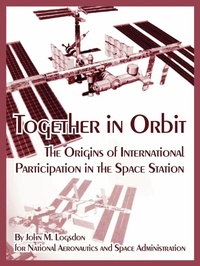
Together in Orbit
The Origins of International Participation in the Space Station
Published on 29. June 2005
Book
Paperback/Softback
64 pages
978-1-4102-2453-8 (ISBN)
Description
From virtually the beginning of the twentieth century, those interested in the human exploration of space have viewed as central to that endeavor the building of an Earth-orbital space station that would serve as the jumping-off point to the Moon and the planets. Always, space exploration supporters believed, a permanently occupied space station was a necessary outpost in the new frontier of space. The more technically minded recognized that once humans had achieved Earth orbit about 250 miles above the surface---the presumed location of any space station---the vast majority of the atmosphere and the gravity well would have been conquered, and then human beings were about halfway to anywhere they might want to go.
Space station advocates also recognized that the scientific and technological challenge of building an Earth-orbital space station was daunting and that pooling the resources of many of the spacefaring nations of the world would maximize the probabilities of success. Thus, when the space station project was born in the in the mid-1980s, it almost immediately became an international program. This monograph describes the process of conceptualizing the international partnership and crafting its contours.
More details
Series
Language
English
Product notice
Paperback (trade)
Unsewn / adhesive bound
Illustrations
Illustrations; Illustrations, black and white
Dimensions
Height: 280 mm
Width: 210 mm
Thickness: 4 mm
Weight
183 gr
ISBN-13
978-1-4102-2453-8 (9781410224538)
Copyright in bibliographic data and cover images is held by Nielsen Book Services Limited or by the publishers or by their respective licensors: all rights reserved.
Schweitzer Classification