

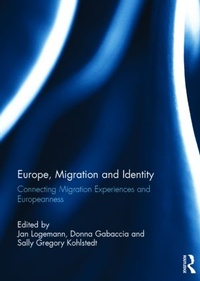
Europe, Migration and Identity
Connecting Migration Experiences and Europeanness
1st Edition
Published on 1. May 2014
Book
Hardback
114 pages
978-1-138-77508-4 (ISBN)
Description
This volume explores connections between migration studies and research in the history of Europeanization and Europeaness, areas which have generated much interest in recent years. Beyond histories of European political integration and the intellectual and elite movements that have supported this process, scholars increasingly pay attention to the constructed nature of Europeaness and European identities, and to the multiplicity of ways in which this construction happens. Migrants can be a particularly useful lens on Europeanization processes as they provide a perspective from the periphery in two ways: by providing a view literally from the outside as in the case of those who left the continent or by providing a view from the margins of the European societies within which they live.
The collection asks what 'Europe' meant to migrants abroad - particularly within the transatlantic context - and within the continent during the twentieth century. Contributions from a variety of disciplinary perspectives reflect both on the broader historical context and theoretical implications and highlight specific cases, such as those of European labor migrants to the United States, of transatlantic exiles and emigres, of Latin-American immigrants in present-day Europe, as well as the experience of highly-skilled migrants within the context of the European Union. Can we trace the emergence of European identities among different groups of migrants and, if so, what forms did they take?
This book was originally published as a special issue of National Identities.
The collection asks what 'Europe' meant to migrants abroad - particularly within the transatlantic context - and within the continent during the twentieth century. Contributions from a variety of disciplinary perspectives reflect both on the broader historical context and theoretical implications and highlight specific cases, such as those of European labor migrants to the United States, of transatlantic exiles and emigres, of Latin-American immigrants in present-day Europe, as well as the experience of highly-skilled migrants within the context of the European Union. Can we trace the emergence of European identities among different groups of migrants and, if so, what forms did they take?
This book was originally published as a special issue of National Identities.
More details
Language
English
Place of publication
London
United Kingdom
Publishing group
Taylor & Francis Ltd
Target group
College/higher education
Dimensions
Height: 246 mm
Width: 174 mm
Weight
362 gr
ISBN-13
978-1-138-77508-4 (9781138775084)
Copyright in bibliographic data and cover images is held by Nielsen Book Services Limited or by the publishers or by their respective licensors: all rights reserved.
Schweitzer Classification
Other editions
Additional editions
Jan Logemann | Donna Gabaccia | Sally Kohlstedt
Europe, Migration and Identity
Connecting Migration Experiences and Europeanness
Book
10/2018
1st Edition
Routledge
€88.08
Shipment within 10-20 days
Jan Logemann | Donna Gabaccia | Sally Kohlstedt
Europe, Migration and Identity
Connecting Migration Experiences and Europeanness
E-Book
10/2015
1st Edition
Routledge
€72.49
Available for download
Jan Logemann | Donna Gabaccia | Sally Kohlstedt
Europe, Migration and Identity
Connecting Migration Experiences and Europeanness
E-Book
10/2015
1st Edition
Routledge
€72.49
Available for download
Persons
Jan Logemann is a Research Fellow at the German Historical Institute in Washington D.C., USA, and project coordinator of?Transatlantic Perspectives: Europe in the Eyes of European Immigrants to the United States. His research focuses on transatlantic comparisons, the role of European immigrants in transatlantic exchanges, as well as on the development of mass consumer societies in the twentieth century.
Donna Gabaccia?is a professor of history at the University of Minnesota, USA. She is a leading migration historian and a noted specialist in women's immigration history. Her work has focused on Italian-American migration to the U.S., food and ethnicity, as well as on global and transnational migrations.
Sally Gregory Kohlstedt is a professor of history of science and technology at the University of Minnesota, USA. Her research focuses on analyzing the ways in which science intersects with culture, recognizing that much social change in recent centuries has been influenced by science and technology and that the issues that arise in science are often connected to contemporary social and economic forces.?
Donna Gabaccia?is a professor of history at the University of Minnesota, USA. She is a leading migration historian and a noted specialist in women's immigration history. Her work has focused on Italian-American migration to the U.S., food and ethnicity, as well as on global and transnational migrations.
Sally Gregory Kohlstedt is a professor of history of science and technology at the University of Minnesota, USA. Her research focuses on analyzing the ways in which science intersects with culture, recognizing that much social change in recent centuries has been influenced by science and technology and that the issues that arise in science are often connected to contemporary social and economic forces.?
Content
1. Europe - Migration - Identity: Connections between migration experiences and Europeanness Jan Logemann 2. Lessons and cautionary tales from the past: Building bridges from migration history to Europeanness Leslie Page Moch 3. Where and when was Europe? Europeanness and its relationship to migration Kiran Klaus Patel 4. Italian Americans in the 'Bocce Belt': 'Old World' memories and 'New World' identities Laura A. Miller 5. Gender and identity in exile: A European emigre in social work Barbara Louis 6. Belonging, beyond the nation: The significance and meaning of European identity for Latin American-origin youth in Spain Jessica Sperling 7. Transnational highly skilled Finnish migrants in Europe: Choosing one's identity Saara Koikkalainen