

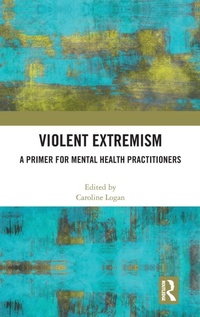
Violent Extremism
A Primer for Mental Health Practitioners
1st Edition
Published on 22. December 2021
Book
Hardback
170 pages
978-1-032-17046-6 (ISBN)
Description
This edited book presents international perspectives on the role of mental health problems in understanding and managing the risk of violent extremism.
The chapters included in this book address two themes. First, they describe the research findings on the nature and prevalence of the range of mental health problems (psychosis, personality disorder, post-traumatic stress disorder, anxiety and depression, autism spectrum disorders) in young people and adults who have in the past, committed acts of violence motivated at least in part by extremist ideologies, or who have attempted or threatened such acts, or who for other reasons are thought to be at risk of doing so. Second, the chapters examine what is known about the relationship - or the functional link - between mental health problems and violent extremism. The focus of this book is on clinical practice and understanding the nature of the challenge faced by practitioners and their response to it. It will therefore be of interest to mental health practitioners, service managers and commissioners, and policy makers with a remit to understand and mitigate risk of radicalisation and violent extremism.
The chapters in this book were originally published in The Journal of Forensic Psychiatry & Psychology.
The chapters included in this book address two themes. First, they describe the research findings on the nature and prevalence of the range of mental health problems (psychosis, personality disorder, post-traumatic stress disorder, anxiety and depression, autism spectrum disorders) in young people and adults who have in the past, committed acts of violence motivated at least in part by extremist ideologies, or who have attempted or threatened such acts, or who for other reasons are thought to be at risk of doing so. Second, the chapters examine what is known about the relationship - or the functional link - between mental health problems and violent extremism. The focus of this book is on clinical practice and understanding the nature of the challenge faced by practitioners and their response to it. It will therefore be of interest to mental health practitioners, service managers and commissioners, and policy makers with a remit to understand and mitigate risk of radicalisation and violent extremism.
The chapters in this book were originally published in The Journal of Forensic Psychiatry & Psychology.
More details
Language
English
Place of publication
London
United Kingdom
Publishing group
Taylor & Francis Ltd
Target group
College/higher education
Dimensions
Height: 240 mm
Width: 161 mm
Thickness: 15 mm
Weight
443 gr
ISBN-13
978-1-032-17046-6 (9781032170466)
Copyright in bibliographic data and cover images is held by Nielsen Book Services Limited or by the publishers or by their respective licensors: all rights reserved.
Schweitzer Classification
Other editions
Additional editions
Book
01/2024
1st Edition
Routledge
€63.20
Shipment within 10-20 days

E-Book
12/2021
1st Edition
Routledge
€55.49
Available for download

E-Book
12/2021
1st Edition
Routledge
€55.49
Available for download
Person
Caroline Logan is Consultant Forensic Clinical Psychologist. She has worked as a scholar practitioner in forensic mental health and criminal justice services for 25 years, and much of this time focused on the assessment, formulation, and management of violence risk.
Content
1. Risk assessment and management in violent extremism: a primer for mental health practitioners 2. Systematic review of mental health problems and violent extremism 3. Severe mental disorder and terrorism: when psychosis, PTSD and addictions become a vulnerability 4. Reviewing the links between violent extremism and personality, personality disorders, and psychopathy 5. Violent extremism, mental health and substance abuse among adolescents: towards a trauma psychological perspective on violent radicalization and deradicalization 6. Autism spectrum disorders and terrorism: how different features of autism can contextualise vulnerability and resilience 7. Characteristics of autism spectrum disorder and susceptibility to radicalisation among young people: a qualitative study