

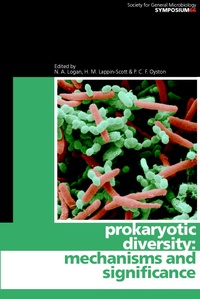
Prokaryotic Diversity
Mechanisms and Significance
Published on 20. April 2006
Book
Hardback
314 pages
978-0-521-86935-5 (ISBN)
Description
The true extent of prokaryote diversity, encompassing the spectrum of variability among bacteria, remains unknown. Current research efforts focus on understanding why prokaryote diversification occurs, its underlying mechanisms, and its likely impact. The dynamic nature of the prokaryotic world, and continuing advances in the technological tools available make this an important area and hence this book will appeal to a wide variety of microbiologists. Its coverage ranges from studies of prokaryotes in specialized environmental niches to broad examinations of prokaryote evolution and diversity, and the mechanisms underlying them. Topics include: bacteria of the gastrointestinal tract, unculturable organisms in the mouth and in the soil, organisms from extreme environments, the diversity of archaea and their phages, comparative genomics and the emergence of pathogens, the spread of genomic islands between clinical and environmental organisms, minimal genomes needed for life, horizontal gene transfer, phenotypic innovation, and patterns and extent of biodiversity.
More details
Series
Language
English
Place of publication
Cambridge
United Kingdom
Target group
Professional and scholarly
Illustrations
17 Tables, unspecified; 4 Halftones, unspecified; 37 Line drawings, unspecified
Dimensions
Height: 235 mm
Width: 158 mm
Thickness: 19 mm
Weight
640 gr
ISBN-13
978-0-521-86935-5 (9780521869355)
Copyright in bibliographic data and cover images is held by Nielsen Book Services Limited or by the publishers or by their respective licensors: all rights reserved.
Schweitzer Classification
Other editions
Additional editions
E-Book
08/2006
Cambridge University Press
€90.49
Available for download
Persons
Niall A. Logan is Professor of Systematic Bacteriology in the School of Life Sciences, Glasgow Caledonian University, UK. Hilary M. Lappin-Scott is Professor of Environmental Microbiology in the School of Biosciences, University of Exeter, UK. Petra C.F. Oyston is Team Leader in Molecular Bacteriology at Porton Down, Salisbury, UK.
Content
Editors' Preface; 1. Microbial diversity in the era of genomics R. R. Colwell; 2. Patterns in prokaryotic biodiversity M. C. Horner-Devine, J. Green and B. J. M. Bohannan; 3. A putative RNA-interference-based immune system in prokaryotes: the epitome of prokaryotic genomic diversity E. V. Koonin, K. S. Maskarova, N. V. Grishin and Y. I. Wolf; 4. The significance of prokaryote diversity in the human gastointestinal tract H. J. Flint; 5. The genetics of phenoytpic innoation H. J. E. Beaumont, S. M. Gehrig, R. Kassen, C. G. Knight, J. Malone, A. J. Spiers and P. B. Rainey; 6. Minimal genomes required for life R. Gil, V. Perez-Brocal, A. Latorre and A. Moya; 7. Evolution of the core of genes V. Daubin and E. Lerat; 8. Biogeographical diversity of archael viruses K. M. Stedman, A. Clore and Y. Combet-Blanc; 9. Is there a link between Chlamydia and heart disease? L. A. Campbell and C.-C. Kuo; 10. Unculturable oral bacteria W. G. Wade; 11. Comparative genomics - what do such studies tell us about the emergence and spread of key pathogens? R. W. Titball and M. Duffield; 12. Spread of genomic islands between clinical and environmental strains J. Klockgether, O. N. Reva and B. Tuemmler; 13. Evolving gene clusters in soil bacteria A. Morningstar, W. H. Gaze, S. Tolba and E. M. H. Wellington; 14. Unusual micro-organisms from unusual habitats: hypersaline environments A. Ventosa; 15. Genomic islands and evolution of catabolic pathways S. Lacour, M. Gaillard and J. R. van der Meer; 16. Horizontal gene transfer and its role in the emergence of new phenotypes A. M. Osborn.