

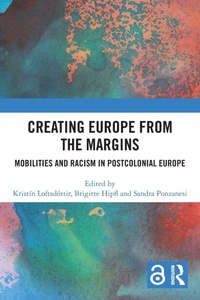
Creating Europe from the Margins
Mobilities and Racism in Postcolonial Europe
1st Edition
Published on 18. December 2024
Book
Paperback/Softback
216 pages
978-1-032-21723-9 (ISBN)
Description
This edited volume explores the idea of Europe through a focus on its margins. The chapters in the volume inquire critically into the relations and tensions inherent in divisions between the Global North and the Global South as well as internal regional differentiation within Europe itself. In doing so, the volume stresses the need to consider Europe from critical interdisciplinary perspectives, highlighting historical and contemporary issues of racism and colonialism.
While recent discussions of migration into 'Fortress Europe' seem to assume that Europe has clearly demarcated geographic, political and cultural boundaries, this book argues that the reality is more complex. The book explores margins conceptually and positions margins and centres as open to negotiation and contestation and characterized by ambiguity. As such, margins can be contextualized in relation to hierarchies within Europe, with different processes involved in creating boundaries and borders between different kinds of Europes and Europeans. Deploying case studies from different places, such as Iceland, Italy, Poland, Spain, Turkey, the UK, Romania, Cyprus, Greece, Sicily, European colonies in the Caribbean and the former Yugoslavia, the contributors analyse how different geopolitical hierarchies intersect with racialized subject positions of diverse people living in Europe, while also exploring issues of gender, class, sexuality, religion and nationality. Some chapters draw attention to the fortification of Europe's 'borderland,' while others focus on internal hierarchies within Europe, critiquing the meaning of spatial boundaries in an increasingly digitalized Europe. In doing so, the chapters interrogate the hierarchies at play in the processes of being and becoming 'European' and the ongoing impacts of race and colonialism.
This timely and thought-provoking collection will be of considerable significance to those in the humanities and social sciences with an interest in Europe.
Chapters 1, 11 and 12 of this book are freely available as downloadable Open Access PDFs at http://www.taylorfrancis.com under a Creative Commons [Attribution-Non Commercial-No Derivatives (CC-BY-NC-ND)] 4.0 license.
While recent discussions of migration into 'Fortress Europe' seem to assume that Europe has clearly demarcated geographic, political and cultural boundaries, this book argues that the reality is more complex. The book explores margins conceptually and positions margins and centres as open to negotiation and contestation and characterized by ambiguity. As such, margins can be contextualized in relation to hierarchies within Europe, with different processes involved in creating boundaries and borders between different kinds of Europes and Europeans. Deploying case studies from different places, such as Iceland, Italy, Poland, Spain, Turkey, the UK, Romania, Cyprus, Greece, Sicily, European colonies in the Caribbean and the former Yugoslavia, the contributors analyse how different geopolitical hierarchies intersect with racialized subject positions of diverse people living in Europe, while also exploring issues of gender, class, sexuality, religion and nationality. Some chapters draw attention to the fortification of Europe's 'borderland,' while others focus on internal hierarchies within Europe, critiquing the meaning of spatial boundaries in an increasingly digitalized Europe. In doing so, the chapters interrogate the hierarchies at play in the processes of being and becoming 'European' and the ongoing impacts of race and colonialism.
This timely and thought-provoking collection will be of considerable significance to those in the humanities and social sciences with an interest in Europe.
Chapters 1, 11 and 12 of this book are freely available as downloadable Open Access PDFs at http://www.taylorfrancis.com under a Creative Commons [Attribution-Non Commercial-No Derivatives (CC-BY-NC-ND)] 4.0 license.
More details
Language
English
Place of publication
London
United Kingdom
Publishing group
Taylor & Francis Ltd
Target group
College/higher education
Postgraduate
Illustrations
16 s/w Abbildungen, 16 s/w Photographien bzw. Rasterbilder, 1 s/w Tabelle
1 Tables, black and white; 16 Halftones, black and white; 16 Illustrations, black and white
Dimensions
Height: 234 mm
Width: 156 mm
Thickness: 13 mm
Weight
360 gr
ISBN-13
978-1-032-21723-9 (9781032217239)
Copyright in bibliographic data and cover images is held by Nielsen Book Services Limited or by the publishers or by their respective licensors: all rights reserved.
Schweitzer Classification
Other editions
Additional editions
Kristin Loftsdottir | Brigitte Hipfl | Sandra Ponzanesi
Creating Europe from the Margins
Mobilities and Racism in Postcolonial Europe
E-Book
08/2023
1st Edition
Routledge
€52.49
Available for download
Kristin Loftsdottir | Brigitte Hipfl | Sandra Ponzanesi
Creating Europe from the Margins
Mobilities and Racism in Postcolonial Europe
Book
08/2023
1st Edition
Routledge
€206.30
Shipment within 10-20 days
Kristin Loftsdottir | Brigitte Hipfl | Sandra Ponzanesi
Creating Europe from the Margins
Mobilities and Racism in Postcolonial Europe
E-Book
08/2023
1st Edition
Routledge
€52.49
Available for download
Persons
Kristin Loftsdottir is Professor of Social Anthropology at the University of Iceland. Her research has focused on notions of exceptionalism, racialization of mobility, racism, gender, crisis, globalization, nationalism, migration and postcolonial Europe. Her publications include Crisis and Coloniality at Europe's Margins: Creating Exotic Iceland (Routledge, 2019) and We Are All African Here: Race, Mobilities and West Africans in Europe (2021), and co-author of Exceptionalism (Routledge, 2021). She is also co-editor of Whiteness and Postcolonialism in the Nordic Region: Exceptionalism, Migrant Others and National Identities (Routledge, 2012), Crisis in the Nordic Nations and Beyond: At the Intersection of Environment, Finance and Multiculturalism (Routledge, 2014), and Messy Europe: Crisis, Race and the Nation State in a Postcolonial World (2018). She is currently the Principal Investigator of the CERM (Creating Europe through Racialized Mobilities) project.
Brigitte Hipfl is Associate Professor Emerita in the Department of Media and Communication Studies at the University of Klagenfurt, Austria. Her research explores media, gender, race, and the affective dynamics of media with a focus on issues related to migration, conviviality, solidarity, and memory work. She is co-editor of Messy Europe: Crisis, Race and the Nation State in a Postcolonial World (2018), Wir und die Anderen: Visuelle Kultur zwischen Aneignung und Ausgrenzung (2020), Handbuch Medien und Geschlecht: Perspektiven und Befunde der feministischen Kommunikations- und Medienforschung (2023), and Intersektionale Solidaritaeten: Beitraege zur gesellschaftskritischen Geschlechterforschung (2023).
Sandra Ponzanesi is Chair and Professor of Media, Gender and Postcolonial Studies in the Department of Media and Culture Studies at Utrecht University, Netherlands, where she is also the founding director of the PCI (Postcolonial Studies Initiative). She has published widely in the field of media, postcolonial studies, digital migration, and cinema, with a particular focus on Postcolonial Europe from comparative and interdisciplinary perspectives. She is author of Paradoxes of Postcolonial Culture: Contemporary Women Writers of the Indian and Afro-Italian Diaspora (2004) and The Postcolonial Cultural Industry: Icons, Markets, Mythologies (2014). She is also editor of Gender, Globalization, and Violence: Postcolonial Conflict Zones (Routledge, 2016) and co-editor of numerous other edited collections, including Postcolonial Transitions in Europe (Rowman and Littlefield 2016), Postcolonial Cinema Studies (Routledge, 2012) and Deconstructing Europe: Postcolonial Perspectives (Routledge, 2012). She has also edited several special issues on digital migration, cinema, and Europe for a range of peer-reviewed journals.
Brigitte Hipfl is Associate Professor Emerita in the Department of Media and Communication Studies at the University of Klagenfurt, Austria. Her research explores media, gender, race, and the affective dynamics of media with a focus on issues related to migration, conviviality, solidarity, and memory work. She is co-editor of Messy Europe: Crisis, Race and the Nation State in a Postcolonial World (2018), Wir und die Anderen: Visuelle Kultur zwischen Aneignung und Ausgrenzung (2020), Handbuch Medien und Geschlecht: Perspektiven und Befunde der feministischen Kommunikations- und Medienforschung (2023), and Intersektionale Solidaritaeten: Beitraege zur gesellschaftskritischen Geschlechterforschung (2023).
Sandra Ponzanesi is Chair and Professor of Media, Gender and Postcolonial Studies in the Department of Media and Culture Studies at Utrecht University, Netherlands, where she is also the founding director of the PCI (Postcolonial Studies Initiative). She has published widely in the field of media, postcolonial studies, digital migration, and cinema, with a particular focus on Postcolonial Europe from comparative and interdisciplinary perspectives. She is author of Paradoxes of Postcolonial Culture: Contemporary Women Writers of the Indian and Afro-Italian Diaspora (2004) and The Postcolonial Cultural Industry: Icons, Markets, Mythologies (2014). She is also editor of Gender, Globalization, and Violence: Postcolonial Conflict Zones (Routledge, 2016) and co-editor of numerous other edited collections, including Postcolonial Transitions in Europe (Rowman and Littlefield 2016), Postcolonial Cinema Studies (Routledge, 2012) and Deconstructing Europe: Postcolonial Perspectives (Routledge, 2012). She has also edited several special issues on digital migration, cinema, and Europe for a range of peer-reviewed journals.
Content
1. Creating Europe from the Margins: Introduction 2. Articulating Europe from the Sephardic Margin: Restoring Citizenship for Expulsed Jews, and not Muslims, in Spain? 3. Racist and Imperial Genealogies in LGBT-free Zones and Struggles over Europe in Poland 4. 'From Nowhere to Nowhere' - Mapping Trajectories of Belonging within the Post-Yugoslav Field 5. On the Margins of Europe: Migration and Sicilian Liminality 6. Digital Media and Migration: Reflections from the Southern Margins of Europe 7. Gay Bod: Civic and LGBTQ+ Pride after Brexit in a City on the Margins of the UK and Europe 8. Marginalized Bodies in Caribbean Europe: Between Vital Inequalities and Health (Im)mobilities 9. Marketing Marginality: Creating Iceland as a White Privileged Destination 10. Making Europe from Below: Intra EU-Migration and Mobilities Connecting the Margins 11. When the Margins Enter the Centre: The Documentary Along the Borders of Turkey and its YouTube Comments as Conflicting Constructions of Europeanity 12. Beating the Border: Playing with Migrant Experiences and Borderveillant Spectatorship in Channel 4's Smuggled (2019)