

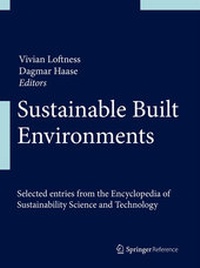
Sustainable Built Environments
Description
International experts in the field address the fundamental questions of sustainable design and landscape management: How should the sustainability of landscapes and buildings be evaluated? Which targets have to be set and which thresholds should not be exceeded? What forms of planning and governance structures exist and to what extent do they further the goals of sustainability? Gathering 30 peer-reviewed entries from the Encyclopedia of Sustainability Science and Technology, Sustainable Built Environments provides comprehensive, multidisciplinary coverage of these issues and other aspects of sustainable building and landscape design.
More details
Other editions
New editions
Additional editions
Persons
At Carnegie Mellon University, Professor Loftness holds the Paul Mellon Distinguished Chair in Architecture, is one of 40 University Professors, and served a decade as Head of the School of Architecture. With over 30 years of industry and government research funding, she is a key member of Carnegie Mellon's leadership in sustainability research and education and contributor to the ongoing development of the Intelligent Workplace - a living laboratory of commercial building innovations for performance.
Her collaborative research is captured in over 100 journal articles, book chapters, and books, as well in the 2013 and 2020 Springer Reference Encyclopedia of Sustainable Built Environments, for which she serves as Editor. Professor Loftness has served on over 25 Boards of Directors, including EPA's NACEPT, DOE's FEMAC, and the National USGBC, AIA, and ILFI Boards. She has served on 12 National Academy of Science panels as well as the Academy's Board on Infrastructure and the Constructed Environment and given four Congressional testimonies on sustainable design. Her work ha influenced national policy and building projects, including the Adaptable Workplace Lab at the U.S. General Services Administration and the Laboratory for Cognition at Electricity de France.
Professor Loftness has been recognized as a LEED Fellow; a Senior Fellow of the Design Futures Council, the New Buildings Institute, and the Scott Energy Institute; and one of 13 Stars of Building Science by the Building Research Establishment in the UK. She received Awards of Distinction from AIA Pennsylvania and NESEA, holds a National Educator Honor Award from the American Institute of Architecture Students, and a "Sacred Tree" Award from the US Green Building Council. Professor Loftness is a Bachelor of Science and Master of Architecture from MIT.
Content
Part I: Sustainable Built Environment
Bioclimatic Design
Biofuels and Sustainable Buildings
Daylight, Indoor Illumination, and Human Behavior
Daylighting Controls, Performance and Global Impacts
Facades and Enclosures, Building for Sustainability
Geothermal Conditioning: Critical Sources for Sustainability
Indoor Environmental Quality and Health Improvement, Evidence-Based Design for
Natural Ventilation in Built Environment
Passive House (Passivhaus)
Passive Solar Heating in Built Environment
Rating Systems for Sustainability
Regenerative Development and Design
Resource Repletion, Role of Buildings
Sustainability Performance Simulation Tools for Building Design
Sustainable and Healthy Built Environment
Sustainable Built Environment, Introduction
Sustainable Design and Construction, Integrated Delivery Processes and Building Information Modeling
Sustainable Heating Ventilation and Air Conditioning
Part II: Sustainable Landscape Design and Green Roof Science and Technology
Biodiversity in Cities, Reconnecting Humans with Nature
Green Infrastructure and Climate Change
Green Roof Infrastructures in Urban Areas
Green Roof Planning in Urban Areas
Green Roofs, Ecological Functions
Landscape Planning for Minimizing Land Consumption
Landscape Planning for Sustainable Water Usage
Landscape Planning/Design of Shrinking Landscapes
Sustainable Landscape Design, Urban Forestry, and Green Roof Science and Technology, Introduction
Sustainable Landscapes
Urban Forest Function, Design and Management
Urban Redevelopment and Quality of Open Spaces