

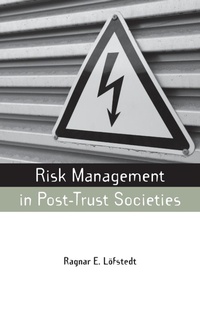
Risk Management in Post-Trust Societies
1st Edition
Published on 16. December 2008
Book
Paperback/Softback
192 pages
978-1-84407-702-1 (ISBN)
Description
A thought-provoking and invaluable book for anyone who cares about risk communication and management in the 21st century - Anna Jung, Director General, European Food Information Council
Professor Ragnar Loefstedt has once again produced a most interesting book on risk management and trust, well-based on theory and built on empirical findings - Mikael Karlsson, President, Swedish Society for Nature Conservation
Highlights the difficult balancing task facing risk regulators. Regulatory inaction against real risks can undermine public trust. However, exaggerated responses to risks can also jeopardize regulators' credibility. The diverse international case studies developed by Ragnar Loefstedt provide guidance for how regulators can navigate these and other frequently competing concerns - W. Kip Viscusi, Cogan Professor of Law and Economics, Harvard University, USA
In democracies, government policies cannot succeed without public acceptance. Yet complex risk management requires technical expertise. How to reconcile these competing needs? Ragnar Loefstedt provocatively challenges recent research claiming that risk managers must engender public trust via deliberative dialogue. He uses four case studies to argue that the reasons for distrust vary and demand different responses; that in some cases trust can flow from technical competence without public deliberation; and that in others public deliberation can actually aggravate distrust. Trust me: Loefstedt's book will add spice to the debate over risk, experts, the public, and trust - Jonathan B. Wiener, Perkins Professor of Law and Environmental Policy, Duke University, USA
We live in "post-trust" societies, in which public confidence in governments and corporations over health, food, and environmental risk is eroding rapidly. Good risk communication can help companies, governments, and institutions minimize disputes, resolve issues, and anticipate problems. Without such communication, the best policies can become derailed and trust can be lost. Most policymakers still use outdated methods to communicate policies and achieve their objectives-methods developed before public trust in industry and government was affected by health scares such as BSE, genetically modified organisms, and dioxins in Belgian chicken. This book provides effective methods for managing and communicating risk effectively in contemporary societies.
Professor Ragnar Loefstedt has once again produced a most interesting book on risk management and trust, well-based on theory and built on empirical findings - Mikael Karlsson, President, Swedish Society for Nature Conservation
Highlights the difficult balancing task facing risk regulators. Regulatory inaction against real risks can undermine public trust. However, exaggerated responses to risks can also jeopardize regulators' credibility. The diverse international case studies developed by Ragnar Loefstedt provide guidance for how regulators can navigate these and other frequently competing concerns - W. Kip Viscusi, Cogan Professor of Law and Economics, Harvard University, USA
In democracies, government policies cannot succeed without public acceptance. Yet complex risk management requires technical expertise. How to reconcile these competing needs? Ragnar Loefstedt provocatively challenges recent research claiming that risk managers must engender public trust via deliberative dialogue. He uses four case studies to argue that the reasons for distrust vary and demand different responses; that in some cases trust can flow from technical competence without public deliberation; and that in others public deliberation can actually aggravate distrust. Trust me: Loefstedt's book will add spice to the debate over risk, experts, the public, and trust - Jonathan B. Wiener, Perkins Professor of Law and Environmental Policy, Duke University, USA
We live in "post-trust" societies, in which public confidence in governments and corporations over health, food, and environmental risk is eroding rapidly. Good risk communication can help companies, governments, and institutions minimize disputes, resolve issues, and anticipate problems. Without such communication, the best policies can become derailed and trust can be lost. Most policymakers still use outdated methods to communicate policies and achieve their objectives-methods developed before public trust in industry and government was affected by health scares such as BSE, genetically modified organisms, and dioxins in Belgian chicken. This book provides effective methods for managing and communicating risk effectively in contemporary societies.
Reviews / Votes
'Stimulation to reflection and provocation to reconsider beliefs and prejudices are needed in any part of science. Risk Management in Post-Trust Societies has those qualities and I therefore recommend it to both scientists and professionals interested in risk communication.'Tomasberg, Associate Professor, University of Kalmar, Sweden, in Risk Analysis
More details
Series
Language
English
Place of publication
London
United Kingdom
Publishing group
Taylor & Francis Ltd
Target group
College/higher education
Professional and scholarly
Dimensions
Height: 216 mm
Width: 140 mm
Thickness: 11 mm
Weight
249 gr
ISBN-13
978-1-84407-702-1 (9781844077021)
Copyright in bibliographic data and cover images is held by Nielsen Book Services Limited or by the publishers or by their respective licensors: all rights reserved.
Schweitzer Classification
Other editions
Additional editions
Ragnar E. Lofstedt
Risk Management in Post-Trust Societies
Book
08/2017
1st Edition
Routledge
€297.12
Shipment within 10-20 days
Ragnar E. Lofstedt
Risk Management in Post-Trust Societies
E-Book
05/2012
1st Edition
Routledge
€52.49
Available for download
Ragnar E. Lofstedt
Risk Management in Post-Trust Societies
E-Book
05/2012
1st Edition
Routledge
€52.49
Available for download
Person
Ragnar E. Loefstedt PhD is a Professor in Risk Management and the Director of the Centre for Risk Management, Department of Geography, School of Social Science and Public Policy, Kings College London. He is a renowned expert on risk communication and regulation issues.
Content
Foreword by George Cvetkovich
Preface to the Paperback Edition
Preface to the Hardback Edition
1. Introduction and Overview
2. A Review of the Four Risk Management Strategies
3. Germany and the Waste Incinerator in the North Black Forest
4. Risk Management in the United States: The Case of International Paper's Hydro-Dam Re-Licensing Procedure
5. Sweden: Barseb ck, Risk Management and Trust
6. Risk Management in the UK: The Case of Brent Spar
7. Conclusions: Integrating Trust into Risk Management
Index
Preface to the Paperback Edition
Preface to the Hardback Edition
1. Introduction and Overview
2. A Review of the Four Risk Management Strategies
3. Germany and the Waste Incinerator in the North Black Forest
4. Risk Management in the United States: The Case of International Paper's Hydro-Dam Re-Licensing Procedure
5. Sweden: Barseb ck, Risk Management and Trust
6. Risk Management in the UK: The Case of Brent Spar
7. Conclusions: Integrating Trust into Risk Management
Index