

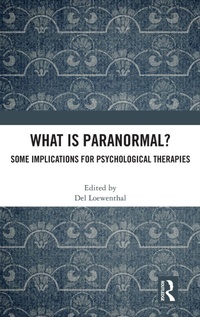
What is Paranormal?
Some Implications for Psychological Therapies
1st Edition
Published on 18. November 2021
Book
Hardback
106 pages
978-1-032-03559-8 (ISBN)
Description
"A layman will no doubt find it hard to understand how pathological disorders of the body and mind can be eliminated by 'mere' words. He will feel that he is being asked to believe in magic. And he will not be so very wrong for the words which we use in our everyday speech are nothing more than watered down magic." (Freud)
This book provides further developments of such ideas, including Freud's uncanny, Jung's synchronicity, Daniels' transpersonal, Clarke's mindfulness and Sollod's anomalous experiences. The paranormal could be seen as being fundamental to the psychological therapies. Occasionally a writer brings this potential to our attention but questions of science, evidence-based practice, etc. continue to dominate. Yet does this continue to lead to 'what's denied running even more wild'? Further, might the lessening of the paranormal be primarily what is lost, the aura, through the increase in internet therapy?
The question of the paranormal and the psychological therapies continues to persist, not only for psychoanalysis but the psychological therapies in general. This book attempts to address that.
The chapters in this book, apart from a new introduction and a new chapter, were originally published in the European Journal of Psychotherapy and Counselling.
This book provides further developments of such ideas, including Freud's uncanny, Jung's synchronicity, Daniels' transpersonal, Clarke's mindfulness and Sollod's anomalous experiences. The paranormal could be seen as being fundamental to the psychological therapies. Occasionally a writer brings this potential to our attention but questions of science, evidence-based practice, etc. continue to dominate. Yet does this continue to lead to 'what's denied running even more wild'? Further, might the lessening of the paranormal be primarily what is lost, the aura, through the increase in internet therapy?
The question of the paranormal and the psychological therapies continues to persist, not only for psychoanalysis but the psychological therapies in general. This book attempts to address that.
The chapters in this book, apart from a new introduction and a new chapter, were originally published in the European Journal of Psychotherapy and Counselling.
More details
Language
English
Place of publication
London
United Kingdom
Publishing group
Taylor & Francis Ltd
Target group
College/higher education
Postgraduate, Undergraduate Advanced, and Undergraduate Core
Dimensions
Height: 240 mm
Width: 161 mm
Thickness: 11 mm
Weight
350 gr
ISBN-13
978-1-032-03559-8 (9781032035598)
Copyright in bibliographic data and cover images is held by Nielsen Book Services Limited or by the publishers or by their respective licensors: all rights reserved.
Schweitzer Classification
Other editions
Additional editions
Book
09/2023
1st Edition
Routledge
€62.40
Shipment within 10-20 days
E-Book
11/2021
1st Edition
Routledge
€55.49
Available for download
E-Book
11/2021
1st Edition
Routledge
€55.49
Available for download
Person
Del Loewenthal is Emeritus Professor of Psychotherapy and Counselling at the University of Roehampton and is Chair of the Southern Association for Psychotherapy and Counselling (SAFPAC), London, UK. He is an existential-analytic psychotherapist and chartered psychologist, with a particular interest in phenomenology. His books include Existential Psychotherapy and Counselling after Postmodernism (2017). www.delloewenthal.com; www.safpac.co.uk.
Content
1. Are you afraid of the dark? Notes on the psychology of belief in histories of science and the occult 2. 'They daren't tell people': therapists' experiences of working with people who report anomalous experiences 3. The paranormal as an unhelpful concept in psychotherapy and counselling research 4. Phantom narratives and the uncanny in cultural life: psychic presences and their shadows 5. Engaging the anomalous: reflections from the anthropology of the paranormal 6. The client, the therapist and the paranormal: a response 7. The magic of the relational