

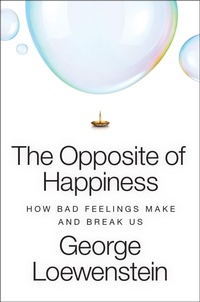
The Opposite of Happiness
How Bad Feelings Make and Break Us
Will be published approx. on 24. September 2026
Book
Hardback
320 pages
978-0-00-875640-6 (ISBN)
Description
'When you finish, you'll know yourself better, you'll understand the people you care about better' ANGELA DUCKWORTH, author of Grit
'Teeming with wisdom, insight, empathy, and sparkle. One of the best books I have ever read' CASS R. SUSNSTEIN, co-author of Noise
A founding father of behavioural economics reveals the hidden logic of negative emotions with a clarity and humour that make our worst feelings strangely easier to bear.
Every age has its illusions. Ours is that happiness is the natural human condition. Behavioural economist George Loewenstein argues the opposite: that our lives are inextricably shaped by the darker emotions we spend so much time trying to avoid.
In The Opposite of Happiness, he draws on decades of influential research-as well as insights from literature and from his own life experiences-to offer a tour de force reexamination of the role negative emotions play in our lives: why pain is stickier than pleasure, how the modern world makes bad feelings worse, and why our attempts to escape misery usually only sharpen its sting. Those who struggle to find and sustain happiness are not unlucky or flawed, he argues, but merely human, suffering the slings and arrows of an inherently negative nature. This knowledge comes, however, not as a bitter pill but as much-needed solace for anyone navigating the frustrations and heartbreaks of modern life.
In this fascinating deconstruction of negative emotions and their behavioral consequences, Loewenstein explains how features of our mind, like memory, attention, and self-esteem, conspire to keep us down. He reveals the downside of supposedly uplifting feelings like hope, and untangles misery's intertwined forms: guilt and shame, jealousy and envy, loneliness and depression, impatience, boredom, and regret. Drawing from a first-of-its-kind Misery Survey, Loewenstein shares participants' stories about, and insights into, the diversity of negative emotions that collectively weigh us down.
Providing a provocative and refreshing counter argument to the self-help industry, The Opposite of Happiness shares a sobering, deeply human, and ultimately comforting truth: The sooner we understand our negative natures, the sooner we will stop feeling guilty about failing to achieve lasting bliss, and the better connected we will be to others who share the same, or their own unique mix of, negative emotions.
'Teeming with wisdom, insight, empathy, and sparkle. One of the best books I have ever read' CASS R. SUSNSTEIN, co-author of Noise
A founding father of behavioural economics reveals the hidden logic of negative emotions with a clarity and humour that make our worst feelings strangely easier to bear.
Every age has its illusions. Ours is that happiness is the natural human condition. Behavioural economist George Loewenstein argues the opposite: that our lives are inextricably shaped by the darker emotions we spend so much time trying to avoid.
In The Opposite of Happiness, he draws on decades of influential research-as well as insights from literature and from his own life experiences-to offer a tour de force reexamination of the role negative emotions play in our lives: why pain is stickier than pleasure, how the modern world makes bad feelings worse, and why our attempts to escape misery usually only sharpen its sting. Those who struggle to find and sustain happiness are not unlucky or flawed, he argues, but merely human, suffering the slings and arrows of an inherently negative nature. This knowledge comes, however, not as a bitter pill but as much-needed solace for anyone navigating the frustrations and heartbreaks of modern life.
In this fascinating deconstruction of negative emotions and their behavioral consequences, Loewenstein explains how features of our mind, like memory, attention, and self-esteem, conspire to keep us down. He reveals the downside of supposedly uplifting feelings like hope, and untangles misery's intertwined forms: guilt and shame, jealousy and envy, loneliness and depression, impatience, boredom, and regret. Drawing from a first-of-its-kind Misery Survey, Loewenstein shares participants' stories about, and insights into, the diversity of negative emotions that collectively weigh us down.
Providing a provocative and refreshing counter argument to the self-help industry, The Opposite of Happiness shares a sobering, deeply human, and ultimately comforting truth: The sooner we understand our negative natures, the sooner we will stop feeling guilty about failing to achieve lasting bliss, and the better connected we will be to others who share the same, or their own unique mix of, negative emotions.
Reviews / Votes
'A magnificent achievement. It's all about misery and suffering, but it elevates the spirit. It's teeming with wisdom, insight, empathy, and sparkle. One of the best books I have ever read' Cass R. Sunstein, Robert Walmsley University professor and author of Manipulation 'This is a book with no happy ending, stories that will gut you, and the sober thesis that to live is to suffer. Read it anyway. You'll be happy you did. Why? Because this brilliantly crafted book explains - in the deepest and most satisfying way possible - why we're consigned to experience sadness, anxiety, fear, loneliness, and other flavors of misery. When you finish, you'll know yourself better, you'll understand the people you care about better, and you'll feel like you're on a first-name basis with this book's genius author, George Loewenstein, the leading scholar in how emotions shape our every decision' Angela Duckworth, New York Times bestselling author of Grit 'While this book is not about happiness, it belongs on every shelf devoted to it. George Loewenstein brings the full apparatus of behavioral economics to bear on the darker half of the emotional spectrum - empathy gaps, feedback loops, spirals of shame - and makes it all feel not just lucid but deeply humane, the rare book that leaves you feeling less alone in what you carry. A must-read for anyone who wants to understand the full breadth of the human experience. The Opposite of Happiness refuses to promise that it can fix you, which may be why, by the last page, it so nearly does' Max Bennett, author of A Brief History of Intelligence 'Who would have thought that a book about suffering would be so much fun to read? ... a clever, insightful, and often personal tour of the worst parts of life. Filled with genuinely surprising insights, The Opposite of Happiness is a brilliant, humane, and unexpectedly delightful book about the many varieties of human misery' Paul Bloom, author of PsychMore details
Language
English
Place of publication
London
United Kingdom
Publishing group
HarperCollins Publishers
Product notice
Laminated cover
Dimensions
Height: 240 mm
Width: 159 mm
Thickness: 14 mm
Weight
270 gr
ISBN-13
978-0-00-875640-6 (9780008756406)
Copyright in bibliographic data and cover images is held by Nielsen Book Services Limited or by the publishers or by their respective licensors: all rights reserved.
Schweitzer Classification
Other editions
Additional editions

E-Book
approx. 09/2026
William Collins
€15.49
Not yet available
Book
approx. 09/2026
William Collins
€21.50
Not yet published
Person
George Loewenstein is the Herbert A. Simon University Professor of Economics and Psychology at Carnegie Mellon University. He is a past president of the Society of Judgment and Decision Making and a Fellow of the American Academy of Arts and Sciences. He has served on multiple National Academy of Science and Institute of Medicine Panels and advised numerous governmental organizations, including the National Institutes of Health and the UK's Behavioural Insights Team. Loewenstein grew up in the Boston suburbs and received his PhD from Yale University. He lives in Pittsburgh with his wife, Donna Harsch, a professor of history at Carnegie Mellon.