

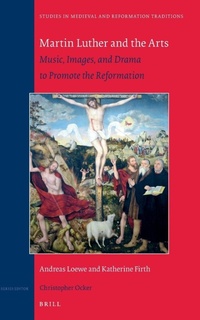
Martin Luther and the Arts
Music, Images, and Drama to Promote the Reformation
Published on 24. November 2022
Book
Hardback
296 pages
978-90-04-52742-3 (ISBN)
Description
Martin Luther was the architect and engineer of the Protestant Reformation, which transformed Germany five hundred years ago. In Martin Luther and the Arts, Andreas Loewe and Katherine Firth elucidate Luther's theory and practice, demonstrating the breadth, flexibility and rigour of Luther's use of the arts to reach audiences and convince them of his Reformation message using a range of strategies, including music, images and drama alongside sermons, polemical tracts, and his new translation of the Bible into German.
Extensively based on German and English sources, including often neglected aspects of Luther's own writings, Loewe and Firth offer a valuable survey for theologians, historians, art historians, musicologists and literary studies scholars interested in interdisciplinary comparisons of Luther's work across the arts.
Extensively based on German and English sources, including often neglected aspects of Luther's own writings, Loewe and Firth offer a valuable survey for theologians, historians, art historians, musicologists and literary studies scholars interested in interdisciplinary comparisons of Luther's work across the arts.
More details
Series
Language
English
Place of publication
Leiden
Netherlands
Target group
Professional and scholarly
Product notice
sewn/stitched
Cloth over boards
Dimensions
Height: 234 mm
Width: 155 mm
Thickness: 18 mm
Weight
585 gr
ISBN-13
978-90-04-52742-3 (9789004527423)
Copyright in bibliographic data and cover images is held by Nielsen Book Services Limited or by the publishers or by their respective licensors: all rights reserved.
Schweitzer Classification
Persons
Andreas Loewe, Ph.D (Cantab, 2001), is Dean of Melbourne, and Fellow of the Conservatorium of Music, the University of Melbourne. Publications include Johann Sebastian Bach's St John Passion (Brill, 2014) and Richard Smyth and the Language of Orthodoxy (Brill, 2003).
Katherine Firth, Ph.D. (Oxford Brookes, 2009), manages the academic programs at International House, the University of Melbourne. Recent publications include Your PhD Survival Guide (Routledge, 2021) and How to Fix your Academic Writing Trouble (Open UP, 2018).
Katherine Firth, Ph.D. (Oxford Brookes, 2009), manages the academic programs at International House, the University of Melbourne. Recent publications include Your PhD Survival Guide (Routledge, 2021) and How to Fix your Academic Writing Trouble (Open UP, 2018).
Content
Acknowledgements
List of Illustrations
Abbreviations
Introduction
?1?Structure and Scope of This Book
1 Luther's Theory of Music
?1?Music among the Seven Liberal Arts
?2?Sources for Luther's Theory of Music
?3?Luther's Theory of Music
?4?The Origins of Music
?5?Music as a 'Habitus' and Model of Goodness and Praise
2 Hymns and Sacred Songs
?1?Singing, Preaching, and Praising God through Music
?2?Lutherans, Music, and the Reformation
?3?Lutheran Music in the Second Half of the Sixteenth Century
?4?Lutheran 'Kantoreien' as Instruments of Reform
3 Martin Luther's 'Mighty Fortress'
?1?Genesis and Dissemination
?2?Reception from 1600 to 1945
?3?A Hymn of Confidence in God's Eternal Salvation
4 Martin Luther on Images
?1?Radical Reforms in Wittenberg
?2?Luther's Understanding of Images
?3?Reading 'Law and Grace': A Composite 'Merkbild' (Image of Remembrance)
5 Teaching the Reformation to Read Images of Hate
?1?Luther's Adversarial Images
?2?Later Reception of Luther's Anti-Semitic Polemic
6 Luther and Drama
?1?Martin Luther and Popular Pre-Reformation Drama
?2?Luther's Objections to Popular Drama and Ceremonies
?3?Lutheran Biblical Drama
?4?Joachim Greff and Popular Drama
?5?Dramatising the Bible
?6?Towards a Protestant Dramatisation of the Passion
?7?Performing the Passion and Resurrection
?8?In Defence of Passion Drama
?9?A Matter of Church Polity
Conclusion
Appendix 1: Luther's Prefaces to the 'Symphoniae Iucundae'
Appendix 2: Comparing 'Law and Grace' (1529-1550)
Bibliography
Index
List of Illustrations
Abbreviations
Introduction
?1?Structure and Scope of This Book
1 Luther's Theory of Music
?1?Music among the Seven Liberal Arts
?2?Sources for Luther's Theory of Music
?3?Luther's Theory of Music
?4?The Origins of Music
?5?Music as a 'Habitus' and Model of Goodness and Praise
2 Hymns and Sacred Songs
?1?Singing, Preaching, and Praising God through Music
?2?Lutherans, Music, and the Reformation
?3?Lutheran Music in the Second Half of the Sixteenth Century
?4?Lutheran 'Kantoreien' as Instruments of Reform
3 Martin Luther's 'Mighty Fortress'
?1?Genesis and Dissemination
?2?Reception from 1600 to 1945
?3?A Hymn of Confidence in God's Eternal Salvation
4 Martin Luther on Images
?1?Radical Reforms in Wittenberg
?2?Luther's Understanding of Images
?3?Reading 'Law and Grace': A Composite 'Merkbild' (Image of Remembrance)
5 Teaching the Reformation to Read Images of Hate
?1?Luther's Adversarial Images
?2?Later Reception of Luther's Anti-Semitic Polemic
6 Luther and Drama
?1?Martin Luther and Popular Pre-Reformation Drama
?2?Luther's Objections to Popular Drama and Ceremonies
?3?Lutheran Biblical Drama
?4?Joachim Greff and Popular Drama
?5?Dramatising the Bible
?6?Towards a Protestant Dramatisation of the Passion
?7?Performing the Passion and Resurrection
?8?In Defence of Passion Drama
?9?A Matter of Church Polity
Conclusion
Appendix 1: Luther's Prefaces to the 'Symphoniae Iucundae'
Appendix 2: Comparing 'Law and Grace' (1529-1550)
Bibliography
Index