

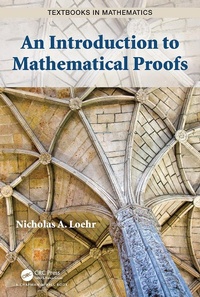
An Introduction to Mathematical Proofs
1st Edition
Published on 21. January 2023
Book
Paperback/Softback
412 pages
978-1-032-47522-6 (ISBN)
Description
An Introduction to Mathematical Proofs presents fundamental material on logic, proof methods, set theory, number theory, relations, functions, cardinality, and the real number system. The text uses a methodical, detailed, and highly structured approach to proof techniques and related topics. No prerequisites are needed beyond high-school algebra.
New material is presented in small chunks that are easy for beginners to digest. The author offers a friendly style without sacrificing mathematical rigor. Ideas are developed through motivating examples, precise definitions, carefully stated theorems, clear proofs, and a continual review of preceding topics.
Features
Study aids including section summaries and over 1100 exercises
Careful coverage of individual proof-writing skills
Proof annotations and structural outlines clarify tricky steps in proofs
Thorough treatment of multiple quantifiers and their role in proofs
Unified explanation of recursive definitions and induction proofs, with applications to greatest common divisors and prime factorizations
About the Author:
Nicholas A. Loehr is an associate professor of mathematics at Virginia Technical University. He has taught at College of William and Mary, United States Naval Academy, and University of Pennsylvania. He has won many teaching awards at three different schools. He has published over 50 journal articles. He also authored three other books for CRC Press, including Combinatorics, Second Edition, and Advanced Linear Algebra.
New material is presented in small chunks that are easy for beginners to digest. The author offers a friendly style without sacrificing mathematical rigor. Ideas are developed through motivating examples, precise definitions, carefully stated theorems, clear proofs, and a continual review of preceding topics.
Features
Study aids including section summaries and over 1100 exercises
Careful coverage of individual proof-writing skills
Proof annotations and structural outlines clarify tricky steps in proofs
Thorough treatment of multiple quantifiers and their role in proofs
Unified explanation of recursive definitions and induction proofs, with applications to greatest common divisors and prime factorizations
About the Author:
Nicholas A. Loehr is an associate professor of mathematics at Virginia Technical University. He has taught at College of William and Mary, United States Naval Academy, and University of Pennsylvania. He has won many teaching awards at three different schools. He has published over 50 journal articles. He also authored three other books for CRC Press, including Combinatorics, Second Edition, and Advanced Linear Algebra.
More details
Series
Language
English
Place of publication
London
United Kingdom
Publishing group
Taylor & Francis Ltd
Target group
College/higher education
Undergraduate
Product notice
Paperback (trade)
Unsewn / adhesive bound
Illustrations
67 s/w Abbildungen
67 Illustrations, black and white
Dimensions
Height: 253 mm
Width: 176 mm
Thickness: 21 mm
Weight
722 gr
ISBN-13
978-1-032-47522-6 (9781032475226)
Copyright in bibliographic data and cover images is held by Nielsen Book Services Limited or by the publishers or by their respective licensors: all rights reserved.
Schweitzer Classification
Other editions
Additional editions
Nicholas A. Loehr
An Introduction to Mathematical Proofs
E-Book
11/2019
1st Edition
CRC Press
€65.99
Available for download
Nicholas A. Loehr
An Introduction to Mathematical Proofs
E-Book
11/2019
1st Edition
CRC Press
€65.99
Available for download
Nicholas A. Loehr
An Introduction to Mathematical Proofs
Book
10/2019
1st Edition
CRC Press
€145.30
Shipment within 15-20 days
Person
Nicholas A. Loehr is an associate professor of mathematics at Virginia Technical University. He has taught at College of William and Mary, United States Naval Academy, and University of Pennsylvania. He has won many teaching awards at three different schools. He has published over 50 journal articles. He also authored three other books for CRC Press, including Combinatorics, Second Edition, and Advanced Linear Algebra.
Content
Logic
Propositions; Logical Connectives; Truth Tables
Logical Equivalence; IF-Statements
IF, IFF, Tautologies, and Contradictions
Tautologies; Quantifiers; Universes
Properties of Quantifiers: Useful Denials
Denial Practice; Uniqueness
Proofs
Definitions, Axioms, Theorems, and Proofs
Proving Existence Statements and IF Statements
Contrapositive Proofs; IFF Proofs
Proofs by Contradiction; OR Proofs
Proof by Cases; Disproofs
Proving Universal Statements; Multiple Quantifiers
More Quantifier Properties and Proofs (Optional)
Sets
Set Operations; Subset Proofs
More Subset Proofs; Set Equality Proofs
More Set Quality Proofs; Circle Proofs; Chain Proofs
Small Sets; Power Sets; Contrasting ? and ?
Ordered Pairs; Product Sets
General Unions and Intersections
Axiomatic Set Theory (Optional)
Integers
Recursive Definitions; Proofs by Induction
Induction Starting Anywhere: Backwards Induction
Strong Induction
Prime Numbers; Division with Remainder
Greatest Common Divisors; Euclid's GCD Algorithm
More on GCDs; Uniqueness of Prime Factorizations
Consequences of Prime Factorization (Optional)
Relations and Functions
Relations; Images of Sets under Relations
Inverses, Identity, and Composition of Relations
Properties of Relations
Definition of Functions
Examples of Functions; Proving Equality of Functions
Composition, Restriction, and Gluing
Direct Images and Preimages
Injective, Surjective, and Bijective Functions
Inverse Functions
Equivalence Relations and Partial Orders
Reflexive, Symmetric, and Transitive Relations
Equivalence Relations
Equivalence Classes
Set Partitions
Partially Ordered Sets
Equivalence Relations and Algebraic Structures (Optional)
Cardinality
Finite Sets
Countably Infinite Sets
Countable Sets
Uncountable Sets
Real Numbers (Optional)
Axioms for R; Properties of Addition
Algebraic Properties of Real Numbers
Natural Numbers, Integers, and Rational Numbers
Ordering, Absolute Value, and Distance
Greatest Elements, Least Upper Bounds, and Completeness
Suggestions for Further Reading
Propositions; Logical Connectives; Truth Tables
Logical Equivalence; IF-Statements
IF, IFF, Tautologies, and Contradictions
Tautologies; Quantifiers; Universes
Properties of Quantifiers: Useful Denials
Denial Practice; Uniqueness
Proofs
Definitions, Axioms, Theorems, and Proofs
Proving Existence Statements and IF Statements
Contrapositive Proofs; IFF Proofs
Proofs by Contradiction; OR Proofs
Proof by Cases; Disproofs
Proving Universal Statements; Multiple Quantifiers
More Quantifier Properties and Proofs (Optional)
Sets
Set Operations; Subset Proofs
More Subset Proofs; Set Equality Proofs
More Set Quality Proofs; Circle Proofs; Chain Proofs
Small Sets; Power Sets; Contrasting ? and ?
Ordered Pairs; Product Sets
General Unions and Intersections
Axiomatic Set Theory (Optional)
Integers
Recursive Definitions; Proofs by Induction
Induction Starting Anywhere: Backwards Induction
Strong Induction
Prime Numbers; Division with Remainder
Greatest Common Divisors; Euclid's GCD Algorithm
More on GCDs; Uniqueness of Prime Factorizations
Consequences of Prime Factorization (Optional)
Relations and Functions
Relations; Images of Sets under Relations
Inverses, Identity, and Composition of Relations
Properties of Relations
Definition of Functions
Examples of Functions; Proving Equality of Functions
Composition, Restriction, and Gluing
Direct Images and Preimages
Injective, Surjective, and Bijective Functions
Inverse Functions
Equivalence Relations and Partial Orders
Reflexive, Symmetric, and Transitive Relations
Equivalence Relations
Equivalence Classes
Set Partitions
Partially Ordered Sets
Equivalence Relations and Algebraic Structures (Optional)
Cardinality
Finite Sets
Countably Infinite Sets
Countable Sets
Uncountable Sets
Real Numbers (Optional)
Axioms for R; Properties of Addition
Algebraic Properties of Real Numbers
Natural Numbers, Integers, and Rational Numbers
Ordering, Absolute Value, and Distance
Greatest Elements, Least Upper Bounds, and Completeness
Suggestions for Further Reading