

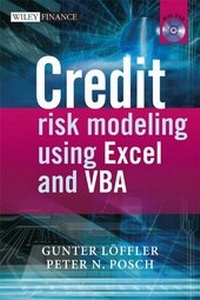
Credit Risk Modeling using Excel and VBA
with DVD
1st Edition
Published on 4. April 2007
Book
Hardback
280 pages
978-0-470-03157-5 (ISBN)
Description
This book provides practitioners and students with an intuitive, hands-on introduction to modern credit risk modeling. A typical chapter starts with an approachable presentation of the methodology. Step by step, the authors then show how to implement the methods in Excel and Visual Basic for Applications. Focusing on risk management issues, the book covers default probability estimation (scoring, structural models, and transition matrices), correlation and portfolio analysis, validation, as well as credit default swaps and structured finance. Several appendices and videos increase ease of access.
The authors present a host of applications - many of which go beyond standard Excel or VBA usages. For example, they show how to estimate logit models with maximum likelihood, or how to conduct large-scale Monte Carlo simulations in little time. Even to experienced modelers the book can serve as a toolbox and source of inspiration.
"In one place, Löffler and Posch provide all that is needed to install state-of-the-art risk management system, including a broad understanding of different risk management frameworks, detailed estimation techniques for deriving PD, LGD, and correlation parameters, and programing tools for putting these methods into practice."
--Richard Cantor, Managing Director, Credit Policy Research, Moody's Investors Service
"I read this book cover-to-cover and recommend it heartily. For each topic, there is straightforward explanation, practical examples, and implementable coding. This book would have saved me months of effort many times over with its full 'toolset' of Excel/VBA code. I have immediate plans to reread sections and incorporate sections of code into my own spreadsheets."
--Greg M. Gupton, Fitch Ratings & DefaultRisk.com
The authors present a host of applications - many of which go beyond standard Excel or VBA usages. For example, they show how to estimate logit models with maximum likelihood, or how to conduct large-scale Monte Carlo simulations in little time. Even to experienced modelers the book can serve as a toolbox and source of inspiration.
"In one place, Löffler and Posch provide all that is needed to install state-of-the-art risk management system, including a broad understanding of different risk management frameworks, detailed estimation techniques for deriving PD, LGD, and correlation parameters, and programing tools for putting these methods into practice."
--Richard Cantor, Managing Director, Credit Policy Research, Moody's Investors Service
"I read this book cover-to-cover and recommend it heartily. For each topic, there is straightforward explanation, practical examples, and implementable coding. This book would have saved me months of effort many times over with its full 'toolset' of Excel/VBA code. I have immediate plans to reread sections and incorporate sections of code into my own spreadsheets."
--Greg M. Gupton, Fitch Ratings & DefaultRisk.com
More details
Series
Edition
1., Auflage
Language
English
Place of publication
Chichester
United Kingdom
Publishing group
John Wiley and Sons Ltd
Target group
Professional and scholarly
Illustrations
Illustrations
Dimensions
Height: 24.4 cm
Width: 16.8 cm
Thickness: 21 mm
Weight
710 gr
ISBN-13
978-0-470-03157-5 (9780470031575)
Schweitzer Classification
Other editions
New editions
Gunter Löeffler | Peter N. Posch
Credit Risk Modeling using Excel and VBA
Book
12/2010
2nd Edition
Wiley
€109.50
Shipment within 10-20 days
Additional editions
Gunter Löeffler | Peter N. Posch
Credit Risk Modeling using Excel and VBA
E-Book
04/2007
Wiley
€56.99
Available for download
Persons
GUNTER LÖFFLER is professor of finance at the University of Ulm in Germany. His current research interests are on credit risk and empirical finance. Previously, Gunter was assistant professor at Goethe University Frankfurt, and served as an internal consultant in the asset management division of Commerzbank. His Ph.D. in finance is from the University of Mannheim. Gunter has studied at Heidelberg and Cambridge Universities.
PETER N. POSCH is PhD student in finance at the chair of Gunter Löffler. His current research focus is on credit risk and financial econometrics. Peter studied philosophy and economics and holds a Diplom, M.Sc. equivalent, in economics from the University of Bonn.
PETER N. POSCH is PhD student in finance at the chair of Gunter Löffler. His current research focus is on credit risk and financial econometrics. Peter studied philosophy and economics and holds a Diplom, M.Sc. equivalent, in economics from the University of Bonn.
Content
Preface.
Some Hints for Troubleshooting.
1 Estimating Credit Scores with Logit.
2 The Structural Approach to Default Prediction and Valuation.
3 Transition Matrices.
4 Prediction of Default and Transition Rates.
5 Modeling and Estimating Default Correlations with the Asset Value Approach.
6 Measuring Credit Portfolio Risk with the Asset Value Approach.
7 Validation of Rating Systems.
8 Validation of Credit Portfolio Models.
9 Risk-Neutral Default Probabilities and Credit Default Swaps.
10 Risk Analysis of Structured Credit: CDOs and First-to-Default Swaps.
11 Basel II and Internal Ratings.
Appendix A1 Visual Basics for Applications (VBA).
Appendix A2 Solver.
Appendix A3 Maximum Likelihood Estimation and Newton's Method.
Appendix A4 Testing and Goodness of Fit.
Appendix A5 User-Defined Functions.
Index.
Some Hints for Troubleshooting.
1 Estimating Credit Scores with Logit.
2 The Structural Approach to Default Prediction and Valuation.
3 Transition Matrices.
4 Prediction of Default and Transition Rates.
5 Modeling and Estimating Default Correlations with the Asset Value Approach.
6 Measuring Credit Portfolio Risk with the Asset Value Approach.
7 Validation of Rating Systems.
8 Validation of Credit Portfolio Models.
9 Risk-Neutral Default Probabilities and Credit Default Swaps.
10 Risk Analysis of Structured Credit: CDOs and First-to-Default Swaps.
11 Basel II and Internal Ratings.
Appendix A1 Visual Basics for Applications (VBA).
Appendix A2 Solver.
Appendix A3 Maximum Likelihood Estimation and Newton's Method.
Appendix A4 Testing and Goodness of Fit.
Appendix A5 User-Defined Functions.
Index.