

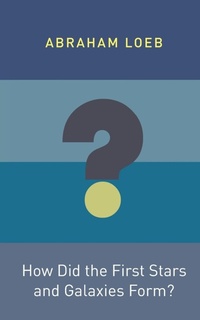
How Did the First Stars and Galaxies Form?
Published on 8. August 2010
Book
Paperback/Softback
216 pages
978-0-691-14516-7 (ISBN)
Description
Though astrophysicists have developed a theoretical framework for understanding how the first stars and galaxies formed, only now are we able to begin testing those theories with actual observations of the very distant, early universe. We are entering a new and exciting era of discovery that will advance the frontiers of knowledge, and this book couldn't be more timely. It covers all the basic concepts in cosmology, drawing on insights from an astronomer who has pioneered much of this research over the past two decades. Abraham Loeb starts from first principles, tracing the theoretical foundations of cosmology and carefully explaining the physics behind them. Topics include the gravitational growth of perturbations in an expanding universe, the abundance and properties of dark matter halos and galaxies, reionization, the observational methods used to detect the earliest galaxies and probe the diffuse gas between them--and much more. Cosmology seeks to solve the fundamental mystery of our cosmic origins. This book offers a succinct and accessible primer at a time when breathtaking technological advances promise a wealth of new observational data on the first stars and galaxies.
* Provides a concise introduction to cosmology * Covers all the basic concepts * Gives an overview of the gravitational growth of perturbations in an expanding universe * Explains the process of reionization * Describes the observational methods used to detect the earliest galaxies
* Provides a concise introduction to cosmology * Covers all the basic concepts * Gives an overview of the gravitational growth of perturbations in an expanding universe * Explains the process of reionization * Describes the observational methods used to detect the earliest galaxies
Reviews / Votes
Winner of the 2012 Chambliss Astronomical Writing Award, American Astronomical Society "[E]ngaging, fast-paced... Loeb's infectious excitement stirs desire to join him in these endeavors... [R]eaders will find How Did the First Stars and Galaxies Form? a lucid introduction to an exciting research field that is set to flourish in the next decades."--Science "Hands up everyone who can answer the question Loeb poses in the title of his small but sprightly book. No, not just the basics: big bang, cosmic inflation, lights, camera, action. Me neither. Harvard University astrophysicist and cosmologist Abraham Loeb can, and he does in this latest installment of the Princeton Frontiers in Physics series. While the book targets potential cosmologists and scientists, general readers will enjoy the non-technical chapters."--Australian "Anyone interested in an introduction to this dramatic story, be they academic or educated nonprofessional, would do well to start with Loeb's book. It contains only the most important equations in the field, and its general level of mathematical sophistication is compatible with introductory courses in calculus or mathematical physics. This small book is a gem belonging to an almost extinct genre: intermediate-level monographs that are both accessible to educated non-specialists in the field and tightly focused on a problem."--Milan M. Cirkovic, American Journal of Physics "Loeb, a leading theoretical cosmologist, has written a lucid account of the relevant physics, beginning with a brief review of cosmological models based on Einstein's general relativity equations."--ChoiceMore details
Series
Language
English
Place of publication
New Jersey
United States
Target group
College/higher education
Professional and scholarly
Product notice
Paperback (trade)
Illustrations
14 halftones. 17 line illus.
Dimensions
Height: 203 mm
Width: 127 mm
Thickness: 12 mm
Weight
231 gr
ISBN-13
978-0-691-14516-7 (9780691145167)
Copyright in bibliographic data and cover images is held by Nielsen Book Services Limited or by the publishers or by their respective licensors: all rights reserved.
Schweitzer Classification
Other editions
Additional editions
Abraham Loeb
How Did the First Stars and Galaxies Form?
Book
08/2010
Princeton University Press
€76.75
Article exhausted; check different version
Abraham Loeb
How Did the First Stars and Galaxies Form?
E-Book
07/2010
1st Edition
Princeton University Press
from
€35.89
Available for download
Person
Abraham Loeb is professor of astronomy and director of the Institute for Theory and Computation at Harvard University.
Content
PREFACE xi Chapter 1: Prologue: The Big Picture 1 1.1 In the Beginning 1 1.2 Observing the Story of Genesis 2 1.3 Practical Benefits from the Big Picture 5 Chapter 2: Standard Cosmological Model 8 2.1 Cosmic Perspective 8 2.2 Past and Future of Our Universe 11 2.3 Gravitational Instability 15 2.4 Geometry of Space 16 2.5 Cosmic Archaeology 18 2.6 Milestones in Cosmic Evolution 23 2.7 Most Matter Is Dark 30 Chapter 3: The First Gas Clouds 35 3.1 Growing the Seed Fluctuations 36 3.2 The Smallest Gas Condensations 43 3.3 Spherical Collapse and Halo Properties 45 3.4 Abundance of Dark Matter Halos 50 3.5 Cooling and Chemistry 59 3.6 Sheets, Filaments, and Only Then, Galaxies 61 Chapter 4: The First Stars and Black Holes 64 4.1 Metal-Free Stars 65 4.2 Properties of the First Stars 74 4.3 The First Black Holes and Quasars 78 4.4 Gamma-Ray Bursts: The Brightest Explosions 89 Chapter 5: The Reionization of Cosmic Hydrogen by the First Galaxies 95 5.1 Ionization Scars by the First Stars 95 5.2 Propagation of Ionization Fronts 98 5.3 Swiss Cheese Topology 111 Chapter 6: Observing the First Galaxies 116 6.1 Theories and Observations 116 6.2 Completing Our Photo Album of the Universe 117 6.3 Cosmic Time Machine 119 6.4 The Hubble Deep Field and Its Follow-Ups 125 6.5 Observing the First Gamma-Ray Bursts 129 6.6 Future Telescopes 133 Chapter 7: Imaging the Diffuse Fog of Cosmic Hydrogen 136 7.1 Hydrogen 136 7.2 The Lyman-? Line 137 7.3 The 21-cm Line 140 7.4 Observing Most of the Observable Volume 156 Chapter 8: Epilogue: From Our Galaxy's Past to Its Future 159 8.1 End of Extragalactic Astronomy 159 8.2 Milky Way + Andromeda = Milkomeda 164 APPENDIX: USEFUL NUMBERS 171 NOTES 173 RECOMMENDED FURTHER READING 181 GLOSSARY 183 INDEX 189