

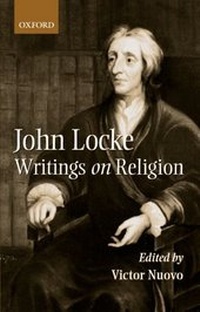
Writings on Religion
Published in April 2002
Book
Hardback
348 pages
978-0-19-924341-9 (ISBN)
Description
This volume brings together a broad selection of John Locke's writings on religion and theology, many of which have never been published before. Locke was a founder and shaper of modern thought and society, and his principal works are among the most influential ever written. Much that he wrote is either about religion or touches on it, which is not surprising, for he lived and worked during a time of heightened religious sensibility. Subjects that today would be considered to have little or no bearing on religion were viewed by him and his contemporaries within a theological frame: the nature of knowledge and belief, the origin of ideas, the nature of language, metaphysical questions concerning substance, personal identity, the relation of mind and body, the foundation of morality, the origin of civil society, toleration. A right understanding of Locke requires that all of his opinions be viewed within this religious frame. Read together, and in context, these writings illustrate the deep and pervasive religious motivation in Locke's thought. They are key texts in intellectual history.
Reviews / Votes
This collection offers a useful source of materials for people interested in discovering Locke's ideas ... while Locke's conclusions may not provide indisputable answers to current problems, his views on the nature of faith and belief still have important contributions to make to the judicious search for them. Nuovo's collection is thus to be welcomed for making more of Locke's materials easily accessible. Journal of Theological Studies This collection will be invaluable in righting a hitherto imbalance in Lockean studies. Contemporary Review The collection is intended to be, and undoubtedly will be, of use to philosophers, theologians and intellectual historians... Moreover, the interest of the book is not restricted to religion and theology, but extends to general, metaphysical questions. Thomas Lennon, Notre Dame Philosophical Reviews [The] wonderful, forty-two page introduction ... is in many respects a model of its kind. Clearly and elegantly, it argues the case for the centrality of religion and theology to Locke's thought, and introduces each of the seven sections in turn, with helpful discussion in footnotes of the relevant bibliography of both primary and secondary sources. Throughout, Locke is depicted as representing an enlightened and universalistic version of Christianity, as opposed to the dogmatism of Rome and Geneva... there is an irresistible civility and decency that carries over from Locke into the introduction that will charm readers of every persuasion. Nor is its charm the introduction's only virtue; it is patently very competent in every respect. Thomas Lennon, Notre Dame Philosophical ReviewsMore details
Language
English
Place of publication
Oxford
United Kingdom
Publishing group
Oxford University Press
Target group
Professional and scholarly
Illustrations
chronology, notes, bibliography, index
Dimensions
Height: 215 mm
Width: 136 mm
ISBN-13
978-0-19-924341-9 (9780199243419)
Copyright in bibliographic data and cover images is held by Nielsen Book Services Limited or by the publishers or by their respective licensors: all rights reserved.
Schweitzer Classification
Content
Preface; Chronology of the Life and Times of John Locke; Introduction; 1. Theology, its sources, and the Pragmatics of Assent; 2. Morality and Religion; 'Of Ethick in General'; 'Ethica 92'; 'Sacerdos 98'; 3. 'Adversaria Theologica 94'; 4. Inspiration, Revelation, Scripture, and Faith; 'Immediate Inspiration'; 'Scriptura Sacra'; A Discourse of Miracles; 'An Essay for the Understanding of St Paul's Epistles by Consulting St Paul himself; 5. The Nature and Authority of the Church; 'Infallibility'; 'Critical Notes Upon Edward Stillingfleet's Mischief and Unreasonableness of Separation - Extracts; 'Ecclesia'; 'Error 98'; 6. The Reasonableness of Christianity; The Reasonableness of Christianity as delivered in the Scriptures; A Vindication of the Reasonableness of Christianity &c; 7. Fall and Redemption; 'Peccatum originale 92'; 'Homo ante et post lapsus'; 'Resurrection et quae sequitur'; 'On the Priesthood of Christ: Analysis of Hebrews'; 'Christianae Religionis Synopsis'; Appendix: A list of theological place in An Essay concerning Human; UNDERSTANDING; Notes, Bibliography, Index