

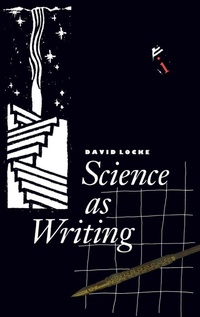
Science as Writing
Will be published approx. on 1. October 1992
Book
Hardback
256 pages
978-0-300-05452-1 (ISBN)
Description
For many years it has been assumed that a great gulf exists between science and the humanities, that the writings of science are simply the record of things scientists do and find and are devoid of literary features. Recently this assumption has been challenged by those who regard science and literature as companion endeavors, working side by side to describe, in their respective ways, the world of human experience. Now David Locke, a professor of literature who has also been a scientist, joins the debate, arguing that scientific language can be highly imaginative, expressive, and self-conscious and demonstrating for the first time how the major modes of literary criticism can be keys to the reading of scientific texts.
Locke takes up in sequence six critical perspectives on reading. These view literary texts as: essentially a representation of the real world; an expression of its author's thoughts and feelings; an activator of response from its readers; a work of art, interesting in its purely formal properties; an artifact situated in a social milieu; or an instrument that brings the world of phenomena into being. Locke applies these perspectives to the reading of a variety of scientific texts, from works by Galileo and Darwin to writings in contemporary molecular biology and theoretical physics. Locke suggests that attention to the literary qualities of scientific discourse will aid in further opening up the literary canon and widening the practice of literary criticism, even as it sharpens science's growing interest in, and understanding of, its own mode of operation.
Locke takes up in sequence six critical perspectives on reading. These view literary texts as: essentially a representation of the real world; an expression of its author's thoughts and feelings; an activator of response from its readers; a work of art, interesting in its purely formal properties; an artifact situated in a social milieu; or an instrument that brings the world of phenomena into being. Locke applies these perspectives to the reading of a variety of scientific texts, from works by Galileo and Darwin to writings in contemporary molecular biology and theoretical physics. Locke suggests that attention to the literary qualities of scientific discourse will aid in further opening up the literary canon and widening the practice of literary criticism, even as it sharpens science's growing interest in, and understanding of, its own mode of operation.
More details
Language
English
Place of publication
United States
Target group
College/higher education
Professional and scholarly
Product notice
Cloth over boards
Dimensions
Height: 241 mm
Width: 161 mm
Thickness: 27 mm
Weight
616 gr
ISBN-13
978-0-300-05452-1 (9780300054521)
Copyright in bibliographic data and cover images is held by Nielsen Book Services Limited or by the publishers or by their respective licensors: all rights reserved.
Schweitzer Classification
Person
David Locke is associate professor of English at the University of Florida. He has been a staff writer for the American Chemical Society News Service as well as an associate editor at the Encyclopaedia Britannica.