

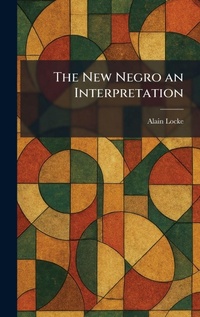
The New Negro an Interpretation
Description
"The New Negro an Intrepretation" is a seminal anthology edited by Alain Locke that serves as the definitive manifesto of the Harlem Renaissance. This foundational work captures a pivotal moment in history when a burgeoning generation of African American artists, writers, and thinkers sought to redefine Black identity through creative excellence and intellectual autonomy. Moving away from historical stereotypes, the volume articulates a vision of the "New Negro" characterized by self-respect, cultural pride, and a renewed sense of social purpose.
The collection features a diverse array of contributions, including groundbreaking poetry, fiction, and essays from influential voices of the era. Through these works, the anthology explores themes of migration, heritage, and the search for social justice, while celebrating the richness of the African American experience. Locke's insightful introductions provide a philosophical framework for the movement, positioning art and literature as essential tools for social transformation. As a landmark of twentieth-century literature, "The New Negro an Intrepretation" remains an indispensable resource for understanding the roots of modern African American culture and the enduring power of the artistic spirit.
This work has been selected by scholars as being culturally important, and is part of the knowledge base of civilization as we know it. This work was reproduced from the original artifact, and remains as true to the original work as possible. Therefore, you may see the original copyright references, library stamps (as most of these works have been housed in our most important libraries around the world), and other notations in the work.
This work is in the public domain in the United States of America, and possibly other nations. Within the United States, you may freely copy and distribute this work, as no entity (individual or corporate) has a copyright on the body of the work.
As a reproduction of a historical artifact, this work may contain missing or blurred pages, poor pictures, errant marks, etc. Scholars believe, and we concur, that this work is important enough to be preserved, reproduced, and made generally available to the public. We appreciate your support of the preservation process, and thank you for being an important part of keeping this knowledge alive and relevant.