

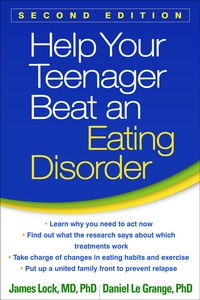
Help Your Teenager Beat an Eating Disorder, Second Edition
2nd Edition
Published on 1. April 2015
Book
Paperback/Softback
310 pages
978-1-4625-1748-0 (ISBN)
Description
This book has been replaced by Help Your Teenager Beat an Eating Disorder, Third Edition, ISBN 978-1-4625-5712-7.
Reviews / Votes
"This book is essential reading for any parent or family member of a teen with an eating disorder. It's especially useful for those who have been told to 'not be the food police' or that they have no role in helping support a loved one with an eating disorder. It offers practical advice for how to help, along with something just as important: hope."--Harriet Brown, author of Brave Girl Eating: A Family's Struggle with Anorexia"Parents facing their son or daughter's eating disorder are caught in a stormy night of fear and confusion. This second edition is a welcome lighthouse. Like the authors' family-based treatment model, the book empowers parents with the information and direction needed to ride out the storm and find safety. I recommend this book to parents, clinicians, and advocates."--Laura Collins Lyster-Mensh, MS, founder of Families Empowered and Supporting Treatment of Eating Disorders (F.E.A.S.T.)
"From two renowned clinician-researchers, this book offers plenty of useful information. Throughout, vignettes offer clear-cut advice on how to respond to the many issues parents encounter before, during, and after treatment. This book is suitable for anyone who wants to learn more about the impact of eating disorders on families, and how to help."--W. Stewart Agras, MD, Department of Psychiatry and Behavioral Sciences (Emeritus), Stanford University
"Eating disorders can creep into your family life and take you by surprise. This book, written by two of the foremost clinicians in the field, illustrates the multifaceted nature of the problem and allows you to expand your resources based on their wisdom."--Janet Treasure, PhD, FRCP, FRCPsych, Director, Eating Disorders Research Unit, Kings College London, United Kingdom
"In the fall of 2005 our daughter was confined to a hospital bed. Her doctor recommended Help Your Teenager Beat an Eating Disorder. I recognized my daughter's anorexic behaviors in the very first paragraph of Chapter 1, but didn't realize then how invaluable the book would be in the months to follow. This book has been one oasis of sanity that I've revisited many times, and each time I've found hope and help. I'll continue to recommend it as required reading for any parent who's fighting for their child's life."--Ann, parent
"The second edition has been fully updated to incorporate current diagnostic classifications for feeding and eating disorders and the latest research evidence. Lock and Le Grange use their wealth of academic expertise and clinical wisdom to offer parents empathy, understanding, and practical advice. Written in accessible language, the book is filled with realistic scenarios aimed at affirming and mobilizing parents to take action. Lock and Le Grange address many of the pervasive myths about eating disorders, assuage guilt, and offer hope to parents in the frightening early stages of the illness. Highly recommended."--Dasha Nicholls, MBBS, MD, Feeding and Eating Disorders Service, Great Ormond Street Hospital and Institute of Child Health, London, United Kingdom-The book is of high quality and would be of help to any family facing this difficult situation. (on the first edition)--Doody's Review Service, 8/26/2005??There are many red flags that parents should recognize when it comes to their adolescent daughter or son's eating habits, and this intelligent book points them out clearly and concisely. (on the first edition)--Publishers Weekly, 1/31/2005 . - The book is of high quality and would be of help to any family facing this difficult situation. (on the first edition)--Doody's Review Service, 8/26/2005AE'AE' There are many red flags that parents should recognize when it comes to their adolescent daughter or son's eating habits, and this intelligent book points them out clearly and concisely. (on the first edition)--Publishers Weekly, 1/31/2005
More details
Edition
2nd edition
Language
English
Place of publication
New York
United States
Publishing group
Guilford Publications
Target group
Professional Practice & Development
Dimensions
Height: 229 mm
Width: 152 mm
Weight
347 gr
ISBN-13
978-1-4625-1748-0 (9781462517480)
Copyright in bibliographic data and cover images is held by Nielsen Book Services Limited or by the publishers or by their respective licensors: all rights reserved.
Schweitzer Classification
Other editions
New editions
James Lock | Daniel Le Grange
Help Your Teenager Beat an Eating Disorder, Third Edition
Book
07/2025
3rd Edition
Guilford Press
€21.50
Shipment within 15-20 days
Additional editions
James Lock | Daniel Le Grange
Help Your Teenager Beat an Eating Disorder, Second Edition
Book
03/2015
2nd Edition
Guilford Press
€81.99
Article exhausted; check for reprint
Previous edition
James Lock | Daniel Le Grange
Help Your Teenager Beat an Eating Disorder, First Edition
Book
12/2004
1st Edition
Guilford Publications
€37.35
Article exhausted; check for reprint
Persons
James Lock, MD, PhD, is Professor of Child Psychiatry and Pediatrics at Stanford University and Director of the Stanford Child and Adolescent Eating Disorders Program. Dr. Lock has received numerous awards for his research on eating disorders and has published several books for professionals in collaboration with Daniel Le Grange. He is committed to providing evidence-based treatments to children, adolescents, and their families.
Daniel Le Grange, PhD, FAED, is Benioff UCSF Professor in Children's Health in the Department of Psychiatry and UCSF Weill Institute for Neurosciences and Director of the Eating Disorders Program at the University of California, San Francisco. He is Emeritus Professor at the University of Chicago, where he was Director of the Eating Disorders Program until 2014. Dr. Le Grange was a member of the team at the Maudsley Hospital in London that developed family-based treatment for anorexia nervosa. Over his career, he has treated numerous adolescents and families struggling with eating disorders. He is a past recipient of the Leadership Award in Research from the Academy of Eating Disorders and an Early Career Development Award from the National Institute of Mental Health. The author of over 500 articles, books, book chapters, and published abstracts, Dr. Le Grange has published several books for professionals and parents in collaboration with James Lock, including Help Your Teenager Beat an Eating Disorder, Second Edition.
Daniel Le Grange, PhD, FAED, is Benioff UCSF Professor in Children's Health in the Department of Psychiatry and UCSF Weill Institute for Neurosciences and Director of the Eating Disorders Program at the University of California, San Francisco. He is Emeritus Professor at the University of Chicago, where he was Director of the Eating Disorders Program until 2014. Dr. Le Grange was a member of the team at the Maudsley Hospital in London that developed family-based treatment for anorexia nervosa. Over his career, he has treated numerous adolescents and families struggling with eating disorders. He is a past recipient of the Leadership Award in Research from the Academy of Eating Disorders and an Early Career Development Award from the National Institute of Mental Health. The author of over 500 articles, books, book chapters, and published abstracts, Dr. Le Grange has published several books for professionals and parents in collaboration with James Lock, including Help Your Teenager Beat an Eating Disorder, Second Edition.
Content
Introduction
I. Getting Started: First Steps Toward Helping Your Child with an Eating Disorder
1. Act Now
2. Get Together
3. Don't Waste Time on "Why?"
II. Understanding Eating Disorders
4. Know What You're Dealing With: The Complexity of Eating Disorders
5. Get into Your Child's Head: The Distorted Thinking Behind Your Teenager's Behavior
6. Understand Your Options: What the Research Says about the Best Ways to Treat Anorexia, Bulimia, Binge-Eating Disorder, and Avoidant/Restrictive Food Intake Disorder
III. Making Treatment Work: How to Solve Everyday Problems to Help Your Child Recover
7. Taking Charge of Change: How to Apply Family-Based Treatment to Help with Eating Disorders
8. Playing a Supporting Role: Other Ways You Can Be a Part of Your Child's Recovery
9. Harnessing the Power of Unity: How to Stay on the Same Page in Your Fight against Eating Disorders
10. Staying Empowered and Informed: How to Work with Professionals Who Are Trying to Help Your Child
Resources
Further Reading
Index
About the Authors
I. Getting Started: First Steps Toward Helping Your Child with an Eating Disorder
1. Act Now
2. Get Together
3. Don't Waste Time on "Why?"
II. Understanding Eating Disorders
4. Know What You're Dealing With: The Complexity of Eating Disorders
5. Get into Your Child's Head: The Distorted Thinking Behind Your Teenager's Behavior
6. Understand Your Options: What the Research Says about the Best Ways to Treat Anorexia, Bulimia, Binge-Eating Disorder, and Avoidant/Restrictive Food Intake Disorder
III. Making Treatment Work: How to Solve Everyday Problems to Help Your Child Recover
7. Taking Charge of Change: How to Apply Family-Based Treatment to Help with Eating Disorders
8. Playing a Supporting Role: Other Ways You Can Be a Part of Your Child's Recovery
9. Harnessing the Power of Unity: How to Stay on the Same Page in Your Fight against Eating Disorders
10. Staying Empowered and Informed: How to Work with Professionals Who Are Trying to Help Your Child
Resources
Further Reading
Index
About the Authors