

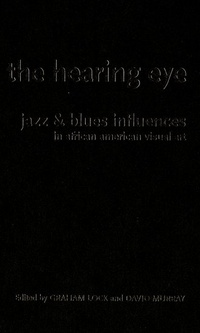
The Hearing Eye
Jazz and Blues Influences in African American Visual Art
Published on 9. April 2009
Book
Hardback
384 pages
978-0-19-534050-1 (ISBN)
Description
The widespread presence of jazz and blues in African American visual art has long been overlooked. The Hearing Eye makes the case for recognizing the music's importance, both as formal template and as explicit subject matter. Moving on from the use of iconic musical figures and motifs in Harlem Renaissance art, this groundbreaking collection explores the more allusive - and elusive - references to jazz and blues in a wide range of mostly contemporary visual artists.
There are scholarly essays on the painters Rose Piper (Graham Lock), Norman Lewis (Sara Wood), Bob Thompson (Richard H. King), Romare Bearden (Robert G. O'Meally, Johannes V:oltz) and Jean-Michel Basquiat (Robert Farris Thompson), as well an account of early blues advertising art (Paul Oliver) and a discussion of the photographs of Roy DeCarava (Richard Ings). These essays are interspersed with a series of in-depth interviews by Graham Lock, who talks to quilter Michael Cummings and painters Sam Middleton, Wadsworth Jarrell, Joe Overstreet and Ellen Banks about their musical inspirations, and also looks at art's reciprocal effect on music in conversation with saxophonists Marty Ehrlich and Jane Ira Bloom.
With numerous illustrations both in the book and on its companion website, The Hearing Eye reaffirms the significance of a fascinating and dynamic aspect of African American visual art that has been too long neglected.
There are scholarly essays on the painters Rose Piper (Graham Lock), Norman Lewis (Sara Wood), Bob Thompson (Richard H. King), Romare Bearden (Robert G. O'Meally, Johannes V:oltz) and Jean-Michel Basquiat (Robert Farris Thompson), as well an account of early blues advertising art (Paul Oliver) and a discussion of the photographs of Roy DeCarava (Richard Ings). These essays are interspersed with a series of in-depth interviews by Graham Lock, who talks to quilter Michael Cummings and painters Sam Middleton, Wadsworth Jarrell, Joe Overstreet and Ellen Banks about their musical inspirations, and also looks at art's reciprocal effect on music in conversation with saxophonists Marty Ehrlich and Jane Ira Bloom.
With numerous illustrations both in the book and on its companion website, The Hearing Eye reaffirms the significance of a fascinating and dynamic aspect of African American visual art that has been too long neglected.
Reviews / Votes
provide[s] stimulation for the brain as well as the eye * Brian Priestley, Jazzwise * highly readable * Roger Thomas, Jazz UK *More details
Language
English
Place of publication
New York
United States
Illustrations
numerous colour and halftone illustrations
Dimensions
Height: 196 mm
Width: 254 mm
Thickness: 25 mm
Weight
1565 gr
ISBN-13
978-0-19-534050-1 (9780195340501)
Copyright in bibliographic data and cover images is held by Nielsen Book Services Limited or by the publishers or by their respective licensors: all rights reserved.
Schweitzer Classification
Other editions
Additional editions
E-Book
01/2009
1st Edition
OUP eBook
€16.49
Available for download
Persons
Graham Lock is a freelance writer and author of , Forces in Motion: Anthony Braxton and the Meta-reality of Creative Music (Quartet, 1988), Chasing the Vibration: Meetings with Creative Musicians (Stride, 1994), and Blutopia: Visions of the Future and Revisions of the Past in the Work of Sun Ra, Duke Ellington and Anthony Braxton (Duke, 1999), and editor, Mixtery: A Festschrift for Anthony Braxton (Stride, 1995).
David Murray is Professor of American Studies, University of Nottingham, and author, Indian Giving: Economies of Power in Early Indian-White Exchanges (Massachusetts UP, 2000), Forked Tongues: Speech, Writing and Representation in North American Indian Texts (Indiana UP, 1992).
David Murray is Professor of American Studies, University of Nottingham, and author, Indian Giving: Economies of Power in Early Indian-White Exchanges (Massachusetts UP, 2000), Forked Tongues: Speech, Writing and Representation in North American Indian Texts (Indiana UP, 1992).
Content
Acknowledgements ; Introduction ; 1. "Selling that Stuff": Advertising Art and Early Blues on 78s ; 2. Blues on the Brush: Rose Piper's Blues and Negro Folk Songs Paintings of the 1940s ; 3. Michael Cummings: Stitching in Tempo. Interview ; 4. "Pure Eye Music": Norman Lewis, Abstract Expressionism, and Bebop ; 5. Sam Middleton: The Painter as Improvising Soloist. Interview ; 6. The Enigma of Bob Thompson ; 7. Wadsworth Jarrell and AFRICOBRA: Sheets of Color, Sheets of Sound. Interview ; 8. "We Used to Say 'Stashed'": Romare Bearden Paints the Blues ; 9. "Blues and Abstract Truth": Or, Did Romare Bearden Really Paint Jazz? ; 10. Joe Overstreet: Light in Darkness. Interview ; 11. Royalty, Heroism, and the Streets: The Art of Jean-Michel Basquiat ; 12. Ellen Banks: The Geometries of the Score. Interview ; 13. "And You Slip into the Breaks and Look Around": Jazz and Everyday Life in the Photographs of Roy DeCarava ; 14. A Jackson in the House (Musicians Talk Painters). Interview ; i Marty Ehrlich on Oliver Jackson ; ii Jane Ira Bloom on Jackson Pollock