

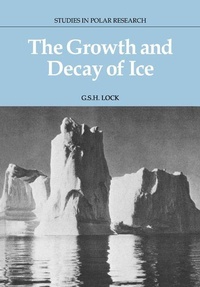
The Growth and Decay of Ice
Published on 3. November 2005
Book
Paperback/Softback
456 pages
978-0-521-02193-7 (ISBN)
Description
Ice exists in water, in air, in earth and in living organisms. The purpose of this book is to describe in mathematical, physical and biological terms, the growth and decay of ice, on a scale ranging from molecular to macroscopic. Consideration of the growth of ice in each of the above contexts provides a clearer understanding of the processes involved and results in a comprehensive overview not available elsewhere. This book will be of particular use to any graduate student, scientist or engineer requiring an introduction and reference for ice-related projects: theoretical or experimental; in the laboratory or the field.
More details
Series
Language
English
Place of publication
Cambridge
United Kingdom
Target group
Professional and scholarly
Product notice
Paperback (trade)
Illustrations
Worked examples or Exercises
Dimensions
Height: 244 mm
Width: 170 mm
Thickness: 24 mm
Weight
781 gr
ISBN-13
978-0-521-02193-7 (9780521021937)
Copyright in bibliographic data and cover images is held by Nielsen Book Services Limited or by the publishers or by their respective licensors: all rights reserved.
Schweitzer Classification
Other editions
Additional editions
G. S. H. Lock
The Growth and Decay of Ice
Book
12/1990
Cambridge University Press
€99.04
Article exhausted; check for reprint
Previous edition
G. S. H. Lock
The Growth and Decay of Ice
Book
12/1990
Cambridge University Press
€99.04
Article exhausted; check for reprint
Person
Content
Preface; Nomenclature; Part I. Introduction: 1. Ice in the heavens; 2. Ice ages; 3. The incidence of ice; 4. The response to ice; Part II. Thermodynamics of Ice: 5. Classical laws and principles; 6. The Gibbs function and phase change; 7. The Gibbs function and chemical potential diffusion in ice, water and water vapour; 8. Metastability and the freezing point; 9. Morphology and microenergetics; 10. Thermal properties; 11. Nucleation interfacial conditions and growth; Part III. The Stefan Problem: 12. The simplified model and its variations; 13. The Neumann solution; 14. Physico-mathematical analysis; 15. Analytic techniques; 16. Numerical techniques; Part IV. Ice and Water: 17. Freezing of solutions and suspensions; 18. Formation of an ice cover; 19. Growth of an ice cover; 20. The effect of natural convection on planar growth; 21. The effect of forced convection on planar growth; 22. Freezing inside cavities and conduits; 23. Freezing on submerged bodies; Part V. Ice and Air: 24. Deposition of water vapour; 25. Accretion; 26. Atmospheric ice; 27. Icing of airborne structures; 28. Icing of waterborne and offshore structures; 29. Icing of land-based structures and equipment; Part VI. Ice and earth: 30. Surface energy exchange; 31. Freezing on the Earth; 32. The pore system: its architecture, hydrodynamics and thermodynamics; 33. Freezing in the Earth; Part VII. Ice and Life: 34. Water in the biosphere; 35. Freezing of biofluids; 36. The cell freezing of unicellular organisms; 37. Freezing in plants; 38. Freezing in animals; 39. Freezing of foods; Part VIII. Decay of Ice: 40. Reversibility and symmetry; 41. Melting of single ice crystals; 42. Melting of polycrystalline ice; 43. Decay of an ice cover; 44. Ablation of atmospheric and structural icing; 45. Thawing of soil; 46. Thawing of organisms; Notes; Selected bibliography; Index.