

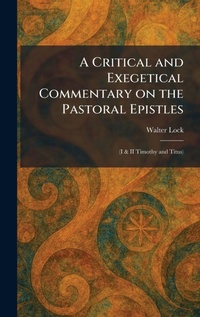
A Critical and Exegetical Commentary on the Pastoral Epistles
Description
"A Critical and Exegetical Commentary on the Pastoral Epistles (I & II Timothy and Titus)" provides an exhaustive and scholarly examination of three vital letters within the New Testament. This work serves as a cornerstone for students and theologians seeking a deep understanding of the linguistic, historical, and theological nuances of the Pauline tradition. The commentary offers a meticulous verse-by-verse analysis, exploring the original Greek text to uncover the author's intent and the developing ecclesiastical structures of the early Christian church.
Focusing on themes of church leadership, sound doctrine, and personal piety, this volume addresses the practical challenges faced by Timothy and Titus in their respective ministries. The author balances rigorous critical inquiry with theological sensitivity, making this an essential resource for those investigating the authenticity and authorship of the Pastoral Epistles. By situating these letters within their first-century context, the work illuminates the transition from the apostolic age to the organized church. This commentary remains a significant contribution to biblical scholarship, valued for its clarity, erudition, and comprehensive treatment of the scripture.
This work has been selected by scholars as being culturally important, and is part of the knowledge base of civilization as we know it. This work was reproduced from the original artifact, and remains as true to the original work as possible. Therefore, you may see the original copyright references, library stamps (as most of these works have been housed in our most important libraries around the world), and other notations in the work.
This work is in the public domain in the United States of America, and possibly other nations. Within the United States, you may freely copy and distribute this work, as no entity (individual or corporate) has a copyright on the body of the work.
As a reproduction of a historical artifact, this work may contain missing or blurred pages, poor pictures, errant marks, etc. Scholars believe, and we concur, that this work is important enough to be preserved, reproduced, and made generally available to the public. We appreciate your support of the preservation process, and thank you for being an important part of keeping this knowledge alive and relevant.