

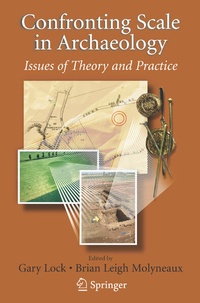
Confronting Scale in Archaeology
Issues of Theory and Practice
Published on 15. November 2007
Book
Paperback/Softback
XIV, 280 pages
978-0-387-75701-8 (ISBN)
Description
Archaeological analysis operates on a continuum of scale from the microscopic analysis of a single artifact to regional interpretations of cultural adaptations over thousands of years. A common assumption is that shifting from one scale to another in space and time is a seamless process. Scale in this sense is invisible, a mere mathematical abstraction. Yet, issues of scale exist at the fundamental level of archaeological interpretation. The traditional analytical debate in archaeology - between advocates of the so-called ''processual'' and ''postprocessual'' approaches - ranges around the question of scales of reasoning. At the one extreme, remote observation and the ability to interpret events and processes over vast reaches of time and space are possible, because the analysis concerns the hoped-for elucidation of general cultural processes; at the other, they are not, as both analyst and subject are isolated in their own subjectivities. Analysts occupying the middle ground often advocate a ''multidimensional'' or ''holistic'' approach, which involves multiple scales of analysis and interpretation. As the battleground tends to be the degree to which specific datasets and analytical processes justify the interpretations put forth, archaeologists rarely - dress issues relating to the profound shifts in the scale of visualization necessary in all approaches to the past. And why should they? Ignoring scale is the concession archaeology makes to interpretation.
Reviews / Votes
"Archaeologists from North America, Europe, and Australia grapple with the concept of scale and its intentional and unintentioanl influence in their practice. The fundamental problem is that archaeologists, being human, have trouble imagining things very much larger or very much smaller than humans, and things very much longer or very much shorter than a human lifetime. The contributions look at space, time, and size in the past and the present; problems of scale and their identification; and new methodologies and understandings for interpreting scale." (Reference and Research Book News, November 2006)More details
Edition
2006 ed.
Language
English
Place of publication
New York
United States
Target group
Professional and scholarly
Professional/practitioner
Illustrations
XIV, 280 p.
Dimensions
Height: 235 mm
Width: 155 mm
Thickness: 17 mm
Weight
452 gr
ISBN-13
978-0-387-75701-8 (9780387757018)
DOI
10.1007/0-387-32773-8
Schweitzer Classification
Other editions
Additional editions

E-Book
11/2006
1st Edition
Springer
€53.49
Available for download
Book
08/2006
Springer
€106.99
Shipment within 5-7 days
Content
Introduction: Confronting Scale.- Introduction: Confronting Scale.- Introducing Scale: Space, Time and Size in The Past and the Present.- On Being the Right Size: Affordances and the Meaning of Scale.- Timescales.- Scale as Artifact: GIS, Ecological Fallacy, and Archaeological Analysis.- Artifacts as Social Interference: The Politics of Spatial Scale.- Constructing Scale: Identifying Problems.- Topographical Scale as Ideological and Practical Affordance: The Case of Devils Tower.- Perspective Matters: Traversing Scale through Archaeological Practice.- Artifacts as Landscapes: A Use-Wear Case Study of Upper Paleolithic Assemblages at the Solutré Kill Site, France.- Scale and Archaeological Evaluations: What are We Looking For?.- Scale, Model Complexity, and Understanding: Simulation of Settlement Processes in the Glenwood Locality of Southwestern Iowa, 1976 and 2000.- Scale and Its Effects on Understanding Regional Behavioural Systems: An Australian Case Study.- Custer's Last Battle: Struggling with Scale.- Interpreting Scale: Towards New Methodologies and Understandings.- Temporal Scales and Archaeological Landscapes from the Eastern Desert of Australia and Intermontane North America.- Large Scale, Long Duration and Broad Perceptions: Scale Issues in Historic Landscape Characterisation.- Multiscalar Approaches to Settlement Pattern Analysis.- Grain, Extent, and Intensity: The Components of Scale in Archaeological Survey.- Persons and Landscapes: Shifting Scales of Landscape Archaeology.